

 HubSpot Integration
Connect marketing spend to pipeline to revenue - in one metric tree your whole team can act on.
HubSpot is where your marketing campaigns, sales deals, and customer interactions live. But its native reporting keeps these in separate modules with separate dashboards.HubSpot is where your marketing campaigns, sales deals, and customer interactions live. But its native reporting keeps these in separate modules with separate dashboards. KPI Tree connects to your HubSpot data via MCP, your existing warehouse, or a fully managed data foundation - and builds a single causal metric tree from ad spend through MQL to closed-won, with statistical analysis and RACI ownership at every node. No more stitching reports across Marketing Hub and Sales Hub to answer "what's actually driving revenue?"
From HubSpot data to a unified revenue tree
Connect your HubSpot data
Three ways to get started, depending on your stack.

Pull metrics from HubSpot directly through the Model Context Protocol.



Connect your existing warehouse where HubSpot data already lands.


Our professional services team can build you turn-key AI foundations in a matter of weeks. Data warehouse on Snowflake/BigQuery, ELT with Fivetran, all modelled in dbt with a semantic layer.
Map metrics across HubSpot modules
Define metrics spanning marketing, sales, and service data: website sessions, form submissions, MQLs, deals created, pipeline value, win rates, ticket resolution times. Use SQL, your dbt layer, or let KPI Tree auto-suggest from discovered tables.
Build causal trees and assign ownership
Connect marketing metrics to sales metrics to revenue outcomes in a single tree. Assign RACI ownership - the content team owns blog traffic, demand gen owns MQL conversion, sales owns pipeline velocity. KPI Tree adds statistical analysis, anomaly alerts, and action plans.
Break down the wall between HubSpot modules
Full-funnel metric trees from first touch to closed-won
Cross-hub correlation analysis
Shared accountability between marketing and sales
One tree from ad spend to revenue - not twenty dashboards.
- Full-funnel tree from marketing channels through sales stages to revenue
- Automatic decomposition showing which funnel stage caused a metric change
- Period-over-period comparison across the entire tree in one view
- Drill from revenue down to the specific campaign, channel, or rep that drove the change
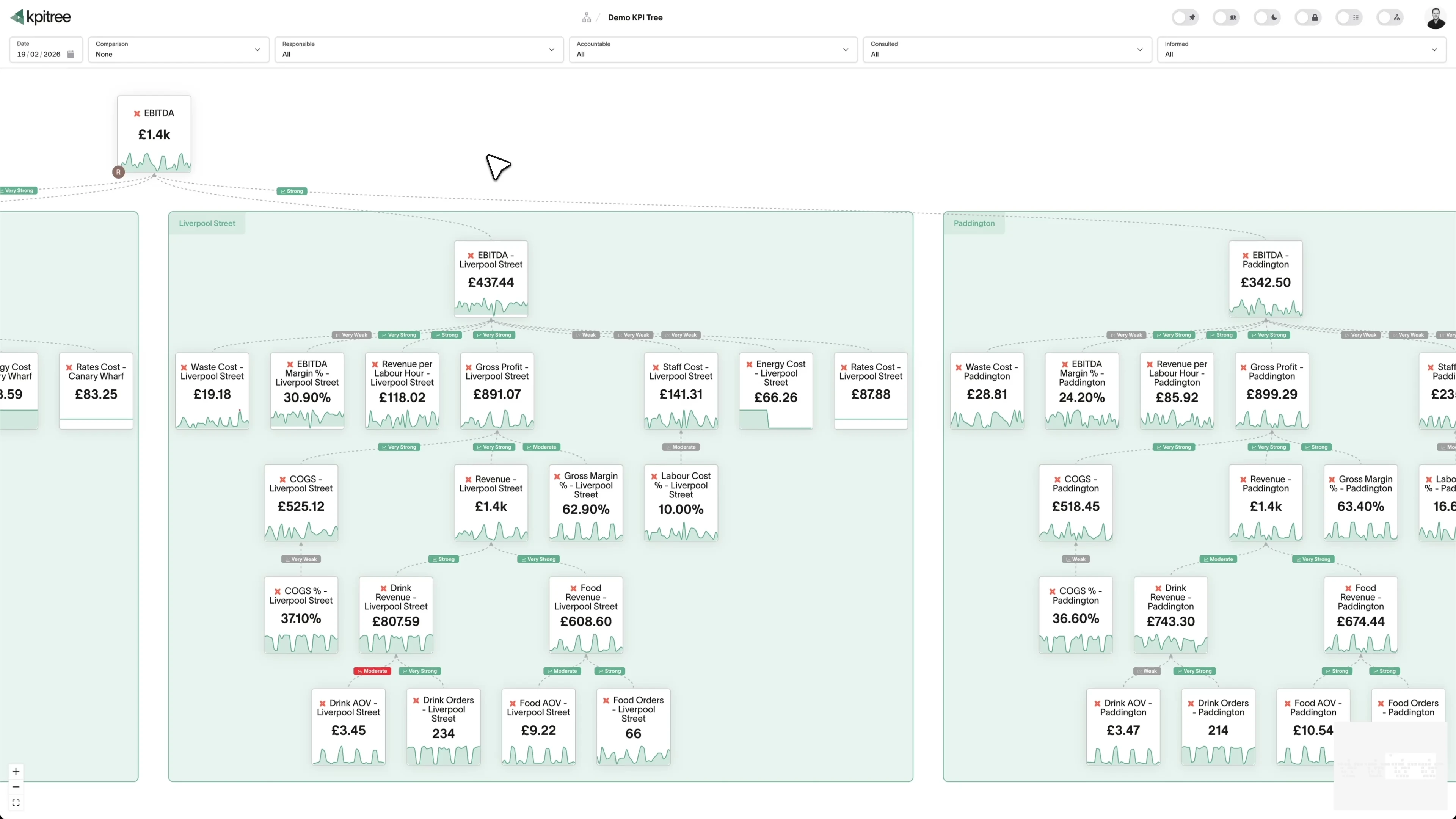
Statistical proof of what's working - not just attribution models.
- Correlation matrices across marketing activities and revenue outcomes
- Compare campaign effectiveness with statistical confidence, not just lead counts
- Regression analysis to quantify the revenue impact of marketing spend changes
- Surface hidden dependencies between content, channel mix, and deal quality
Marketing owns leads. Sales owns pipeline. Everyone sees the same tree.
- RACI ownership across every marketing and sales metric
- Personalised views for each role - marketers see campaign metrics, reps see deal metrics
- Automated alerts when any metric in the shared tree deviates from target
- Action plans delivered to the specific person accountable for the metric that moved
Detect funnel problems before they reach the pipeline forecast.
- Anomaly detection across every metric in the funnel tree
- Leading indicator alerts before lagging metrics are affected
- Change insights decompose exactly what shifted and by how much
- Historical pattern analysis distinguishes real changes from normal variation
How KPI Tree uses HubSpot data differently
HubSpot is a powerful platform with strong native reporting. KPI Tree doesn't replace it - it adds the cross-module causal analysis, statistical rigour, and metric ownership that HubSpot's built-in tools aren't designed to provide.
Data warehouses
The numbers





Semantic layers
The definitions


Business apps
Launches, decisions, blockers




Org structure
Directory-synced




For humans
Answers, briefings and pushes
 @
@Read and write over MCP
Anthropic: 21% → ~95% with curated context



Canopy Agentic Workflows the metrics start them, humans gate them
Canopy Agents four out of the box, any model, your keys
Canopy
The business context layer
Structural context The causal tree, the org chart
Temporal context What was true when, plan against actual
Behavioural context What people did, what worked
Operational context RACI, workflows, approvals
Strategic context Objectives, key results, initiatives
Map & Measure
Metric Trees
Business Models
Prove & Act
Root Cause
Ownership
Verified Impact
Strategy
Grounded in proven causality
Verified proof
Meta spend → Revenue, +£32k vs forecast, q < 0.01
Personalised Action Plans 31 experiments running
hypothesis → a real person’s plan → measure the change
Causation the test cascade
ADF p 0.02 → Granger p 0.003 → q < 0.05, 87 of 1,204 survive
Correlation
22,791 pairs tested nightly, NPS – Churn r 0.71
Data warehouses
The numbers
Semantic layers
The definitions
Business apps
Launches, decisions, blockers
Org structure
Directory-synced
Cross-module causation, not module-bound dashboards
Root cause analysis in seconds
Statistical analysis without a data team
Metrics you can track. Ready to add to your metric trees.
Activity Volume Per Contact
CRM & MarketingActivity Volume Per Contact = Total Logged Activities / Number of Active Contacts
Activity volume per contact counts the average number of logged interactions, including emails, calls, meetings, and notes, recorded against each contact over a given period. It captures the intensity of relationship-building effort across your database.
View metricContact Engagement Score
CRM & MarketingContact engagement score is a composite metric that weights interactions such as email opens, link clicks, form submissions, page views, and meeting bookings into a single score per contact. It quantifies how actively a contact is engaging with your brand.
View metricContact Segmentation Analysis
CRM & MarketingContact segmentation analysis evaluates the distribution and performance of contacts across defined segments such as industry, company size, lifecycle stage, and persona. It measures how well your database is structured for targeted engagement.
View metricCustomer Acquisition Cost
CRM & MarketingCAC = Total Sales & Marketing Spend / New Customers Acquired
Customer acquisition cost (CAC) is the total sales and marketing expenditure divided by the number of new customers acquired in the same period. It quantifies the investment required to convert a prospect into a paying customer.
View metricCustomer Churn Analysis
CRM & MarketingChurn Rate = (Customers Lost in Period / Customers at Start of Period) x 100
Customer churn analysis measures the rate at which customers stop doing business with you over a defined period. It examines churn by segment, reason, tenure, and value to uncover actionable patterns in customer attrition.
View metricCustomer Lifetime Value
CRM & MarketingLTV = Average Revenue Per Customer x Average Customer Lifespan
Customer lifetime value (LTV) estimates the total revenue a customer will generate across the entire duration of their relationship with your business. For HubSpot users, it aggregates deal values, renewals, and upsells tracked in the CRM.
View metricCustomer Support Ticket Analysis
CRM & MarketingCustomer support ticket analysis tracks the volume, resolution time, category distribution, and outcomes of support tickets managed in HubSpot Service Hub. It provides a comprehensive view of customer issue patterns and support team effectiveness.
View metricDeal Size Distribution
CRM & MarketingDeal size distribution analyses the spread of closed-won deal values across defined size bands. It reveals whether revenue is concentrated in a few large deals or diversified across many smaller ones, and how the mix is shifting over time.
View metricSales Pipeline Velocity
CRM & MarketingDeal Velocity = (Number of Deals x Average Deal Size x Win Rate) / Sales Cycle Length
Deal velocity quantifies the speed at which deals progress from creation to close, combining pipeline value, win rate, and sales cycle length into a single revenue throughput metric. It measures how much revenue your pipeline produces per unit of time.
View metricEmail Engagement Rate
CRM & MarketingEmail Engagement Rate = (Unique Clicks + Replies) / Emails Delivered x 100
Email engagement rate is a composite metric encompassing open rates, click-through rates, and reply rates across marketing emails and sales sequences sent through HubSpot. It measures how effectively your email communications drive recipient action.
View metricForm Conversion Rate
CRM & MarketingForm Conversion Rate = (Form Submissions / Page Views) x 100
Form conversion rate is the percentage of page visitors who submit a HubSpot form. It measures the effectiveness of landing pages, calls to action, and form design in capturing visitor information and generating leads.
View metricLead Conversion Rate
CRM & MarketingLead Conversion Rate = (Converted Leads / Total Leads) x 100
Lead conversion rate measures the percentage of leads that progress to a qualified opportunity or customer status. It captures the effectiveness of your entire lead nurturing and qualification process from initial capture through to sales acceptance.
View metricLead Scoring Analysis
CRM & MarketingLead scoring analysis evaluates the predictive accuracy of your HubSpot lead scores by correlating score values with actual conversion outcomes. It measures whether higher-scored leads genuinely convert at higher rates and produce greater revenue.
View metricLead Source Performance
CRM & MarketingLead source performance measures the volume, quality, and conversion rate of leads generated by each acquisition channel tracked in HubSpot. It compares organic search, paid advertising, referrals, social media, and direct traffic to determine which sources deliver the best return.
View metricMarketing Attribution Analysis
CRM & MarketingMarketing attribution analysis assigns credit for revenue and conversions to the marketing touchpoints that influenced them. Using HubSpot attribution reporting, it maps the customer journey across channels, campaigns, and content to quantify each interaction's contribution to closed revenue.
View metricMonthly Recurring Revenue
CRM & MarketingMRR = Sum of (Active Recurring Deal Values Normalised to Monthly)
Monthly recurring revenue (MRR) is the normalised monthly value of all active recurring deals in HubSpot. It standardises annual, quarterly, and monthly billing frequencies into a single monthly figure that reflects the predictable revenue run rate.
View metricPipeline Stage Conversion Analysis
CRM & MarketingStage Conversion Rate = (Deals Advancing to Next Stage / Deals Entering Stage) x 100
Pipeline stage conversion analysis measures the percentage of deals that successfully advance from one pipeline stage to the next. It identifies where deals stall, regress, or fall out, pinpointing the stages that constrain overall pipeline throughput.
View metricPipeline Value
CRM & MarketingPipeline Value = Sum of All Open Deal Amounts
Pipeline value is the total monetary worth of all open deals in your HubSpot sales pipeline. It represents the potential revenue available for conversion and serves as the foundation for revenue forecasting and target attainment planning.
View metricQuote-to-Close Rate
CRM & MarketingQuote-to-Close Rate = (Deals Closed Won After Quote / Total Quotes Issued) x 100
Quote-to-close rate is the percentage of deals that close won after a formal quote or proposal has been issued through HubSpot. It isolates the final stage of the sales process to measure proposal effectiveness and negotiation success.
View metricSales Cycle Length
CRM & MarketingSales Cycle Length = Average (Close Date - Create Date) for Won Deals
Sales cycle length measures the average number of days from deal creation to closed-won outcome in HubSpot. It reflects the overall speed of your sales process, encompassing qualification, evaluation, proposal, and decision stages.
View metricSales Forecast Accuracy
CRM & MarketingForecast Accuracy = (1 - |Forecast - Actual| / Actual) x 100
Sales forecast accuracy measures the variance between predicted and actual revenue outcomes for a given period. It evaluates how reliably your sales team and pipeline data predict future revenue, reflecting both deal-level accuracy and aggregate forecasting discipline.
View metricSales Funnel Analysis
CRM & MarketingSales funnel analysis tracks the volume and conversion rate at every stage of your buyer journey, from website visitor through lead, MQL, SQL, opportunity, and closed customer. It provides an end-to-end view of funnel health and efficiency.
View metricSales Rep Performance Analysis
CRM & MarketingSales rep performance analysis compares individual sales representatives across a balanced set of metrics including pipeline generated, activity volume, win rate, deal size, cycle length, and quota attainment. It provides a holistic view of each rep's contribution and areas for development.
View metricWin Rate
CRM & MarketingWin Rate = (Deals Won / (Deals Won + Deals Lost)) x 100
Win rate is the percentage of closed deals that result in a won outcome. It is the most direct measure of sales effectiveness, reflecting the team's ability to convert qualified opportunities into customers.
View metricWorkflow Automation Effectiveness
CRM & MarketingWorkflow automation effectiveness measures how successfully HubSpot workflows achieve their intended outcomes, tracking enrolment volumes, completion rates, error rates, and the downstream impact on metrics like conversion, engagement, and response time.
View metricDeal Velocity
SalesDeal Velocity = (Number of Open Deals x Average Deal Value x Win Rate) / Average Sales Cycle Length in Days
Deal Velocity measures how much revenue your HubSpot pipeline generates over a given period, factoring in the number of open deals, their average value, the win rate, and the average length of the sales cycle. It uses HubSpot deal records, their stage history, and close dates to show the speed at which deals convert into closed revenue. A higher figure means the pipeline is producing more revenue per unit of time.
View metricRelated integrations. More sources that work with KPI Tree.


Common questions
Can I join Marketing Hub, Sales Hub, and Service Hub in a single tree?
Yes, and that is the biggest reason most teams adopt KPI Tree for HubSpot. Marketing Hub tracks email, forms, and workflows. Sales Hub tracks deals, pipelines, and sequences. Service Hub tracks tickets and satisfaction. HubSpot dashboards keep these three worlds separate, and KPI Tree joins them into a single causal tree where an MQL generated by a content offer can be traced to a deal, to a closed-won event, to a service ticket six months later. MCP is the fastest path to this because it queries contacts, companies, deals, tickets, and marketing emails in one place. If HubSpot is already replicated to Snowflake, BigQuery, or another warehouse via Fivetran, Hightouch, or Operations Hub, KPI Tree reads that warehouse instead. Professional services engagements build the cross-hub semantic layer in dbt from scratch.
What HubSpot metrics can I track?
Any metric derivable from your HubSpot data in the warehouse: website sessions, form submissions, contacts created, MQLs, SQLs, deals created, pipeline value, win rates, deal velocity, email performance, campaign ROI, ticket metrics, and any custom properties or calculated metrics you define.
Can I track metrics across Marketing Hub and Sales Hub in one tree?
Yes - that's precisely the problem KPI Tree solves. Build a single metric tree that spans marketing and sales data, with causal relationships connecting them. When revenue changes, you trace the cause from sales metrics up through marketing metrics in one view.
How long does setup take?
With MCP, you can be pulling HubSpot data in minutes. If your HubSpot data is already in a warehouse, most teams are up and running in under an hour. The professional services route takes longer but delivers a complete, production-ready data foundation.
Does KPI Tree replace HubSpot's built-in reporting?
No. HubSpot's reporting is excellent for day-to-day operational tasks - managing deals, tracking email campaigns, and monitoring individual activities. KPI Tree adds cross-module causal analysis, statistical rigour, and metric ownership that complement HubSpot's native tools.
Can I combine HubSpot data with other tools?
Yes. KPI Tree is built for this. Combine HubSpot data with Snowflake warehouse data, Google Analytics, Stripe billing, Intercom support data, or any other tool that syncs to your warehouse. One unified metric tree across your entire stack.
Is my HubSpot data secure?
KPI Tree connects to your warehouse, not to HubSpot directly. Warehouse access uses least-privilege read-only credentials, encrypted at rest with HSM-backed KMS. Your HubSpot data governance and warehouse security policies remain fully intact.
We use HubSpot's free CRM - does this still work?
Yes. With MCP you can pull data directly from HubSpot regardless of plan. If you use a warehouse, the features available depend on which HubSpot data is synced there, not on your HubSpot plan.
Related guides. Frameworks and metrics in depth.

How to build a metric tree
A step-by-step metric tree and KPI tree template from North Star to daily levers
Metric trees for marketing teams
Connect every campaign to revenue impact
Metric trees for sales teams
Connect every rep activity to a revenue outcome
MQL to SQL conversion rate: a metric tree decomposition
Measure the critical handoff between marketing and sales and diagnose where alignment breaks down
Your HubSpot data spans marketing and sales. Your metric tree should too.
Connect HubSpot data to KPI Tree through your warehouse. Build full-funnel metric trees with causal analysis, RACI ownership, and statistical insights that turn siloed reports into shared accountability.










