

 Google Ads Integration
Your Google Ads spend is visible. What it actually drives is not - until now.
Google Ads tells you CPC, CTR, and conversion counts. KPI Tree connects those metrics into a causal tree that traces how paid search spend flows through your acquisition funnel - from impressions to clicks, clicks to leads, leads to pipeline, and pipeline to revenue.Google Ads tells you CPC, CTR, and conversion counts. KPI Tree connects those metrics into a causal tree that traces how paid search spend flows through your acquisition funnel - from impressions to clicks, clicks to leads, leads to pipeline, and pipeline to revenue. Connect via MCP to pull Google Ads data directly, point KPI Tree at your existing data warehouse where Google Ads data already lands, or let our Professional Services team build the AI foundations for you. KPI Tree maps your data into metric trees with ownership, statistical correlations, and action tracking. Stop optimising bids in isolation. Start understanding how paid acquisition actually drives your business.
From connection to paid-search accountability in under an hour
Connect your Google Ads data
Three ways to get started, depending on your stack.

Pull metrics from Google Ads directly through the Model Context Protocol.



Connect your existing warehouse where Google Ads data already lands.


Our professional services team can build you turn-key AI foundations in a matter of weeks. Data warehouse on Snowflake/BigQuery, ELT with Fivetran, all modelled in dbt with a semantic layer.
Map metrics from your Google Ads data
Define metrics from your Google Ads tables - cost per click, click-through rate, cost per acquisition, ROAS, impression share, quality score, conversion rate by campaign, and revenue attributed to paid search. Use SQL, your dbt semantic layer, or natural language with Cortex Analyst.
Build metric trees and assign ownership
Arrange paid acquisition metrics into causal trees. Link CPC and CTR to cost per lead. Connect cost per lead to pipeline value. Map pipeline to closed-won revenue and ROAS. Assign RACI owners - your paid search specialist owns keyword-level metrics, your demand gen lead owns campaign-level CAC, your VP Marketing owns blended ROAS.
Paid search metrics that connect to revenue, not just conversions
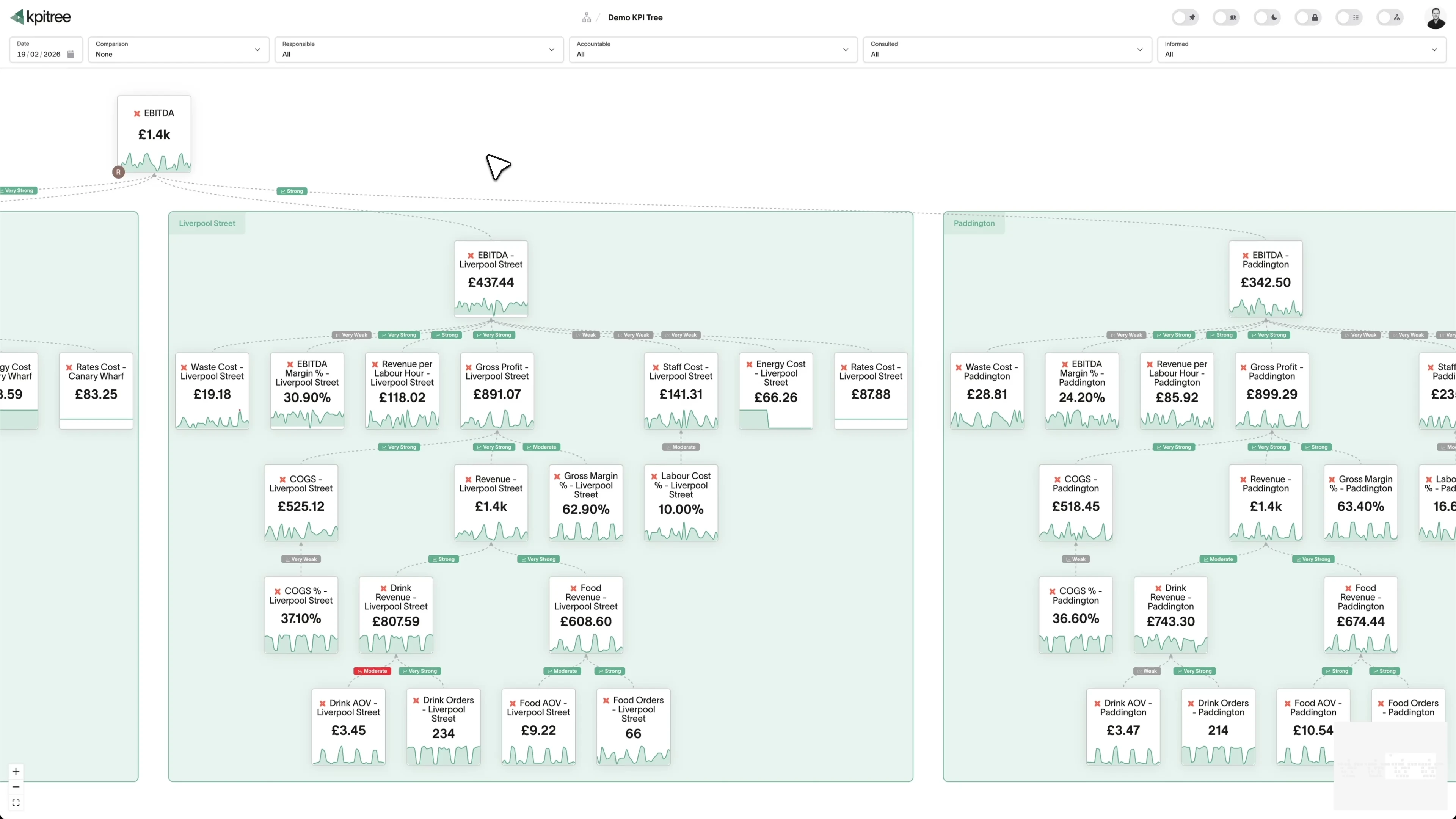
Causal trees from clicks to revenue
Cross-channel attribution in a single tree
Campaign-level ownership and accountability
Trace paid acquisition spend all the way to revenue.
- Causal trees linking ad spend to clicks, leads, pipeline, and revenue
- Trace ROAS changes to the specific funnel stage causing the drop
- Combine Google Ads data with CRM data in a unified tree
- Period-over-period comparisons with statistical significance
Correlations that reveal which campaigns drive long-term value.
- Statistical correlation between campaign metrics and customer LTV
- Causality testing across paid and organic channels
- Identify keyword themes correlated with high-retention customers
- Partial correlations controlling for seasonality and market factors
Every metric in your paid funnel has a name next to it.
- RACI ownership from keyword-level metrics to blended CAC
- Push notifications via Slack or email
- Action tracking tied to specific metric movements
- Impact verification closes the loop between action and outcome
All your paid search data, analysed off-warehouse.
- One scheduled query per metric, regardless of how many people check it
- All analytics computation runs off-warehouse
- Supports BigQuery, Snowflake, and other major warehouses
- Works alongside your existing dbt semantic layer if you have one
How KPI Tree uses Google Ads data differently
Google Ads has excellent native reporting for campaign optimisation. BI tools put that data in dashboards. KPI Tree connects paid acquisition metrics to downstream business outcomes with causation, ownership, and accountability.
Data warehouses
The numbers





Semantic layers
The definitions


Business apps
Launches, decisions, blockers




Org structure
Directory-synced




For humans
Answers, briefings and pushes
 @
@Read and write over MCP
Anthropic: 21% → ~95% with curated context



Canopy Agentic Workflows the metrics start them, humans gate them
Canopy Agents four out of the box, any model, your keys
Canopy
The business context layer
Structural context The causal tree, the org chart
Temporal context What was true when, plan against actual
Behavioural context What people did, what worked
Operational context RACI, workflows, approvals
Strategic context Objectives, key results, initiatives
Map & Measure
Metric Trees
Business Models
Prove & Act
Root Cause
Ownership
Verified Impact
Strategy
Grounded in proven causality
Verified proof
Meta spend → Revenue, +£32k vs forecast, q < 0.01
Personalised Action Plans 31 experiments running
hypothesis → a real person’s plan → measure the change
Causation the test cascade
ADF p 0.02 → Granger p 0.003 → q < 0.05, 87 of 1,204 survive
Correlation
22,791 pairs tested nightly, NPS – Churn r 0.71
Data warehouses
The numbers
Semantic layers
The definitions
Business apps
Launches, decisions, blockers
Org structure
Directory-synced
From campaign dashboards to full-funnel causation
Cross-channel statistical analysis
Budget accountability, not just budget visibility
Metrics you can track. Ready to add to your metric trees.
Ad Copy Testing Analysis
Paid AdvertisingAd copy testing analysis evaluates the performance differences between ad creative variants in Google Ads campaigns. It measures how headline, description, and call-to-action variations affect click-through rates, conversion rates, and cost efficiency to identify the most effective messaging for each audience.
View metricAd Frequency Analysis
Paid AdvertisingAd frequency analysis examines how often individual users see your Google Ads and the relationship between impression frequency and engagement, conversion, and cost metrics. It identifies the optimal exposure level before diminishing returns or ad fatigue set in.
View metricAudience Segmentation Analysis
Paid AdvertisingAudience segmentation analysis compares performance metrics across different Google Ads audience segments - including in-market, affinity, custom, remarketing, and customer match audiences. It evaluates which segments deliver the best conversion rates, cost efficiency, and return on ad spend.
View metricAverage Position
Paid AdvertisingAverage position indicates where your Google Ads typically appear on the search results page relative to other ads. While Google deprecated the exact average position metric, top impression share and absolute top impression share serve as modern proxies for ad placement visibility.
View metricBid Strategy Performance Analysis
Paid AdvertisingBid strategy performance analysis evaluates the effectiveness of different Google Ads bidding approaches - including manual CPC, target CPA, target ROAS, maximise conversions, and maximise conversion value. It compares how each strategy performs on cost efficiency, conversion volume, and return on ad spend.
View metricBudget Allocation Analysis
Paid AdvertisingBudget allocation analysis evaluates how Google Ads spend is distributed across campaigns, ad groups, and audience segments, and how that distribution relates to conversion volume and return on ad spend. It identifies over-invested and under-invested areas to optimise overall portfolio performance.
View metricCampaign Attribution Analysis
Paid AdvertisingCampaign attribution analysis determines the contribution of individual Google Ads campaigns to conversions and revenue across multi-touch customer journeys. It evaluates how different attribution models - last-click, first-click, data-driven, and time-decay - change the perceived value of each campaign.
View metricClick-Through Rate
Paid AdvertisingClick-Through Rate = (Clicks / Impressions) x 100
Click-through rate measures the percentage of Google Ads impressions that result in a click. It indicates how relevant and compelling your ads are to the audience seeing them, serving as a primary signal of ad-audience alignment and creative effectiveness.
View metricCompetitive Analysis
Paid AdvertisingCompetitive analysis examines Google Ads auction insights data - including overlap rate, outranking share, and impression share relative to competitors. It provides visibility into how your paid search presence compares to competitors within the same auctions.
View metricConversion Rate
Paid AdvertisingConversion Rate = (Conversions / Clicks) x 100
Conversion rate measures the percentage of Google Ads clicks that result in a defined conversion action - such as a purchase, signup, form submission, or phone call. It quantifies how effectively your ads and landing pages turn paid traffic into measurable business outcomes.
View metricCost per Acquisition
Paid AdvertisingCost per Acquisition = Total Ad Spend / Total Conversions
Cost per acquisition measures the average amount spent on Google Ads to acquire one conversion. It combines click costs and conversion rates into a single efficiency metric that represents the true cost of each customer action generated through paid search.
View metricCost per Click
Paid AdvertisingCost per Click = Total Ad Spend / Total Clicks
Cost per click measures the average amount paid for each click on a Google Ads advertisement. It reflects the competitive intensity of the keywords and audiences you target, the quality of your ads, and the effectiveness of your bidding strategy.
View metricCross-Campaign Performance Analysis
Paid AdvertisingCross-campaign performance analysis compares key metrics - conversion rate, CPA, ROAS, and revenue contribution - across all campaigns in a Google Ads account. It identifies top-performing and underperforming campaigns to guide budget allocation and strategic investment decisions.
View metricCustomer Lifetime Value (Ads)
Paid AdvertisingLTV (Ads) = Average Revenue per Customer x Average Customer Lifespan
Customer lifetime value from ads measures the total revenue generated over the full customer relationship for customers acquired through Google Ads. It connects upfront acquisition costs to long-term value, providing a complete picture of paid search ROI beyond initial conversion.
View metricDayparting Analysis
Paid AdvertisingDayparting analysis examines how Google Ads performance varies by hour of day and day of week. It identifies time windows where conversion rates, cost efficiency, and return on ad spend are highest or lowest to inform ad scheduling and bid adjustment strategies.
View metricDevice Performance Analysis
Paid AdvertisingDevice performance analysis compares Google Ads metrics across desktop, mobile, and tablet devices. It examines how click-through rates, conversion rates, cost per acquisition, and return on ad spend differ by device to inform bid adjustments and landing page strategies.
View metricExtension Performance Analysis
Paid AdvertisingExtension performance analysis evaluates the impact of Google Ads extensions - including sitelinks, callouts, structured snippets, call extensions, and price extensions - on click-through rate, conversion rate, and overall campaign performance. It identifies which extensions contribute to better outcomes and which add no measurable value.
View metricGeographic Performance Analysis
Paid AdvertisingGeographic performance analysis examines how Google Ads metrics vary across locations - countries, regions, cities, and postal codes. It identifies areas of strong and weak performance to inform location targeting, bid adjustments, and localised messaging strategies.
View metricImpression Share Lost to Budget
Paid AdvertisingIS Lost (Budget) = (Impressions Lost to Budget / Total Eligible Impressions) x 100
Impression share lost to budget measures the percentage of eligible impressions your Google Ads did not receive because your daily or campaign budget was exhausted. It quantifies the opportunity cost of budget constraints and indicates where additional investment could capture more conversions.
View metricImpression Share
Paid AdvertisingImpression Share = (Impressions Received / Total Eligible Impressions) x 100
Impression share measures the percentage of eligible impressions your Google Ads actually received compared to the total impressions available for your targeted keywords and audiences. It indicates your market coverage and competitive presence in the paid search landscape.
View metricKeyword Performance Analysis
Paid AdvertisingKeyword performance analysis evaluates how individual keywords and keyword themes perform across Google Ads campaigns. It examines click-through rates, conversion rates, cost per acquisition, and revenue attribution at the keyword level to identify your most and least profitable search terms.
View metricLanding Page Performance Analysis
Paid AdvertisingLanding page performance analysis evaluates how different landing pages perform in converting Google Ads traffic. It examines conversion rates, bounce rates, time on page, and quality score impact per landing page to identify which pages effectively convert paid traffic and which create friction.
View metricNegative Keyword Analysis
Paid AdvertisingNegative keyword analysis evaluates the effectiveness of your Google Ads negative keyword strategy in preventing ads from showing for irrelevant search queries. It measures wasted spend avoided, impression quality improvement, and the impact on overall conversion rates from excluding non-converting search terms.
View metricQuality Score
Paid AdvertisingQuality score is Google Ads' rating of the overall quality and relevance of your keywords, ads, and landing pages. Scored from 1 to 10, it combines expected click-through rate, ad relevance, and landing page experience to influence your ad rank and actual cost per click.
View metricReturn on Ad Spend
Paid AdvertisingROAS = Revenue Attributed to Ads / Total Ad Spend
Return on ad spend measures the revenue generated for every pound spent on Google Ads. It provides a direct ratio of revenue to cost that quantifies the financial return of your paid search investment, making it the primary efficiency metric for revenue-focused campaigns.
View metricSearch Term Analysis
Paid AdvertisingSearch term analysis examines the actual search queries that trigger your Google Ads, comparing them against your targeted keywords. It identifies high-performing search terms worth promoting, irrelevant queries worth excluding, and emerging search patterns that reveal new opportunities.
View metricSeasonal Trend Analysis
Paid AdvertisingSeasonal trend analysis examines how Google Ads performance metrics fluctuate across seasons, holidays, and recurring events. It identifies predictable patterns in search volume, CPC, conversion rates, and ROAS to inform proactive budget planning and bid strategy adjustments.
View metricRelated integrations. More sources that work with KPI Tree.


Common questions
Can I roll up Google Ads metrics across multiple MCC accounts?
Yes. Single-account Google Ads advertisers usually start with MCP, which queries campaigns, ad groups, keywords, and conversion actions directly and gets you cost-per-click, CTR, ROAS, and impression share trees the same afternoon. Large advertisers running an MCC (My Client Center) with dozens of child accounts almost always already replicate to Snowflake, BigQuery, or Redshift via Fivetran, Supermetrics, or the Google Ads Transfer Service, and KPI Tree reads those tables so cross-account roll-ups, blended ROAS, and portfolio-level spend analysis all work against the governed copy your finance team trusts. Agencies and performance marketing teams that want the MCC-aware warehouse built for them engage our professional services team, which delivers the pipeline plus the dbt semantic layer for cross-campaign attribution.
What Google Ads metrics can I track?
Any metric you can derive from your Google Ads warehouse tables - impressions, clicks, CPC, CTR, cost per conversion, conversion rate, ROAS, impression share, quality score, cost per lead, cost per MQL, and custom revenue attribution metrics. If it is in your warehouse, you can build a metric from it.
Can I combine Google Ads metrics with data from other channels?
Yes - that is the core value. Build a metric tree where Google Ads paid acquisition feeds into the same funnel as organic traffic from Google Analytics, email engagement from Klaviyo or Customer.io, and product activation from PostHog. KPI Tree runs correlations across all of them.
Does KPI Tree replace Google Ads reporting?
No. Google Ads reporting is excellent for in-platform optimisation - bid management, ad copy testing, keyword research. KPI Tree adds the layer above: connecting paid search metrics to downstream business outcomes (pipeline, revenue, LTV) with causal trees, ownership, and statistical analysis.
How long does setup take?
If you use MCP or already have Google Ads data in a warehouse KPI Tree supports, setup takes under an hour. Connect via MCP or point KPI Tree at your warehouse, define metrics from your Google Ads data, and start building trees. If you need a warehouse built from scratch, our Professional Services team handles that for you.
Does KPI Tree store my Google Ads data?
KPI Tree queries your warehouse and processes aggregated metric values in its own engine for analytics. Raw Google Ads data - keywords, ad copy, audience targeting - stays in your warehouse. All warehouse security remains fully enforced.
Can I track metrics at the keyword level or only at the campaign level?
You define the SQL behind each metric, so you can track at whatever granularity your warehouse tables support - keyword, ad group, campaign, account, or any custom dimension. Most teams build a hierarchy: blended metrics at the top, campaign breakdowns in the middle, keyword-level detail at the bottom.
What if I do not have a data warehouse?
You have two options. Use MCP to pull Google Ads data directly into KPI Tree - no warehouse needed, ideal for getting started quickly. Or engage our Professional Services team, who will build a production-grade data foundation (Snowflake/BigQuery, Fivetran, and dbt) tailored to your stack, giving you richer historical data and the ability to join Google Ads metrics with CRM and revenue data.
Related guides. Frameworks and metrics in depth.

How to build a metric tree
A step-by-step metric tree and KPI tree template from North Star to daily levers
Metric trees for marketing teams
Connect every campaign to revenue impact
Marketing ROI: a metric tree decomposition
Measuring the return on marketing investment and decomposing it into the channel, campaign, and funnel metrics that drive it
Customer acquisition cost: a metric tree approach
Decompose CAC into its component parts so you can see exactly where your acquisition spend goes and how to improve it
Your Google Ads data tells you what you spent. KPI Tree tells you what it drove.
Connect your warehouse to KPI Tree and turn Google Ads campaign metrics into causal trees with ownership, statistical analysis, and accountability. Trace every pound of ad spend to the business outcome it influences.










