

You shipped the roadmap. The north star did not move.
The north star dips and the meeting fills with theories
Shipped is not the same as worked
Your metric tree stops at the product wall
Decompose your north star into drivers you can defend
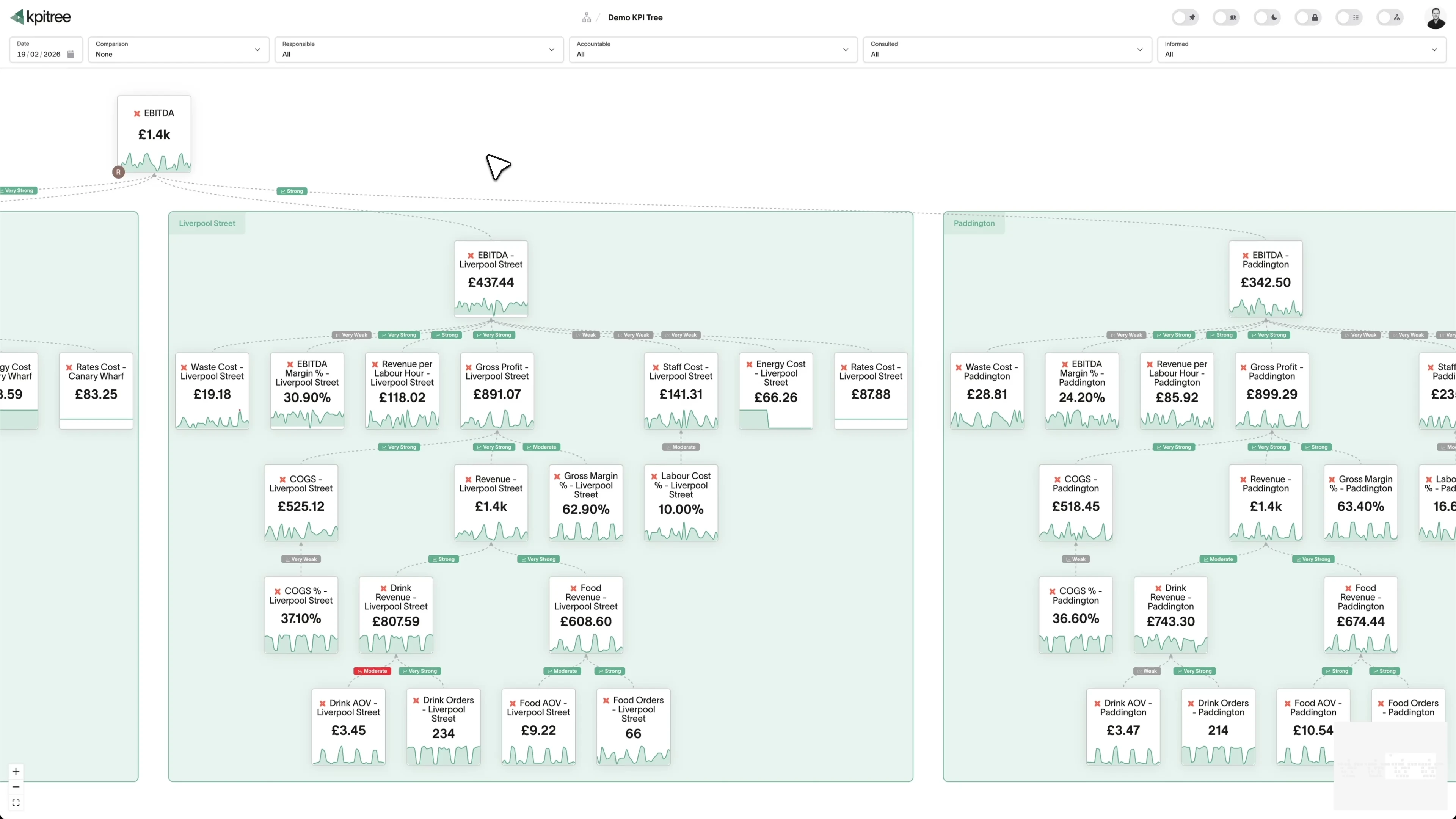
- Describe your product model in plain English and AI drafts the tree, with every node and edge editable
- Break each level into feature inputs: onboarding completion, core action frequency, time to value
- Connect product metrics to marketing, sales and revenue on the same canvas, so the tree does not stop at the product wall
- Every driver edge carries confidence and significance, recalculated nightly, with false positives pruned by your team
Know why the metric moved before the stand-up does
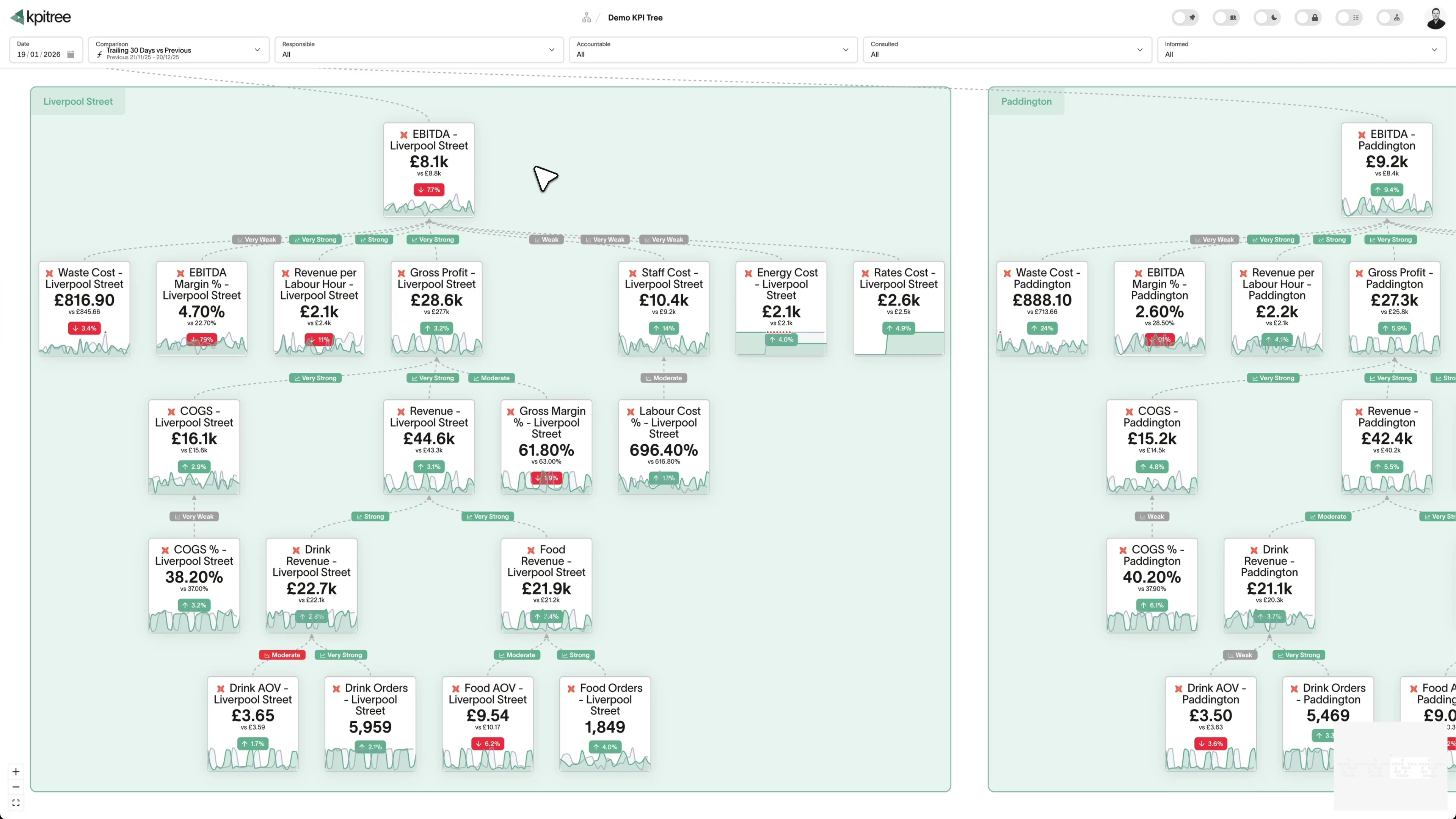
- Drivers are ranked by impact, with confidence levels and statistical significance on every relationship
- Waterfall change insights show what each driver added or removed against its goal
- Cross-domain AI analysis connects insights across product, marketing and finance in one answer
- AI investigations query your warehouse directly, so findings are grounded in the underlying data, not just aggregated values
Give every driver a named owner and a push that fires when it moves
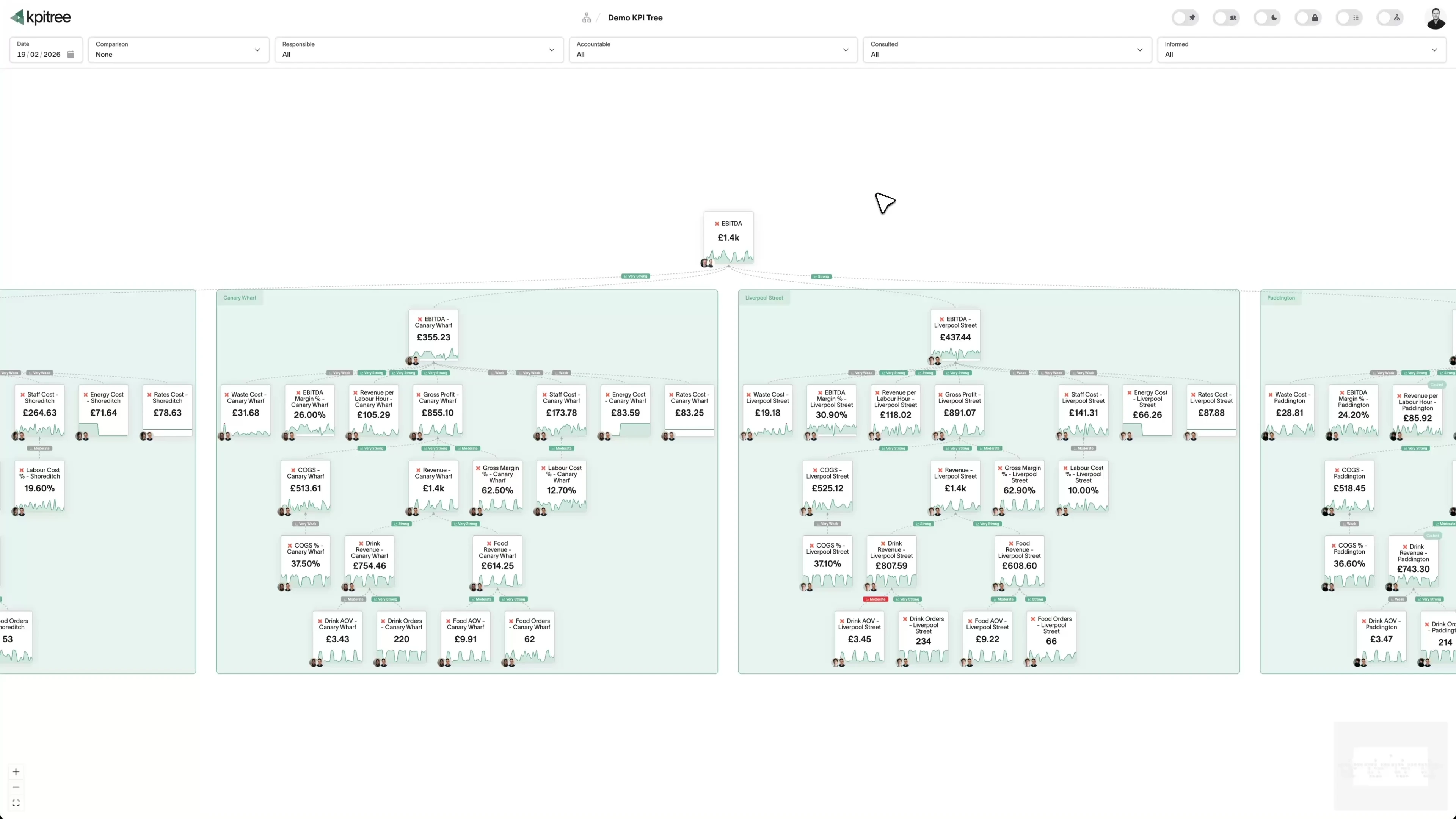
- Assign squads or individuals to any node: the activation squad owns onboarding, the growth squad owns referral
- Triggers fire on threshold crossings, outliers, silent metrics and missed period-close targets, and each push routes to the named Accountable owner
- Escalation follows your live org chart, so a movement nobody acts on reaches the manager automatically
- Ask KPI Tree in Slack why activation dipped and the answer lands in the thread, with the driver and the owner attached
Run the roadmap as a portfolio of verified bets
- Link every initiative to the metrics it targets, and track execution apart from outcome
- Impact is measured by the same pipeline that calculates your actuals, so nobody marks their own homework
- The portfolio view scores each initiative by how far its metrics have moved since the work began, in the direction it intended
- Model a launch with ramp profiles instead of flat assumptions, and compare the plan against actuals at any granularity
“Product analytics tools show you what users do. KPI Tree shows you what drives your north star with confidence and significance attached, who owns each driver, and whether the last release actually moved the number.”
What product analytics tools leave out
The closed loop, delivered
Evidence that outranks seniority
AI answers with an owner and a track record
Common questions
How is this different from our product analytics tool?
Product analytics tools are built for event-level analysis: funnels, cohorts, user flows, feature adoption. KPI Tree sits a layer above. It connects the metrics those tools produce into a causal model that spans the whole business, with confidence levels and statistical significance on every relationship, named ownership on every metric, and verified impact on every action. Keep your product analytics tool for event analysis. KPI Tree is the layer that says what drives what, who owns it, and whether the work moved the number.
Our analytics tool already draws metric trees. Why is yours different?
A tree you can look at is a visualisation. KPI Tree is built around the tree as a system: whole-business scope rather than product events only, driver edges that carry confidence and statistical significance and are retested nightly, RACI ownership with pushes that fire when a metric moves and route to the named Accountable owner, actions tracked against metrics, and impact verified over time. Shipping the picture does not ship the loop.
Is the driver analysis causal or just correlation?
Correlation is only the first gate. Driver relationships are statistically proven over time, tested nightly against your data for lag and seasonality, and every edge carries a confidence level and a significance score. Your team prunes relationships the statistics cannot rule out but you know have no causal link. The draft comes from AI, the corrections come from your team, and the verdict comes from the nightly tests, with the model telling you how sure it is rather than overclaiming.
Can we run our objectives and key results on it?
Yes. Objectives live on the same tree as the metrics. Each key result is a real metric with a target, so progress is read from the data rather than typed into a status field, and outcome is tracked apart from execution, so a fully delivered plan against a flat number is visible rather than hidden behind one bar. Initiatives carry the budget, the owner and the metrics they target, and the portfolio view shows which bets are moving their numbers.
Can the AI tools we already use read the model?
Yes. Connect Claude, ChatGPT, Cursor and other MCP clients and your assistant reads the tree: significance-tested driver edges with confidence levels, RACI ownership, targets and verified impact history, scoped to what the asker is permitted to see. This surface is Canopy, the business context layer, and it is the same model your team uses. Because comparisons and correlations are precomputed around every metric, an agent gets the full picture in one call instead of ten warehouse queries.
What do we need in place to get started?
A warehouse or a semantic layer is enough. KPI Tree calculates metrics where your data lives, syncs definitions from dbt, Looker or Snowflake Semantic Views, and reads aggregation semantics automatically. Metrics that live outside the warehouse can come in through any MCP-compatible source, so numbers from tools like Stripe, HubSpot or Linear sit in the same tree, owned and targeted like any warehouse metric. If you have no metric definitions yet, describe your product model in plain English and AI drafts the first tree.
Related guides

Metric trees for product teams
Connect every feature, experiment, and initiative to the outcomes that matter
North Star Framework vs metric trees
Comparing and connecting two approaches to strategic measurement
How to run an A/B test with metric trees
Connecting experimentation to the metric tree framework
Bring your north star. Leave with its drivers.
Book an hour. We map your north star to the inputs that drive it, across product, marketing and revenue, with confidence and significance on every relationship, and show you the loop from a metric moving to a verified action. Your analytics stack stays exactly where it is.










