

You are tracking everything and understanding nothing
Twelve spreadsheets, zero agreement
Busy teams, flat numbers
The model you raised on is not the business you run
AI drafts your tree. You correct it. Evidence decides.
- Explain the business in plain English and AI drafts the metrics, drivers and relationships in minutes.
- Every node and edge stays editable, so the founding team can reshape the draft before the evidence takes over.
- Driver relationships are tested against your data nightly, each carrying a confidence level and statistical significance.
- Start with manual inputs or Google Sheets and connect a warehouse when you have one.
Build the execution culture before headcount forces process
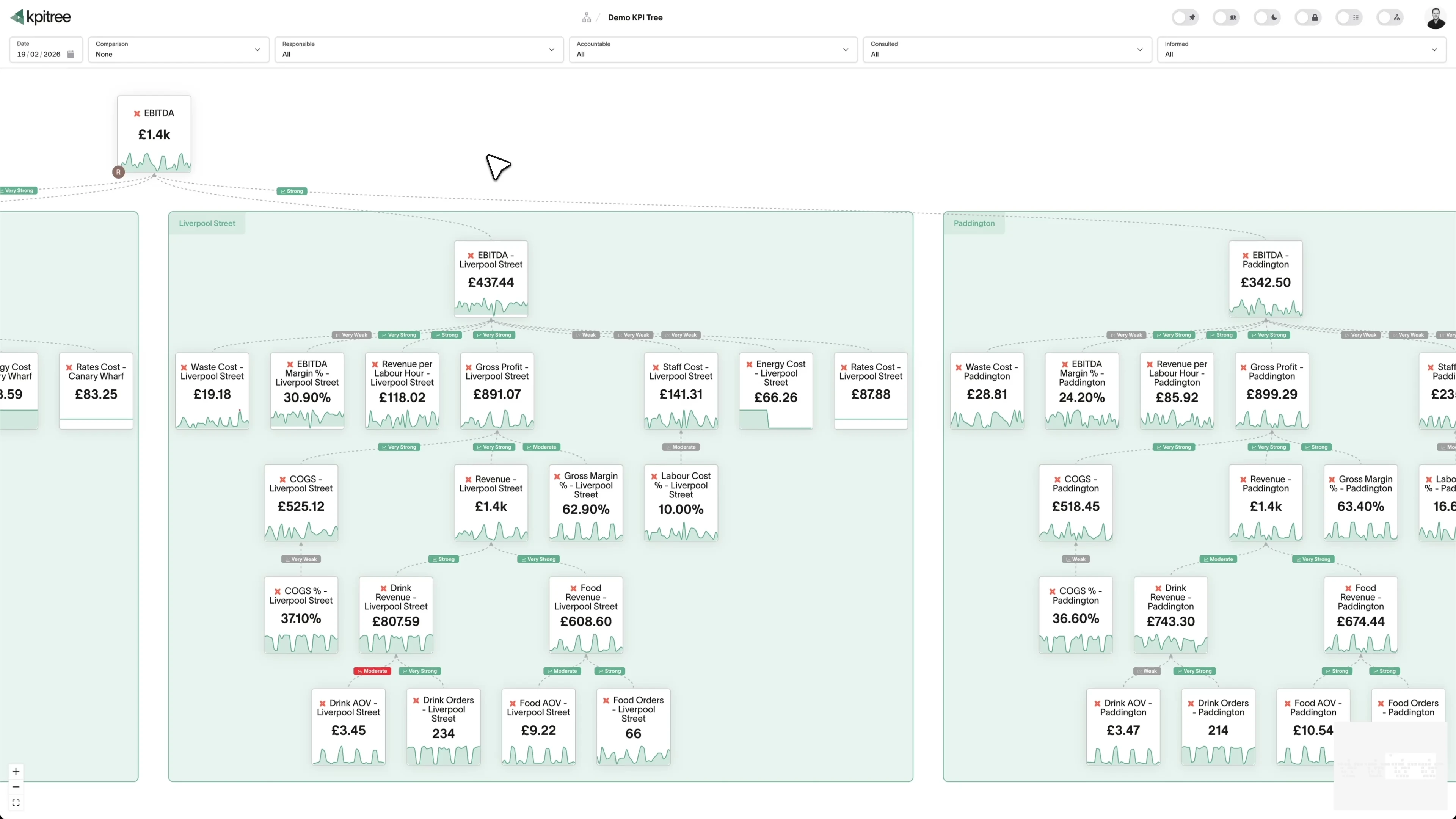
- Every metric has a named Accountable owner, visible on the tree before you have managers to enforce it.
- When a metric itself moves, the named Accountable owner is notified in Slack or by email with the driver behind the move, complete with confidence level and statistical significance.
- Actions are tracked against the metric they were meant to move, and the metric decides whether they worked.
- New hires read the tree and understand how the business works in their first week.
The fundraising model and the operating reality, in one place
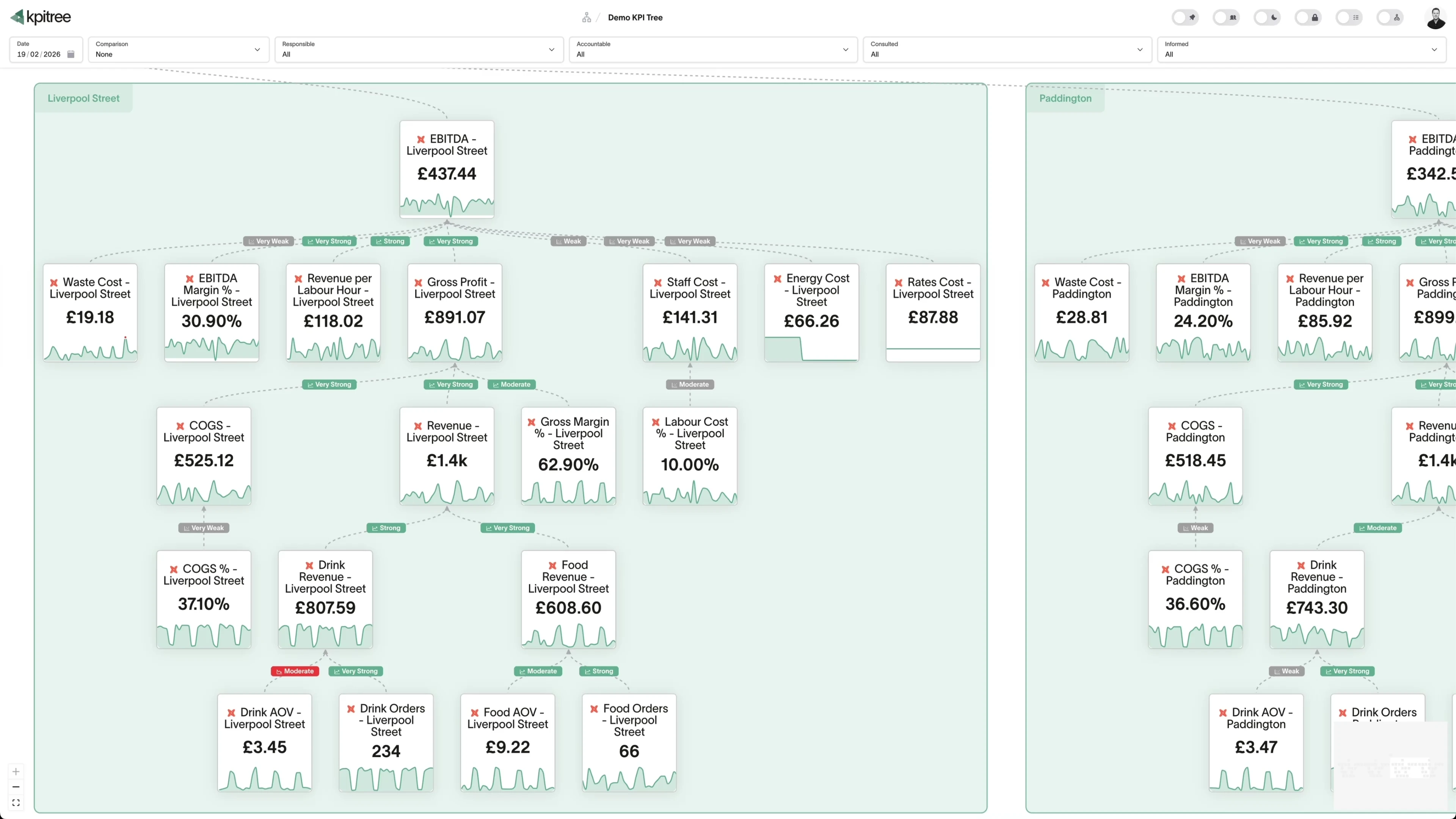
- Budgets, forecasts and targets flow through the same pipeline as your actuals, so plan and reality never disagree about the calculation.
- Ramp profiles give each metric a realistic adoption curve instead of a flat assumption from day one.
- Compare plan against actuals across any period, granularity or comparison frame directly on the canvas.
- The board sees the same numbers you run the company on, because both live in one system.
Show investors a system, not a slide
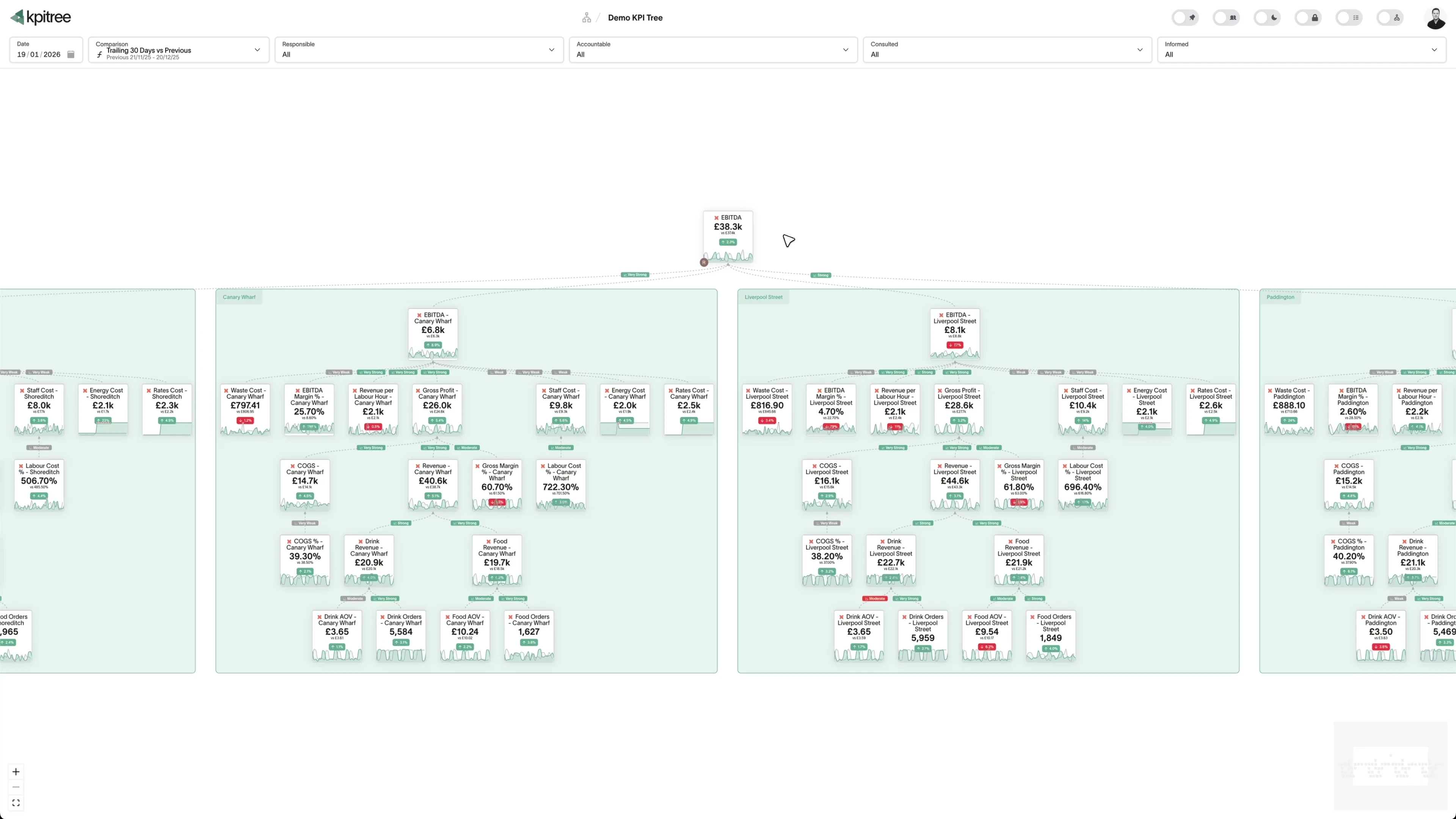
- Answer "what drives your retention?" with driver relationships that carry confidence levels and statistical significance, not a narrative.
- Walk the chain from daily activity to revenue, with a named owner on every metric along it.
- Show the verified impact history of what the team shipped and what it moved, which is evidence of execution rather than a claim of it.
- Export your tree for board decks and investor updates.
“Spreadsheets hold the numbers. The board deck holds the story. Neither shows what drives what, who owns it, or whether last month's bet moved anything.”
Built for the team you have, sized for the one you are hiring
Live in minutes, not quarters
Your AI assistants read the same tree you do
Room to grow without a rebuild
Common questions
We just use spreadsheets for tracking. Why would we switch?
You would not switch. You would add the layer that spreadsheets cannot provide. A spreadsheet shows numbers side by side. A metric tree shows how they drive each other, with a confidence level and statistical significance on every relationship. Revenue is not just a number next to conversion rate; it is a function of traffic, conversion and average order value, and when your team sees that structure they stop guessing where to focus. You can keep your spreadsheets. The tree gives them meaning.
Do we need a data warehouse or analytics stack?
No. Most founding teams start by entering numbers manually or connecting Google Sheets, and the tree is useful as a thinking tool before any data is connected. When your stack matures, connect Snowflake, BigQuery, Databricks, Redshift, Azure SQL or PostgreSQL, sync your dbt semantic layer, or bring in metrics from MCP-compatible tools such as Stripe, HubSpot or Linear. Nothing you built gets thrown away; the same tree fills in with better data.
Is this useful before we have product-market fit?
Especially before product-market fit. You are running experiments constantly, and the tree forces your assumptions into the open: we believe onboarding completion drives week-two retention, which drives lifetime value. Each of those beliefs becomes a driver relationship tested against your data, with a confidence level and statistical significance attached, so you learn which assumptions survive contact with the evidence rather than which ones survived the meeting.
We just ask AI when we have a question about our numbers. Why maintain a tree?
For one-off questions, an AI on your data is genuinely good, and nothing here asks you to stop. But an answer evaporates when the chat closes, and asking twice gets you two stories. The tree is drafted once, tested against your data nightly with confidence levels and statistical significance on every relationship, and corrected by the founders who know the business. Every future answer, from a person or an agent, inherits that judgement, and the verified history of what actually worked is context no model can supply from a training corpus.
How much does it cost for a small team?
Starter is built for early-stage teams: £1,000 a month for up to 10 users with no per-seat fees, so the whole founding team can see the same causal tree. We believe building the right model of your business early is one of the highest-leverage investments a founding team can make. Visit our pricing page for the full comparison.
How is this different from OKRs?
OKRs are a cadence; KPI Tree is the model underneath them. The metric tree persists rather than resetting every 90 days, each metric carries a real target and a named owner, and impact is verified against the data. If you run OKRs formally, our Strategy Execution tier puts objectives and key results on the same tree, with delivery and outcome tracked separately. Either way, when the quarter ends, the causal model, the ownership and the impact history remain.
Related guides

Metric trees for startups
The right metrics at the right stage, from day one to Series A and beyond
North star metric: what it is and how to find yours
Choose the right north star metric and make it actionable
The metrics maturity model
Five levels from ad hoc reporting to optimised decision-making
Build the system before you scale it
Describe your business, correct the draft, and let the evidence decide. Get the loop running while the team still fits in one room, then walk into your next investor meeting with a system instead of a story.










