

Marketing has more data than any other function. And less trust.
You optimise what you can measure, not what moves revenue
Attribution debates that consume every QBR
Campaign retros that run on self-reported success
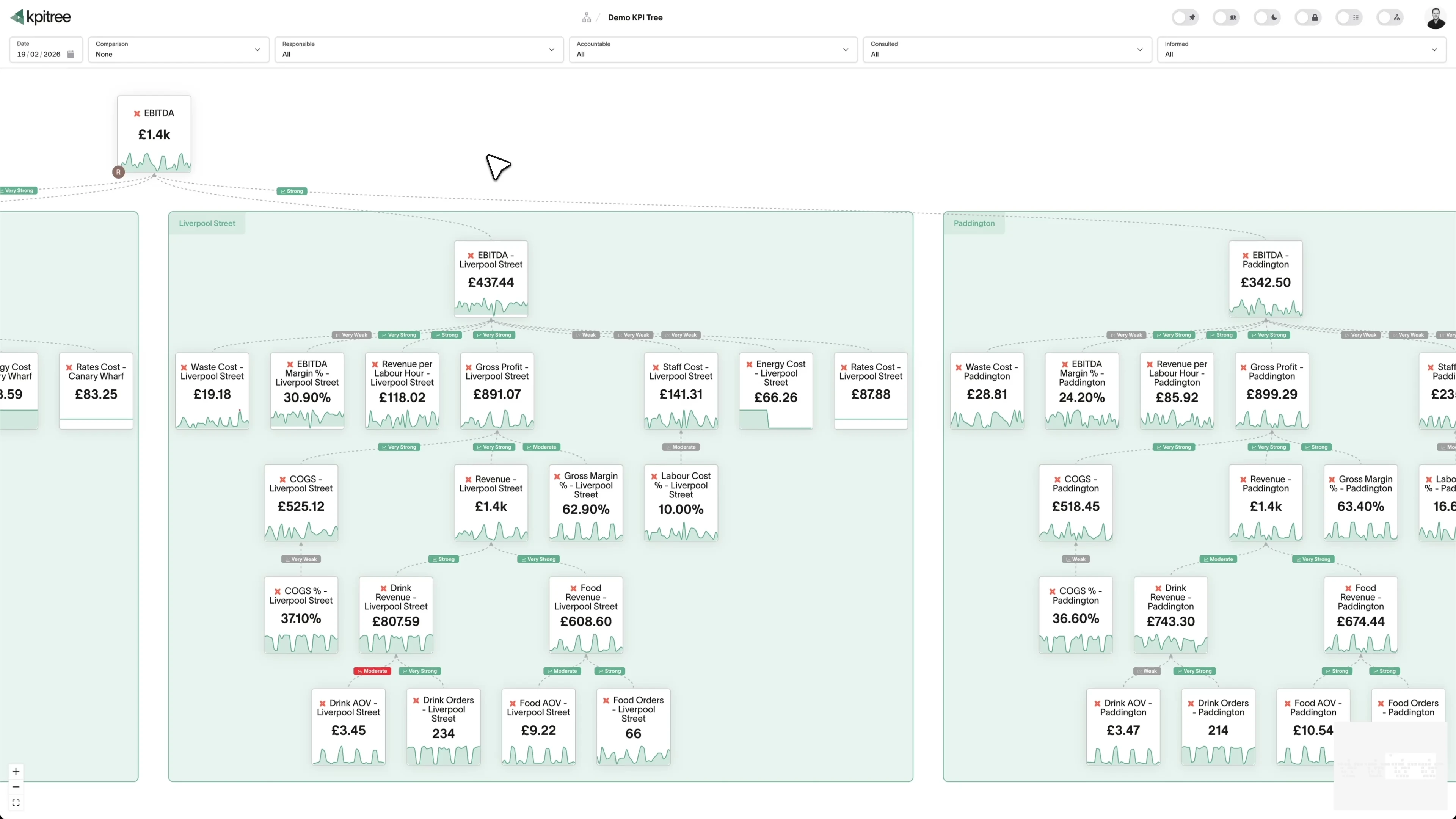
A metric tree from revenue down to channel activity
- The whole funnel sits on one canvas, from channel spend to revenue, instead of scattered across tools.
- Every edge from channel activity to pipeline and revenue carries a confidence level and statistical significance.
- You see which channels hold a statistically proven connection to revenue and which only look busy.
- Your channel dashboards keep their job. The tree is the layer that shows what all that activity actually drives.
The tools marketing runs on, in the tree without an engineering ticket
- You add a connection with a server URL and a token, and KPI Tree discovers the tools the server offers.
- You map a response to a metric by pointing at the date and value fields, with a live preview of the exact rows before you save.
- Metrics from HubSpot or Stripe sit in the same tree as warehouse metrics, with the same ownership and targets.
- Warehouse and semantic layer metrics sync alongside them, so one tree spans every source your funnel touches.
When pipeline moves, the why and the who arrive together
- A waterfall view shows exactly which drivers contributed to a movement in pipeline and by how much, each carrying its confidence level and statistical significance.
- Outlier and threshold triggers fire the moment the metric moves, and the notification goes to the named Accountable owner.
- Every metric in the funnel carries RACI ownership, so a slipping conversion rate lands with a person, not a dashboard.
- When nobody acts, the escalation walks the live org chart automatically.
Every campaign tracked against the metric it was meant to move
- Each campaign action links to the metric it is meant to move, with a named owner attached.
- Impact is read from how the metric moved after launch, not from the campaign team's own scorecard.
- The verified history shows which campaign types moved pipeline and which only moved impressions.
- Budgets and targets sit alongside actuals in the same tree, so plan versus reality needs no reconciliation.
“Your dashboards report the funnel. Your attribution model argues about credit. Neither shows what drives revenue, who should act when a number slips, or whether the last campaign worked.”
Channel dashboards describe the funnel. This closes the loop on it.
Proof that travels with the claim
Answers in Slack, grounded in the tree
Pushes that fire on the metric, not the calendar
Common questions
How does KPI Tree handle marketing attribution?
KPI Tree does not replace your attribution model. It makes the debate less important. Instead of arguing about which channel gets credit for a single conversion, you see a directed driver edge between each channel and the outcomes it feeds, carrying a confidence level and statistical significance, tested against your data over time. Channels that consistently move pipeline and revenue show it in the evidence, and channels that do not stop absorbing budget on assertion.
Can we connect tools like HubSpot without engineering help?
Yes. Any MCP-compatible server can be added as a data source with a server URL and a token. KPI Tree discovers the tools the server offers, proposes a mapping from a sample response, and shows a live preview of the exact rows before you save. No code is involved, and the resulting metrics sit in your trees, carry ownership and drive targets like any other. Data that already lands in your warehouse connects the way it always has.
How is this different from the funnel reports in our marketing automation tool?
Funnel reports show conversion rates between stages. KPI Tree shows the system around them: how funnel metrics drive pipeline and revenue, with a confidence level and statistical significance on each relationship, who owns each metric, what reaches that owner the moment one moves, and whether the actions taken actually worked. It is the difference between reporting a funnel and running one.
Can the team use it without leaving Slack?
Yes. Mention KPI Tree in any Slack channel to ask how a metric is doing, what is driving a change, or who owns it, and the answer arrives in the thread, with a chart when the question is best answered visually. One-tap follow-ups let you dig deeper without retyping, every reply stays threaded, and a daily spend cap per workspace keeps AI cost predictable.
How do we know whether a campaign actually worked?
Every campaign action is tracked against the metric it was meant to move, and the impact is verified against the number itself. Two weeks later you are not reading a retro deck, you are reading the metric. Over time that verified history builds a track record of which campaign types move pipeline, which is what next quarter's budget conversation should run on.
How long does it take to set up?
Most marketing teams have a working metric tree within a few days. You describe your funnel in plain English, AI drafts the tree, and your team corrects it while you connect your data from the warehouse or over MCP. From there every driver relationship is tested against your data nightly, with confidence levels and statistical significance on every edge, so the tree keeps earning its place as the funnel changes.
Related guides

Metric trees for marketing teams
Connect every campaign to revenue impact
Customer acquisition cost: a metric tree approach
Decompose CAC into its component parts so you can see exactly where your acquisition spend goes and how to improve it
Conversion rate: a metric tree decomposition
Break conversion rate into its component parts so you can see exactly where prospects drop off and how to fix it
Close the loop from campaign to verified impact
Book a demo and we will build a metric tree for your marketing funnel, from revenue down to channel activity. You will see driver edges carrying confidence levels and statistical significance, watch a movement decomposed in the change insights waterfall, and follow a campaign from launch to verified impact on the metric it was meant to move.










