

You invested in the data stack. The decisions did not improve.
Every department has its own truth
Hundreds of metrics, no named owners
AI agents are multiplying faster than governance
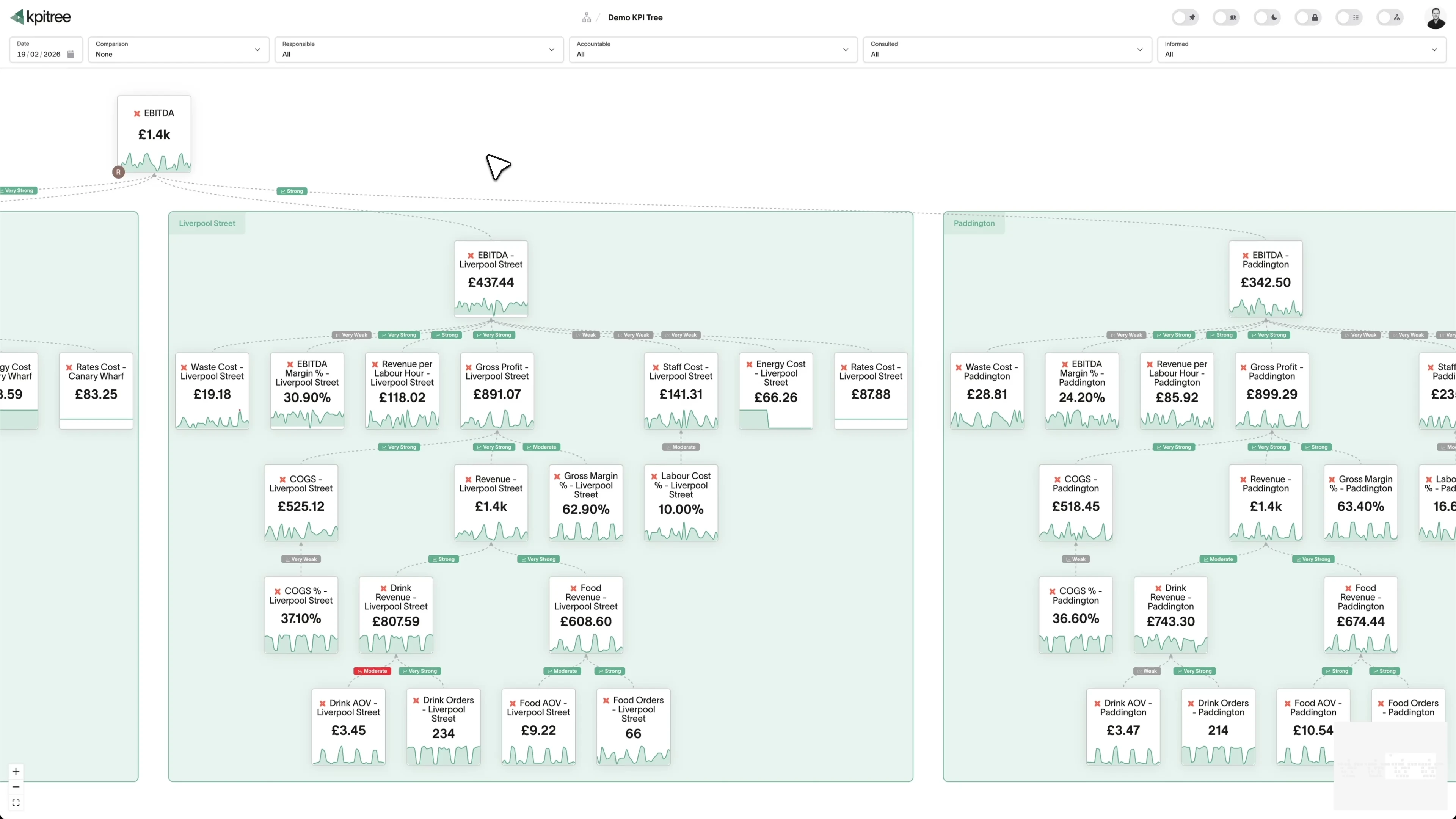
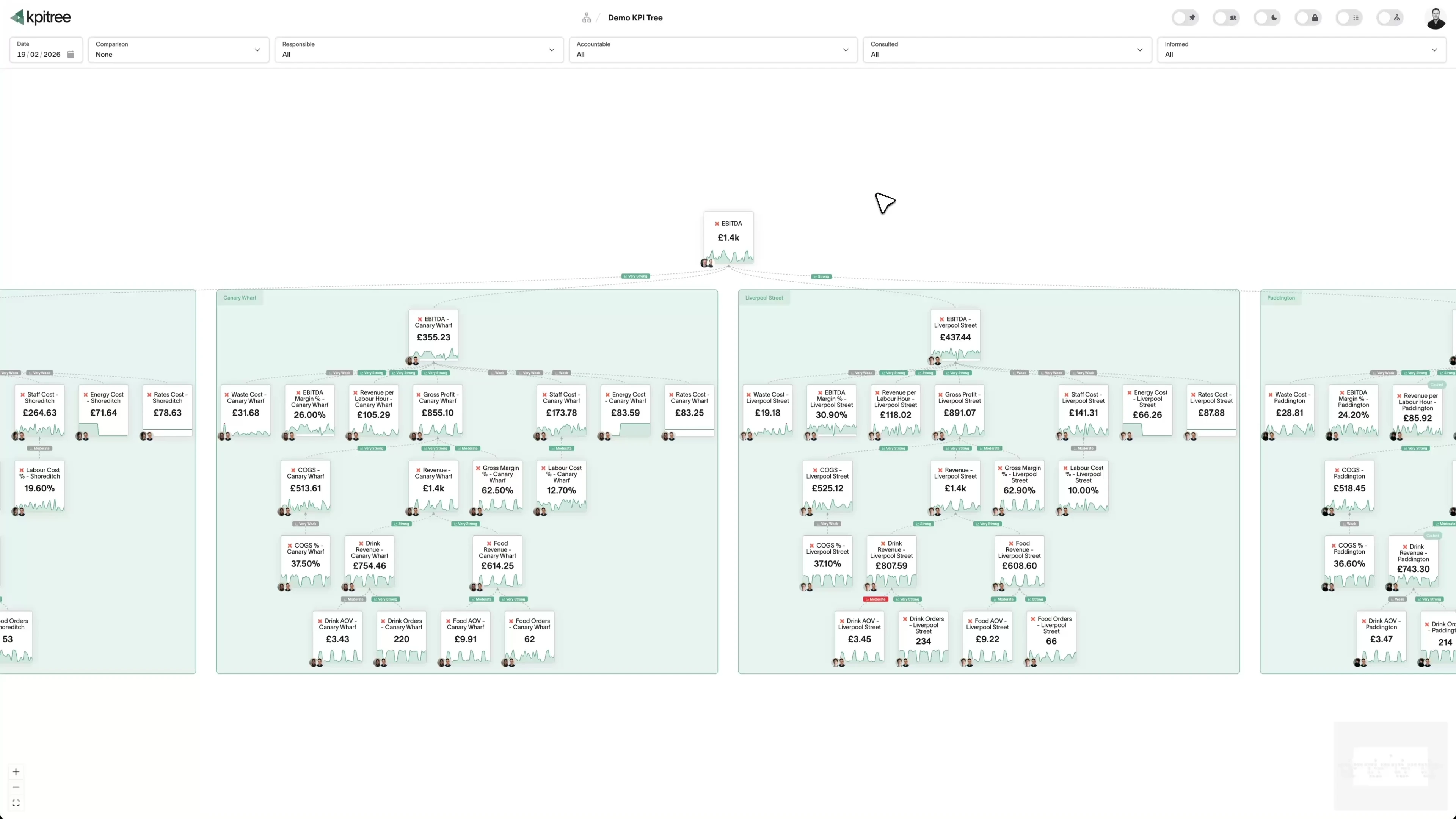
One causal model across every business unit
- The model scales to 5,000 metrics per account, so every business unit fits in one causal structure rather than a tree per silo.
- Every driver relationship is statistically tested against your data nightly, with its confidence and significance visible on the edge.
- Departmental trees keep their own structure, owners and thresholds, and roll up into a consolidated organisational view.
- Every change to definitions, ownership and structure is recorded and attributable.
Accountability that runs on your live org chart
- RACI assignments on every metric, synced from your directory provider so ownership never goes stale.
- Notifications fire when the metric itself moves and go to the named owner via Slack or email, not to a channel someone once configured.
- Escalation policies notify the manager, reassign up the reporting line and record every step, with approvals as first-class gates.
- Every action is tracked against the metric it targets, and its impact is verified by the same calculations that produce your actuals.
Every sanctioned agent, the same governed context
- One-click MCP setup covers the assistants your teams already use, so there is no integration project per agent.
- Agents inherit the asking user's permissions on every run. There is no all-access service account.
- Admins manage agents and workflows centrally, and a shared run history records every run and what it cost.
- Precomputed metric context turns roughly ten agent queries per metric into one, and every calculation runs in KPI Tree's own compute engine, so the warehouse bill stays flat as agent use grows.
“Your warehouse knows what happened. Your semantic layer knows how it was calculated. Nothing in the stack knows why it moved, who is accountable, or whether the last action worked. That is the layer KPI Tree adds, for your people and every agent they use.”
Security and compliance without compromise.
SOC 2 Type II. The gold standard for compliance.

SSO. One click, your identity provider.









Directory sync. Users managed automatically.
Microsoft Entra ID


 Okta
Okta Google Workspace
Audit logs. Stream to your SIEM.Enterprise+
 Datadog
Endpoint protection. Restrict access to approved IPs.Enterprise+
 Zscaler
HSM encryption. Hardware-backed, always encrypted.
BYOK. Bring your own key.Enterprise+
The missing layer in your data stack
Causal structure, not dashboards
Accountable agents, not another assistant
Enterprise-grade from day one
Common questions
We already have a semantic layer. What does KPI Tree add?
Your semantic layer tells AI and BI how metrics are calculated, and KPI Tree syncs from it rather than replacing it. What it adds is the layer above: how metrics drive each other, with confidence levels and statistical significance on every relationship, who owns each one, and whether the last action moved the number. Peers in a stack, not substitutes. Your semantic layer solves the definition problem. KPI Tree solves the "so what do we do about it" problem.
How does ownership work across hundreds of teams?
Every metric carries RACI assignments, synced from your directory provider, with manager assignments mirroring your real reporting lines. When a metric moves beyond expected ranges, the named Accountable owner is notified through their preferred channel, with the driver and its confidence and significance attached. If they do not act, escalation policies walk the live org chart: notify the manager, reassign up the line, and record every step. Ownership syncs rather than being hand-maintained, so it stays current as people join, move and leave.
How do we keep AI use under control?
AI is admin-governed end to end. You choose which models agents run on, bring your own API keys if you prefer to bill LLM usage directly, set a daily spend cap per workspace, and switch on content moderation where regulation or brand policy requires it. Admins manage agents and workflows from one place with a shared run history, and every agent runs with the permissions of the user it acts for, so what it sees is exactly what they see.
Can the AI assistants our teams already use connect?
Yes. Canopy exposes the model over MCP, with one-click setup for Claude, ChatGPT, Gemini, Copilot and other MCP clients. Every connected agent reads the same governed context: driver edges with confidence and significance, RACI ownership, budgets and targets, and the verified impact of past actions, always scoped to the asking user's permissions. Teams that live in Slack can also mention KPI Tree in any channel and get threaded answers, with charts, from the same model.
What if different departments want different tree structures?
Each department can have its own tree with its own structure, owners and thresholds, and trees roll up to a consolidated organisational view. The marketing tree feeds the revenue tree, which feeds the P&L tree, and the platform scales to 5,000 metrics per account with viewport-prioritised loading, so the full model stays fast. Each team sees the detail they need. Leadership sees the full picture.
Does this replace OKRs?
It can. Objectives and key results live on the causal metric tree, and each key result reads its value from the same calculations that produce your actuals, so progress is observed rather than self-reported. Outcome and execution are tracked apart, initiatives carry the budget and the owner, and the portfolio view shows where the money is actually moving metrics. Some teams run their whole strategy cycle in KPI Tree. Others keep a separate OKR tool and use the tree as the evidence underneath it.
Related guides
One governed model. Every business unit. Every agent.
Map the causal relationships between metrics across every department, each one carrying a confidence level and a statistical significance score, put a named owner on every metric, and give your people and your AI agents the same governed context, with the closed loop from insight to action to verified impact. Talk to our enterprise team.










