

You have more data than ever. And less proof than you need.
Six dashboards. Six different stories.
Strategy in January. Drift by March.
Everything shipped. The number did not move.
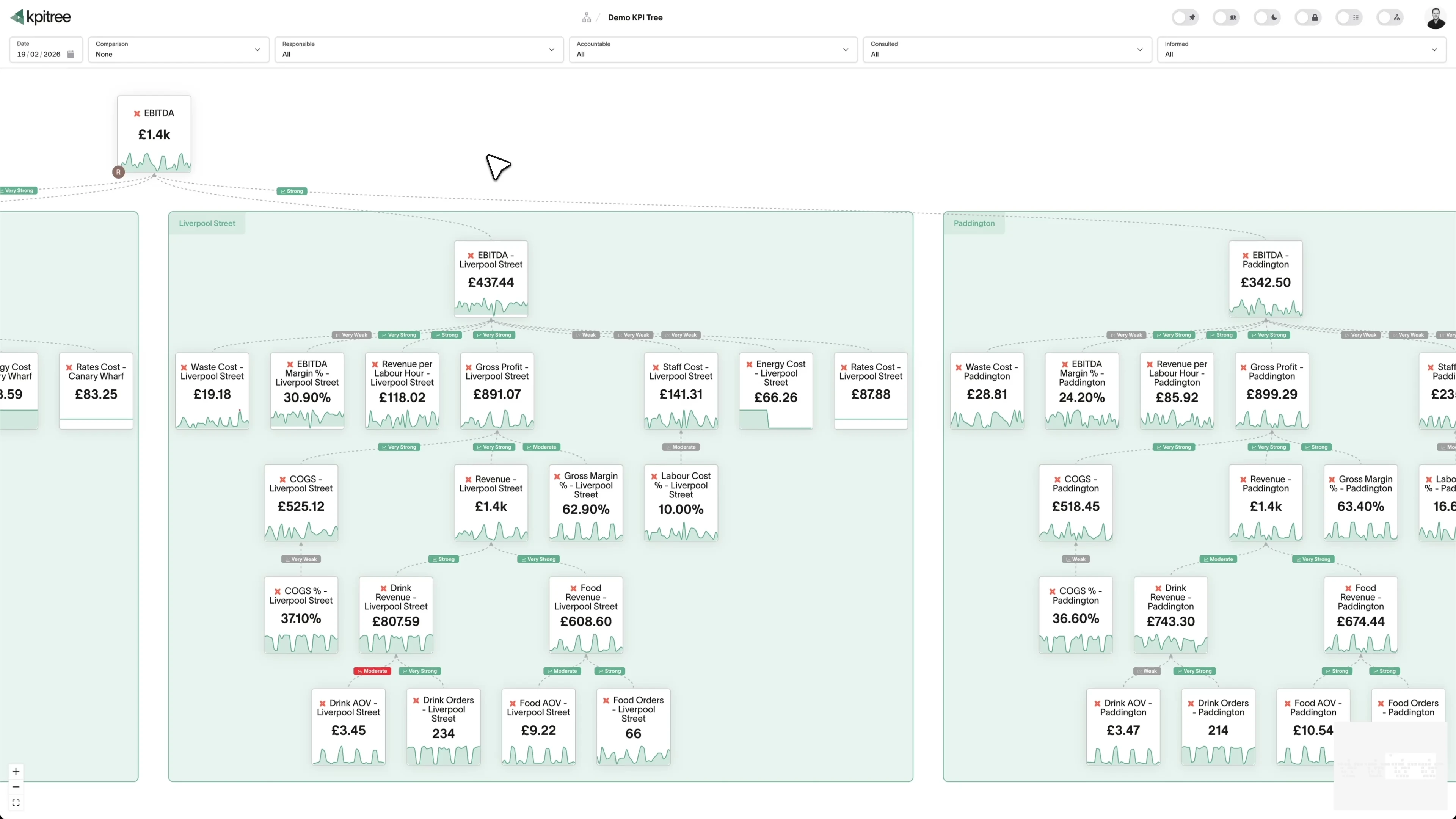
The whole business on one causal map
- Every metric connects on one map, from revenue and margin down to the team-level drivers beneath them.
- Every driver relationship carries a confidence level and statistical significance, retested against your data nightly.
- AI drafts the tree from a plain-English description of your business, and your team corrects it on the canvas.
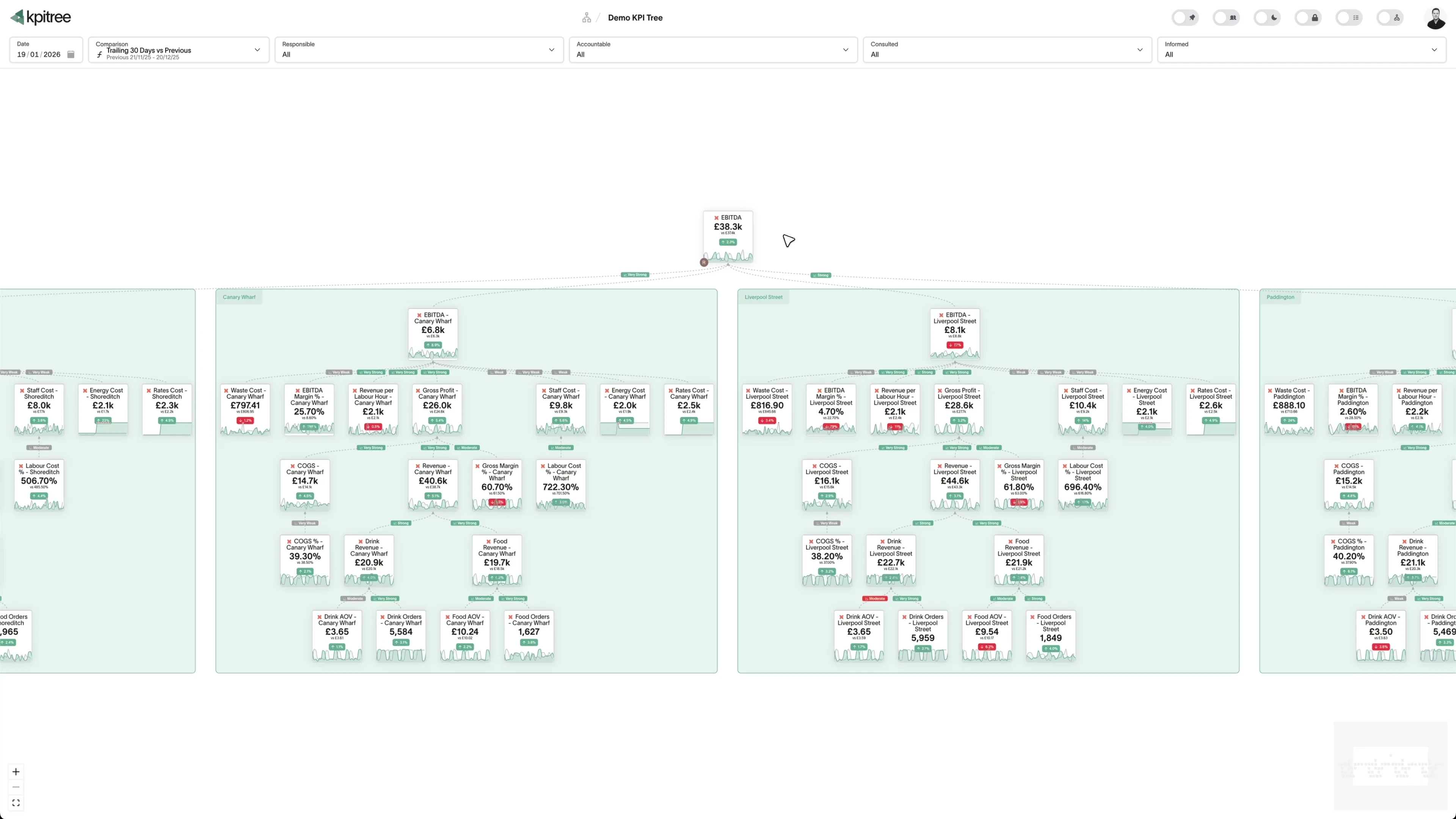
- Budgets, forecasts and targets flow through the same pipeline as actuals, so plan versus reality is one view, not two documents.
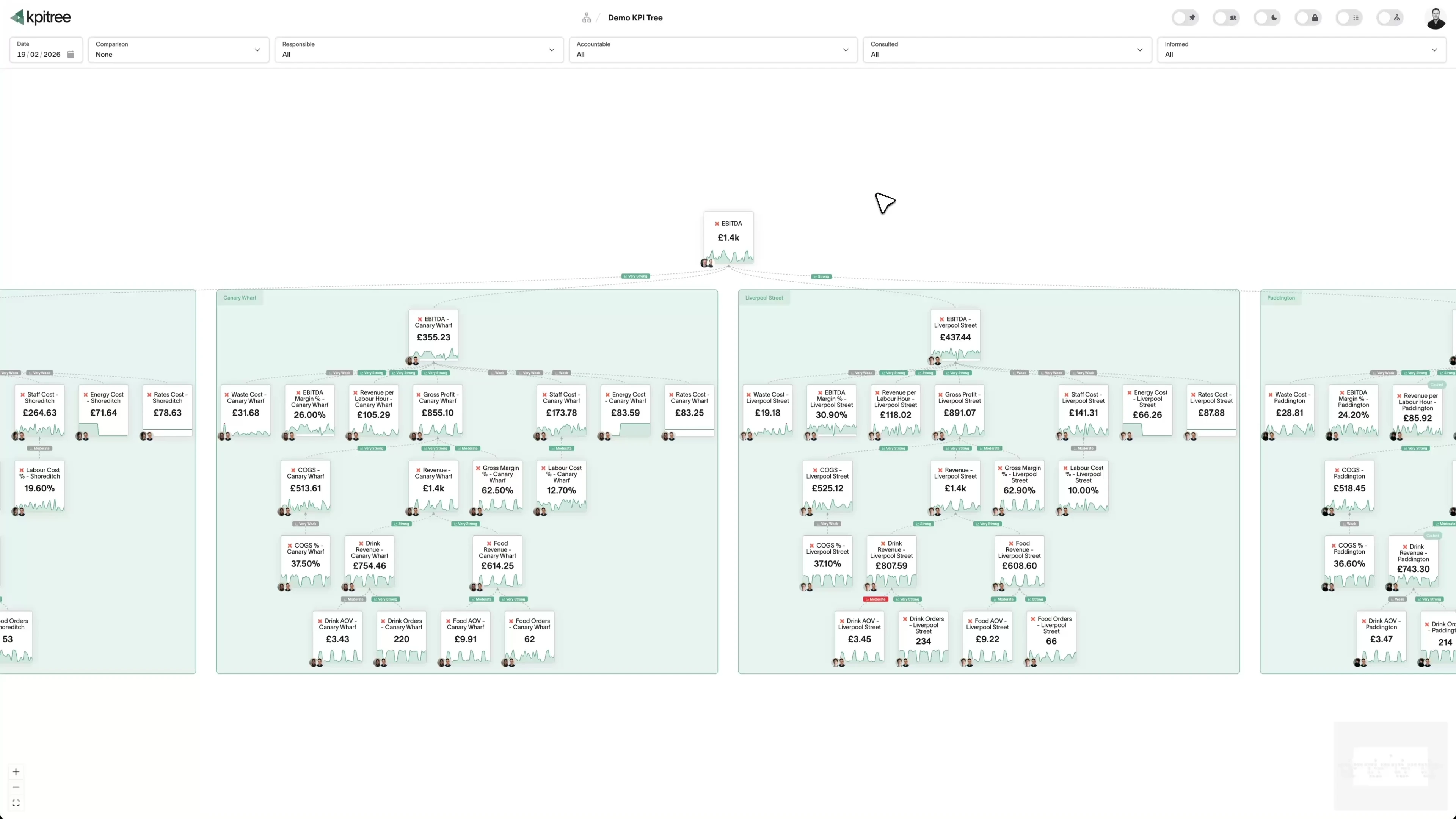
When a number moves, a name moves with it
- Every metric names who is Responsible, Accountable, Consulted and Informed, kept current from your directory.
- Pushes fire when the metric itself moves and route to the named Accountable owner, with the driver and its confidence and statistical significance attached.
- If nobody acts, escalation climbs your live org chart automatically until someone does.
- Every action is tracked against its metric, and its verified-impact status shows whether the number moved.
Strategy on one map, read from the data
- Each key result is a real metric that completes when it hits target, so nobody self-reports progress.
- Initiatives carry budget, spend, a named owner and milestones, linked to the metrics they are meant to move.
- Outcome and execution are tracked separately, so a delivered project on a flat number is visible at a glance.
- The Portfolio view shows where the money is working, with every initiative scored by the movement of the metrics it targets.
The board review becomes a working session
- Live presence and cursors let the whole leadership team work on the same canvas at the same time.
- Any movement is traced through the tree in seconds, with each driver's contribution quantified and its confidence and significance shown.
- The view is always current, so board packs stop going stale between assembly and meeting.
- Questions raised in the room become actions with named owners, tracked against the metrics they target.
“Dashboards show what happened. Chat tools answer questions. Neither names who acts, routes the moment to them, or proves the action moved the number. That loop is the product.”
The closed loop no dashboard, chat tool or goal tracker ships
Causality you can defend to the board
Verified impact is the learning signal
One model for your team and your agents
Common questions
How is this different from the dashboards I already have?
Dashboards report individual numbers. KPI Tree connects them, names who is Accountable for each one, and tracks whether actions moved them. When revenue drops, a dashboard tells you it dropped. KPI Tree shows the driver behind the fall with its confidence and statistical significance, pings the named owner, and later shows whether the fix worked. Your BI tool keeps the reporting; KPI Tree is the layer above it that connects the numbers, names the owners and verifies the actions.
Why not just ask an AI assistant about our data?
For one-off questions, do exactly that: a frontier model on your warehouse is fast and getting faster. But an answer evaporates when the chat closes, and the things leadership actually needs are recorded in no warehouse table: which driver relationships survive statistical testing in your business, who is Accountable for each number, and which past actions verifiably moved it. KPI Tree records exactly those, so your people and your AI tools reason over the same accumulated ground truth instead of re-deriving the business on every question.
Does this replace our OKR tool?
It can. Objectives and key results live on the causal metric tree, and each key result is a real metric that completes when it hits target, so progress is read from the data rather than a status field. Initiatives carry budget, spend, a named owner and milestones, outcome and execution are tracked apart, and the Portfolio view scores every initiative by how far its metrics have actually moved. When the quarter ends, the model, the ownership and the impact history remain.
Can I run a board meeting from it?
Yes. Share the live model with board members and review it together: presence avatars and live cursors show who is looking where, the numbers are always current, and any question about a movement is traced through the tree in the room, in seconds. Questions become actions with named owners before the meeting ends, and at the next meeting the verified-impact status shows what those actions did.
How much of my team's time does this take to set up?
Very little. Your data team connects your existing sources, AI drafts the tree from a plain-English description of your business, and your leadership team corrects it in a single working session. From then on, the data judges every relationship nightly. You do not need perfect data to start: most organisations begin with the 15 to 20 metrics that matter most and expand from there.
What does this do to our data and AI costs?
Less than you might expect. Your warehouse is queried once per metric per sync, and every aggregation, comparison and correlation runs in KPI Tree's own compute engine, so more questions from your team and your agents do not mean a bigger warehouse bill. AI spend is governed too: a daily cap per workspace, with cost tracked per agent and per user.
Related guides

Metric trees for executives
A visual guide for senior leaders
How to present metrics to your board
From data dump to decision-ready board deck.
How metric trees close the strategy-execution gap
The gap is not between strategy and execution. It is between strategy and understanding.
See the loop run on your own numbers
Book a walkthrough. We map your top metrics, show the drivers behind them with confidence and significance attached, and run the loop end to end, from a metric moving to a named owner acting to the impact being verified.










