


About KPI Tree
What should we do differently tomorrow to grow revenue?
It is the question every business runs on, and the one a dashboard cannot answer. We built KPI Tree to answer it, for your team and for the AI agents that work alongside them, with the evidence to act on it.
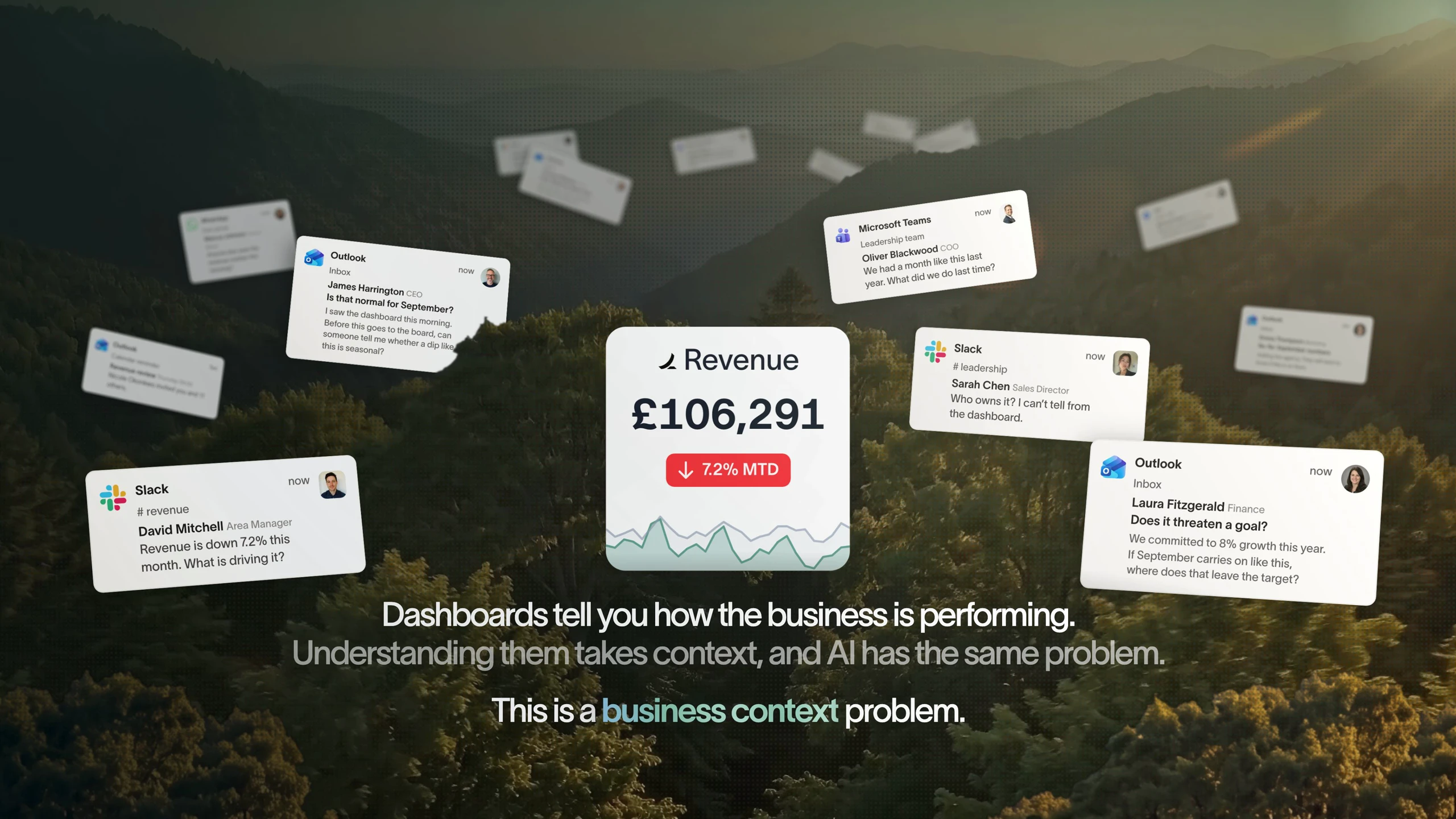
Everyone had dashboards. Nobody had answers.
I spent years as a Chief Data Officer, brought into private equity portfolio companies after an acquisition to make sense of the chaos. We would consolidate the data, build the modern stack and stand up the dashboards. Dozens of them. And every Monday morning the same scramble played out anyway: the CFO rebuilding a master spreadsheet before the exec meeting, tab after tab, revenue from Tableau, pipeline from Salesforce, customer metrics from Mixpanel. Every number told part of the story. None of them told the whole one.
Richard Oastler
Founder & CEO
Shadow dashboards. Rebuilt in Excel.
What changed, never why.
Teams pulling apart. Without knowing it.
“The problem was never the data. It was that every metric lived on its own.”
First, for people
A business is one system. So we modelled it as one.
 Revenue
£384k
4.2%
 AOV
AOV
£7.25
5.8%

Orders
52,998
2.1%
Then, for AI agents
The agents arrived, and hit the same wall.
~ % claude mcp add --transport http kpitree https://mcp.kpitree.co/mcp
Added HTTP MCP server kpitree with URL: https://mcp.kpitree.co/mcp to local config
~ % claude
> Why is revenue below target?
⏺ kpitree - analyze_metric (MCP)(metric: "Revenue", comparison: "month_over_month")
⎿ Revenue £425k against a £500k target, 15% below. Primary driver: conversion rate, down 23%, Granger-causal at a 3 day lag. Sarah Chen is Accountable.
⏺ Revenue is below target because checkout conversion dropped after Monday's release, not because fewer people arrived. Sarah Chen owns it. Shall I file the rollback as a task?
Decision Intelligence for humans and AI agents. One causal model, serving both.
Today KPI Tree is the company brain for how your business makes decisions. A metric moves, its owner is notified, the action is tracked and the impact is verified. The same evidence grounds every AI agent you run, so the answer to the founding question arrives with the proof to act on it. The film tells it in two minutes.
For humans · AI Analytics
For your team, a personalised action plan.
Everyone sees the whole system and the few things that fall to them, each with the driver attached and a window to measure it in.
Sarah Chen
Accountable · ConversionDavid Mitchell
Responsible · Paid trafficEmma Thompson
Accountable · Cash collectedFor agents · Canopy
For your agents, context they can't get anywhere else.
Canopy records how your metrics drive each other, who owns them, what actually worked and the plan it all serves, and answers over MCP or in Slack.
Active Customers
ContextNew pricing went live on Tuesday
eventon the timeline
Head of Sales out this week
absenceowners only
CRM migration blocked on security review
blocker
Chose annual billing push over discounting
decisionrationale kept
On the metric’s Context tab, in every agent answer.
Experience That Matters
Built by a team that's been in your shoes
Our team brings deep experience from leading Data, Growth and People teams at some of the fastest growing scaleups in Europe through to IPO and beyond. We've faced the same challenges you're facing now.











Built to sit inside an enterprise. From the first day.
Your data stays yours. Read-only by design.
SOC 2 Type II. Continuously monitored.
On top of your stack, nothing to rip out.
The company brain for how your business makes decisions.
Understanding changes behaviour. Dashboards don't. Understand and automate every decision, with a name on every number.
The manifesto
People change when they see the system, see their place in it, and see what moves when they do.
Read why we built KPI Tree