
KPI Tree

For humans · Act

Every metric has a name on it.

RACI applied to every metric, kept current against your live org chart. When a metric moves, the named Accountable owner is pushed the driver context within minutes, and it escalates until someone acts.
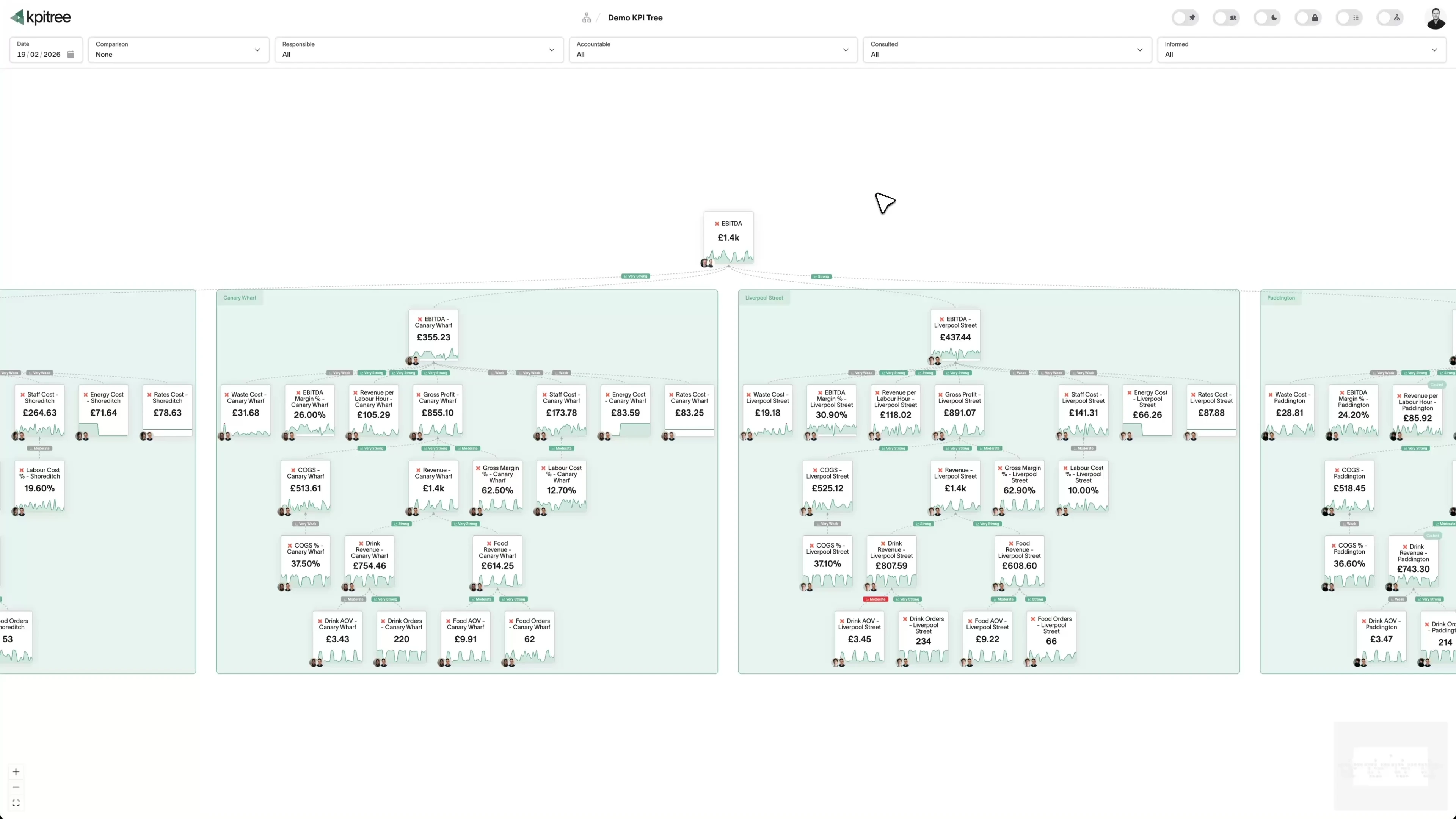
Every metric has a name on it. Accountability that runs itself.

RACI on every metric. Real reporting lines

Responsible, Accountable, Consulted and Informed on every node, current from your directory provider.

The system goes to the person. Not the other way round

The moment a metric moves, the named owner is notified with the driver attached, in Slack or wherever they work.

Escalates when nobody acts. Workflows built in

Approvals, tasks and escalation up the live org chart, so accountability holds at 2am on the last day of the quarter.

Scheduled delivery is a newsletter. This is an intervention.

Every tool can send a Monday-morning summary to a Slack channel; that is a scheduler, and it changes nothing. KPI Tree's push fires when the metric itself moves, on an outlier, a threshold cross, a silent metric or a missed period-close target, and it goes to the named Accountable owner, not a self-configured channel. It arrives within minutes via Slack, email, WhatsApp or SMS, with the driver edge that caused the movement attached. The trigger is the metric. The recipient is a person. That combination is the entire difference between delivery and accountability.

KPI Tree

KPI Tree app · 09:14

Revenue is 15% below target. Conversion rate is the primary driver (Granger-causal at lag 3d). @Sarah Chen you are Accountable.

View driversCreate task

RACI in depth: a single owner field is not accountability

Responsible, Accountable, Consulted and Informed on every node, with managers, teams and departments alongside, mirroring your real reporting lines and syncing from your directory provider. When someone leaves or moves team, the accountability moves with them, so ownership never goes stale. One click shows anyone's remit: the tree dims everything outside their responsibilities and zooms to what they own, so you see one person's world in the context of the whole system, and they see exactly what moves when they do.

RACI matrix loading

Workflows: accountability as a running process

Generic automation tools chain steps off a schedule or a webhook; they cannot notice a metric. KPI Tree's workflow triggers watch the metrics themselves: threshold crossings, outliers, silent metrics that stop updating (optionally counted in business hours only, so weekends do not bury weekday gaps), and end-of-period target misses with tolerance, alongside schedules and inbound webhooks when you want them. Steps chain AI agents, approvals, Slack messages, emails, tasks, delays and HTTP calls, with live metric data piped into every step. The result is a process that runs whether or not anyone remembers to check, which is what accountability means at 2am on the last day of the quarter.

Workflow builder loading

The system goes to the person. Not the other way around.

Approvals are first-class, with explicit reject branches, and escalation follows the org chart automatically: notify the manager, reassign up the reporting chain, auto-decline if nobody acts, with a live countdown at every stage. If someone is out, it climbs to their boss without anyone routing it. Every run is recorded with the exact path taken and the inputs and outputs of each step, so governance is automatic, auditable, and free of hardcoded names to maintain.

Outlier detectedNotify ownerApprovalEscalate to manager
Run #482 · Revenue outlierAwaiting approval

From insight to assigned tasks

An insight that ends as a chart is a dead end. Here, driver analysis becomes three tasks assigned to named owners, each linked to the metric it is meant to move, notified in Slack, and tracked on the board where its progress is visible. The link to the metric is the point: it is what makes the impact verifiable later.

Task tracking loading

Ask in Slack, answered from the same causal model

Mention KPI Tree in any Slack channel to ask how a metric is doing, what is driving a change, or who owns it. Answers arrive threaded, with charts posted into the channel and one-tap follow-ups, and every answer is grounded in the same tree, the same tested driver edges and the same RACI as every other surface, so Slack never becomes a second version of the truth. A per-workspace daily AI spend cap keeps cost predictable, and admins manage agents with a shared run history. Every answer is scoped to the asker's permissions: people see in Slack exactly what they can see in KPI Tree.

Emma #revenue
@kpitree what's driving the drop this week?

KPI Tree

KPI Tree app · 09:14

Conversion rate, down 23% (Granger-causal, lag 3d). David Mitchell is Responsible.

Subscriptions that know the owner

Recurring updates have a place, and here they have an address. Build pushed updates from blocks (metrics, tasks, agent output, text) with a live preview resolving real values, themed to your brand, delivered via Slack, email, WhatsApp or SMS. The difference from every other tool's digest is the routing: these go to the metric's named owner, while the metric-triggered pushes above do the urgent work.

Subscription delivery loading

Common questions

How are owners assigned?
Assign RACI per metric by hand, in bulk, or by job title through Workflows, with profiles syncing from your directory provider and managers, teams and departments mirroring your reporting structure. AI can suggest owners based on the tree.
Which channels are supported?
Slack, email, WhatsApp and SMS, and the Slack assistant answers questions conversationally in any channel.
Can we tune the escalation ladder?
Escalation steps, timings and fallbacks are configured per workflow, so the process matches how your organisation actually runs.
How is this different from alerts in our BI tool?
An alert tells a channel that a number crossed a line. This pushes the driver context to the named Accountable owner the moment the metric moves, escalates up the org chart if nothing happens, and tracks the action taken against the metric so the impact can be verified.
Does it replace our OKR tool?
No. Ownership and accountability run on the metrics themselves; your goal-setting cadence stays wherever it lives.

See it on your own metrics.