


 Monday.com Integration
Turn Monday.com board data into metric trees that connect team execution to measurable outcomes.
com gives every team a flexible workspace for managing work - boards, automations, dashboards. But boards show status, not causation.Monday.com gives every team a flexible workspace for managing work - boards, automations, dashboards. But boards show status, not causation. KPI Tree connects to Monday.com in three ways - pull data directly via MCP with no warehouse needed, connect your existing data warehouse where Monday.com data already lands, or let our professional services team build the AI foundations for you. Task throughput, on-time delivery, and automation effectiveness are modelled to show how they causally drive the business metrics your leadership team tracks. Move beyond "is it done?" to "did it matter?" - with ownership at the metric level, statistical analysis that validates process changes, and a closed loop from board activity to business result.
From Monday.com boards to causal metric trees in three steps
Connect your Monday.com data
Three ways to get started, depending on your stack.

Pull metrics from Monday.com directly through the Model Context Protocol.



Connect your existing warehouse where Monday.com data already lands.


Our professional services team can build you turn-key AI foundations in a matter of weeks. Data warehouse on Snowflake/BigQuery, ELT with Fivetran, all modelled in dbt with a semantic layer.
Map metrics from your Monday.com data
Define metrics from Monday.com tables - task completion rate, average item age, on-time delivery percentage, automation trigger count, board throughput by team, status transition time. Use SQL or sync from your dbt semantic layer.
Build trees and assign ownership
Arrange Monday.com metrics into causal trees alongside revenue, customer, and operational metrics. Assign RACI owners to each node. When on-time delivery drops or item age increases, the tree surfaces the business impact and the person accountable for the trend.
Board data that drives accountability, not just visibility
Causal trees from board activity to business results
Cross-board, cross-team metric visibility
Automation effectiveness measured against outcomes
On-time delivery as a leading indicator, not a retrospective.
- Track on-time delivery percentage as a trend with statistical baselines
- Model as a leading indicator of customer satisfaction and delivery commitments
- Decompose by team, board, and item type to find root causes
- RACI ownership assigns accountability before deadlines are missed
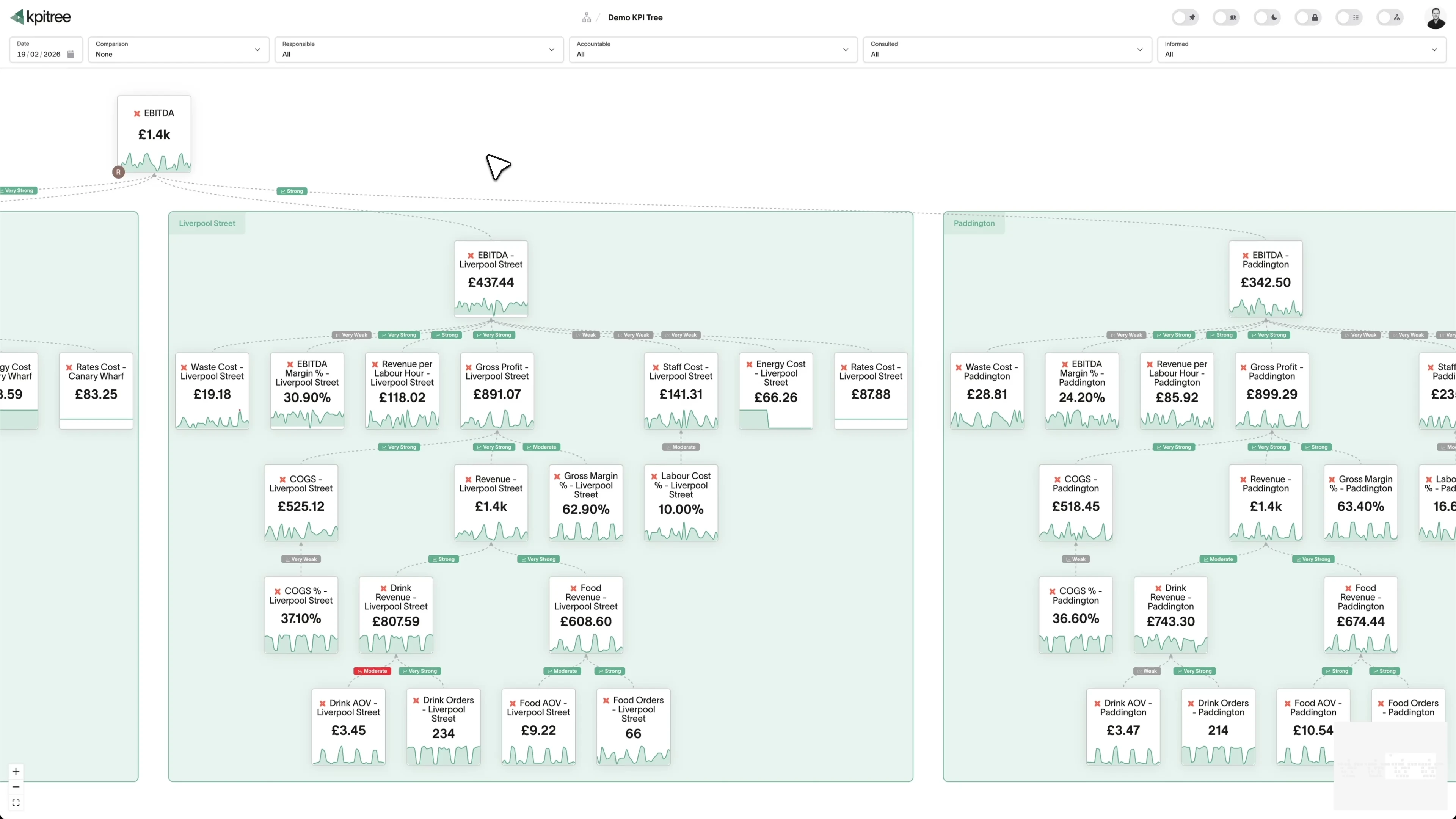
Team productivity measured by impact, not volume.
- Track throughput by team, board, and workspace alongside business outcomes
- Surface disconnects between activity volume and business impact
- Correlate team productivity trends with revenue, cost, and customer metrics
- Alert team leads when throughput-to-outcome ratios deteriorate
Cross-functional workflows connected end to end.
- Model multi-board, cross-team workflows as end-to-end metric trees
- Track stage-to-stage transition times and identify bottlenecks
- Alert downstream stage owners when upstream metrics slip
- Statistical analysis surfaces systemic bottlenecks across workflow runs
Board data enriched with revenue, product, and customer metrics.
- Unify Monday.com work data with revenue, product, and support metrics
- Model causal relationships across operational and commercial systems
- Statistical analysis validates whether work activity drives business outcomes
- Every metric has a RACI owner regardless of source system




How KPI Tree uses Monday.com data differently
Monday.com dashboards show work status and board-level analytics. KPI Tree adds causal structure, cross-system visibility, and statistical proof that connects board activity to the outcomes it is meant to drive.
Data warehouses
The numbers





Semantic layers
The definitions


Business apps
Launches, decisions, blockers




Org structure
Directory-synced




For humans
Answers, briefings and pushes
 @
@Read and write over MCP
Anthropic: 21% → ~95% with curated context



Canopy Agentic Workflows the metrics start them, humans gate them
Canopy Agents four out of the box, any model, your keys
Canopy
The business context layer
Structural context The causal tree, the org chart
Temporal context What was true when, plan against actual
Behavioural context What people did, what worked
Operational context RACI, workflows, approvals
Strategic context Objectives, key results, initiatives
Map & Measure
Metric Trees
Business Models
Prove & Act
Root Cause
Ownership
Verified Impact
Strategy
Grounded in proven causality
Verified proof
Meta spend → Revenue, +£32k vs forecast, q < 0.01
Personalised Action Plans 31 experiments running
hypothesis → a real person’s plan → measure the change
Causation the test cascade
ADF p 0.02 → Granger p 0.003 → q < 0.05, 87 of 1,204 survive
Correlation
22,791 pairs tested nightly, NPS – Churn r 0.71
Data warehouses
The numbers
Semantic layers
The definitions
Business apps
Launches, decisions, blockers
Org structure
Directory-synced
Causal structure, not board-level dashboards
Metric ownership across systems and teams
Statistical validation of process changes
Metrics you can track. Ready to add to your metric trees.
Board Activity Analysis
Work ManagementBoard Activity Analysis tracks the volume and patterns of activity across Monday boards, including item updates, status changes, comments, and file uploads. It identifies which boards are actively used and which have become dormant or underutilised.
View metricBoard Completion Velocity
Work ManagementBoard Completion Velocity = Items Completed / Time Period
Board Completion Velocity measures the rate at which items are moved to completed status across Monday boards over time. It provides a throughput baseline for each board that enables capacity planning and delivery forecasting.
View metricBottleneck Identification
Work ManagementBottleneck Identification analyses the flow of items through Monday board statuses to detect stages where work accumulates faster than it is processed. It measures queue depths, dwell times, and throughput at each workflow stage to pinpoint constraints.
View metricBurndown Analysis
Work ManagementBurndown Analysis tracks the remaining work on a Monday board or sprint over time, comparing actual progress against an ideal completion trajectory. It reveals whether teams are on track to finish their committed work within the planned timeframe.
View metricCollaboration Network Analysis
Work ManagementCollaboration Network Analysis maps the interactions between team members across Monday boards, items, and updates. It identifies collaboration clusters, information bridges, and isolated individuals to reveal how work actually flows through the organisation.
View metricColumn Status Distribution
Work ManagementColumn Status Distribution analyses the proportion of items in each status column across Monday boards. It tracks how distributions change over time and identifies columns where items accumulate, indicating potential workflow constraints or process issues.
View metricCross-Board Dependencies
Work ManagementCross-Board Dependencies tracks the linked items, mirror columns, and dependency relationships between different Monday boards. It quantifies how tightly coupled boards are and measures the impact of cross-board dependencies on delivery timelines.
View metricDashboard Utilisation Rate
Work ManagementDashboard Utilisation Rate measures how frequently Monday dashboards are accessed, which widgets are viewed, and which team members engage with reporting views. It evaluates whether the investment in creating dashboards is producing corresponding value through active use.
View metricItem Creation Rate
Work ManagementItem Creation Rate = New Items Created / Time Period
Item Creation Rate measures the volume of new items added to Monday boards over time. It tracks creation patterns by board, team, and item type to reveal demand trends and help teams anticipate upcoming workload changes.
View metricOverdue Item Rate
Work ManagementOverdue Item Rate = (Overdue Items / Total Items with Due Dates) × 100
Overdue Item Rate calculates the percentage of items on Monday boards that have exceeded their due date without being completed. It serves as a direct indicator of schedule slippage and team capacity alignment.
View metricPriority Distribution Analysis
Work ManagementPriority Distribution Analysis examines the proportion of Monday items at each priority level across boards and teams. It tracks distribution trends over time and identifies priority inflation, where too many items are marked as high or critical.
View metricProject Risk Assessment
Work ManagementProject Risk Assessment evaluates the risk profile of Monday projects by combining indicators such as overdue item rates, cross-board dependencies, resource constraints, and timeline adherence. It produces a risk score that enables proactive management of at-risk initiatives.
View metricProject Status Trend Analysis
Work ManagementProject Status Trend Analysis tracks how the overall status of Monday projects changes over time. It monitors status transitions such as on-track to at-risk, or at-risk to off-track, and identifies patterns in status deterioration and recovery.
View metricProject Timeline Adherence
Work ManagementTimeline Adherence = (On-Time Milestones / Total Milestones) × 100
Project Timeline Adherence measures the degree to which Monday projects follow their planned timelines. It compares milestone and deadline targets against actual delivery dates, producing a percentage that reflects scheduling accuracy.
View metricProject Velocity
Work ManagementProject Velocity = Items Completed / Time Period
Project Velocity measures the amount of work completed per time period across Monday projects. It provides a stable throughput baseline that enables delivery forecasting, capacity planning, and evidence-based sprint commitments.
View metricResource Utilisation Rate
Work ManagementResource Utilisation Rate = (Allocated Capacity / Available Capacity) × 100
Resource Utilisation Rate measures the proportion of available team capacity that is actively allocated to items across Monday boards. It compares assigned workload against available capacity to identify over-utilised and under-utilised team members.
View metricSprint Performance Metrics
Work ManagementSprint Performance Metrics provides a comprehensive evaluation of Monday sprint outcomes by combining commitment accuracy, velocity, completed versus carried-over items, and sprint goal achievement into a holistic performance assessment.
View metricSubitem Completion Ratio
Work ManagementSubitem Completion Ratio = (Completed Subitems / Total Subitems) × 100
Subitem Completion Ratio measures the proportion of subitems that are completed relative to the total number of subitems across Monday boards. It reflects both the granularity of task decomposition and the thoroughness of task execution.
View metricTag Usage Analysis
Work ManagementTag Usage Analysis examines how tags are applied across Monday items and boards. It measures tag adoption rates, identifies the most and least used tags, and detects inconsistencies such as duplicate or ambiguous tags that undermine cross-board reporting.
View metricTask Completion Rate
Work ManagementTask Completion Rate = (Items Completed / Total Items) × 100
Task Completion Rate measures the percentage of items on Monday boards that are moved to a completed status within a defined time period. It is the most fundamental throughput metric, reflecting how effectively teams execute against their planned work.
View metricTeam Productivity Trends
Work ManagementTeam Productivity Trends tracks the evolution of team output and efficiency metrics across Monday boards over time. It identifies improving or declining trajectories, seasonal patterns, and the impact of process changes on team performance.
View metricTeam Workload Distribution
Work ManagementTeam Workload Distribution analyses how items and effort are distributed across team members in Monday. It identifies imbalances where some individuals carry disproportionate loads, enabling fairer allocation and more resilient teams.
View metricUpdate Frequency Rate
Work ManagementUpdate Frequency Rate = Total Updates / Active Items / Time Period
Update Frequency Rate tracks how often items on Monday boards receive updates, comments, and status changes. It measures the cadence of communication and progress reporting across teams and projects.
View metricUser Engagement Score
Work ManagementUser Engagement Score quantifies how actively individuals engage with Monday by combining signals such as login frequency, board interactions, update creation, status changes, and feature utilisation into a normalised score.
View metricWorkspace Performance Comparison
Work ManagementWorkspace Performance Comparison benchmarks key performance metrics across different Monday workspaces within an organisation. It normalises for team size and work type to enable fair comparisons and identify top-performing workspaces whose practices can be shared.
View metricRelated integrations. More sources that work with KPI Tree.
Common questions
Can I track metrics across multiple Monday.com workspaces?
Yes. Monday.com customers almost always have several workspaces and hundreds of boards across operations, sales, HR, and delivery, and KPI Tree treats all of them as the same data surface. MCP connects to Monday.com GraphQL directly and reads across workspaces you authorise, so on-time delivery, board throughput, and status transition time roll up without any flattening step. If you already replicate Monday.com to a warehouse via Fivetran, Supabase, or a custom Airbyte job, KPI Tree will query those tables instead and keep your existing reporting untouched. Teams that want to start fresh can let our professional services team build the full stack, including dbt models that unify boards across workspaces into shared operational metrics.
What Monday.com metrics can I track?
Any metric derivable from your Monday.com warehouse tables: task completion rate, average item age, on-time delivery percentage, status transition time, automation trigger count, board throughput by team, items by status and priority, and more. If it is queryable in SQL, it can be a KPI Tree metric.
Does it work with all Monday.com plans?
It depends on your connection method. With MCP, KPI Tree connects to Monday.com directly - most plans work, though some advanced fields may require Pro or Enterprise. With a data warehouse connection, the plan you need depends on what your pipeline syncs. Our professional services team can advise on the best setup for your Monday.com plan.
How long does setup take?
With MCP, you can start pulling Monday.com data in minutes - no warehouse required. With an existing data warehouse, connecting KPI Tree takes under an hour. Professional services engagements typically take a few weeks to deliver a full data foundation.
Can I track metrics across multiple Monday.com boards?
Yes. Define metrics that aggregate data across boards - total throughput, cross-board on-time delivery, workspace-level cycle time - or track individual boards and model them as children of an organisation-wide metric. KPI Tree is designed for cross-board, cross-team visibility.
Can I combine Monday.com metrics with data from other tools?
Yes. Build metric trees that connect Monday.com work metrics with Salesforce revenue data, Stripe billing, HubSpot marketing performance, and any other source in your warehouse. KPI Tree models causal relationships across systems in a single tree.
Is my Monday.com data secure?
Yes, regardless of connection method. MCP connections use secure, scoped API access. Data warehouse connections use encrypted authentication (RSA key-pair for Snowflake, service accounts for BigQuery), and your existing warehouse security policies remain fully enforced. Data is processed in KPI Tree's engine and never stored in raw form.
Does KPI Tree replace Monday.com dashboards?
No. Monday.com dashboards are designed for day-to-day work management and board-level visibility. KPI Tree adds a different layer: causal metric trees that connect work execution across boards and systems to measurable business outcomes, with statistical analysis and RACI ownership. Teams typically use both.
Related guides. Frameworks and metrics in depth.
Connect Monday.com to KPI Tree via MCP, warehouse, or professional services.
Pull Monday.com data directly via MCP, connect your existing warehouse, or let our team build the foundations. Turn activity data into causal metric trees linking team throughput and on-time delivery to the business outcomes your leadership measures.










