


 Notion Integration
Turn Notion databases into metric trees that connect team execution to measurable results.
Notion is where your team organises everything - project trackers, sprint boards, OKR databases, product roadmaps. But a beautifully structured database is not the same as a performance model.Notion is where your team organises everything - project trackers, sprint boards, OKR databases, product roadmaps. But a beautifully structured database is not the same as a performance model. KPI Tree connects to Notion in three ways - pull data directly via MCP with no warehouse needed, connect your existing data warehouse where Notion data already lands, or let our professional services team build the AI foundations for you. Task completion rates, sprint velocity, project delivery timelines - each becomes a metric with an owner, a place in a causal hierarchy, and statistical monitoring that detects when something shifts. The documentation stays in Notion. The accountability lives in KPI Tree.
From Notion databases to causal metric trees in three steps
Connect your Notion data
Three ways to get started, depending on your stack.

Pull metrics from Notion directly through the Model Context Protocol.



Connect your existing warehouse where Notion data already lands.


Our professional services team can build you turn-key AI foundations in a matter of weeks. Data warehouse on Snowflake/BigQuery, ELT with Fivetran, all modelled in dbt with a semantic layer.
Map metrics from your Notion data
Define metrics from Notion database tables - task completion rate, project on-time delivery, sprint throughput, OKR progress, database item age, status transition times. Use SQL directly or sync from your dbt semantic layer if you model Notion data there.
Build trees and assign ownership
Arrange Notion-derived metrics into causal trees alongside revenue, customer, and product metrics. Assign RACI owners to each node. When project delivery slips or sprint throughput drops, the tree surfaces the business impact and identifies the accountable owner.
Structured data from Notion, structured accountability from KPI Tree
Database metrics organised into causal hierarchies
OKR and goal tracking connected to operational metrics
Alerts when Notion-tracked work metrics shift
Project databases turned into performance metrics.
- Transform database fields (status, dates, assignees) into trend metrics
- Track on-time delivery, item age, and throughput from Notion databases
- Statistical baselines detect when pace deviates from plan
- RACI ownership connects Notion database items to accountable people
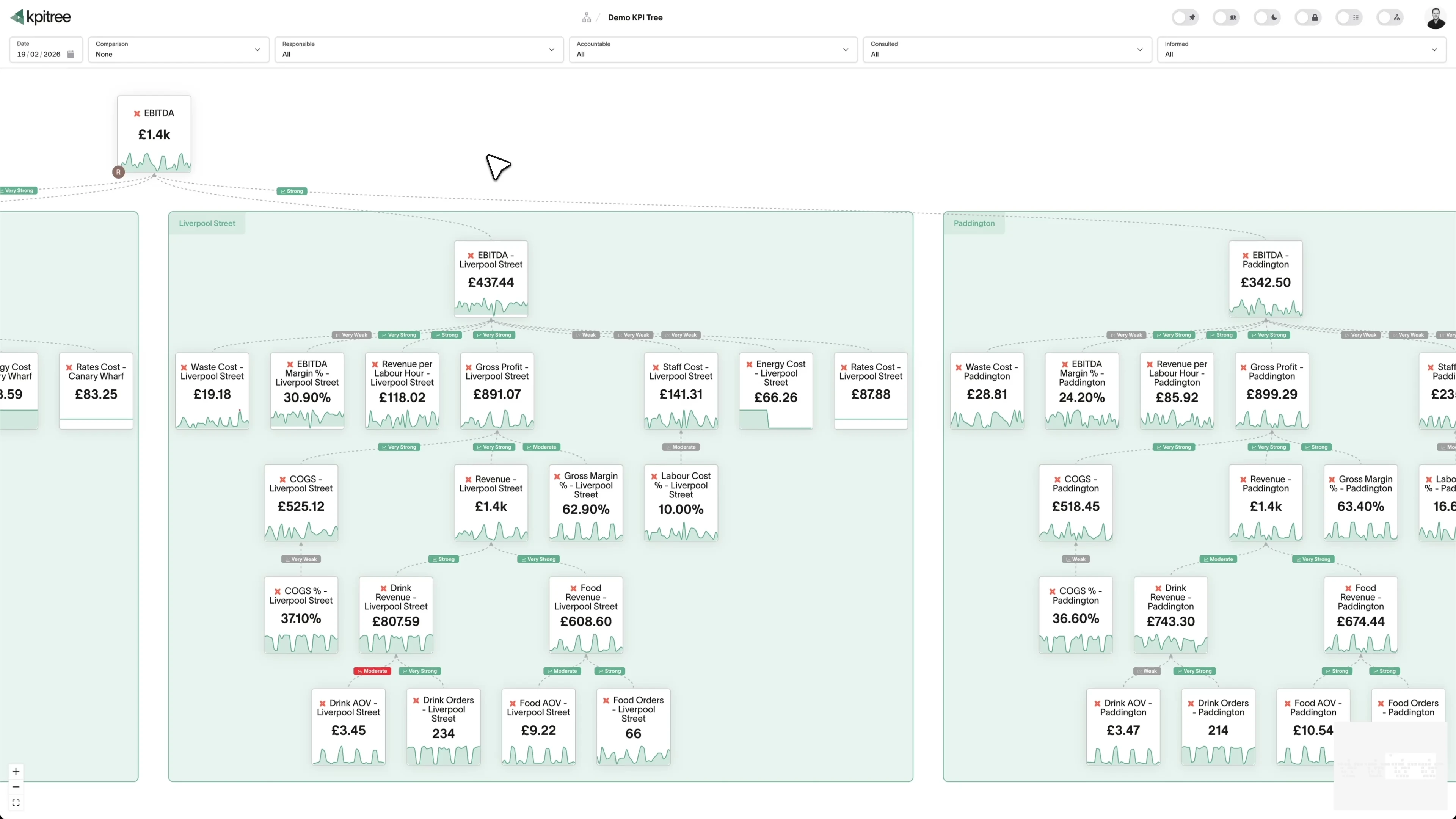
Sprint and task trackers with business outcome context.
- Connect sprint throughput to feature delivery and product adoption metrics
- Surface disconnects between task completion and business outcomes
- Correlate Notion-tracked velocity with revenue and customer metrics
- Alert owners when delivery is on track but business metrics are not
OKR databases connected to the metrics that move key results.
- Link Notion OKR database entries to contributing operational metrics
- Trace stalled key results to the specific sub-metrics causing the delay
- Assign RACI ownership at the contributing metric level
- Post-quarter analysis shows which contributing metrics drove (or blocked) attainment
Notion data enriched with metrics from across your stack.
- Combine Notion work metrics with Stripe, PostHog, Intercom, and Salesforce data
- Model causal relationships across documentation, execution, and commercial systems
- Statistical analysis validates whether Notion-tracked work drives outcomes
- Every metric has a RACI owner regardless of which tool generated the data




How KPI Tree uses Notion data differently
Notion organises information beautifully. KPI Tree takes the structured data in your Notion databases and adds the performance layer: causal analysis, statistical monitoring, and closed-loop ownership.
Data warehouses
The numbers





Semantic layers
The definitions


Business apps
Launches, decisions, blockers




Org structure
Directory-synced




For humans
Answers, briefings and pushes
 @
@Read and write over MCP
Anthropic: 21% → ~95% with curated context



Canopy Agentic Workflows the metrics start them, humans gate them
Canopy Agents four out of the box, any model, your keys
Canopy
The business context layer
Structural context The causal tree, the org chart
Temporal context What was true when, plan against actual
Behavioural context What people did, what worked
Operational context RACI, workflows, approvals
Strategic context Objectives, key results, initiatives
Map & Measure
Metric Trees
Business Models
Prove & Act
Root Cause
Ownership
Verified Impact
Strategy
Grounded in proven causality
Verified proof
Meta spend → Revenue, +£32k vs forecast, q < 0.01
Personalised Action Plans 31 experiments running
hypothesis → a real person’s plan → measure the change
Causation the test cascade
ADF p 0.02 → Granger p 0.003 → q < 0.05, 87 of 1,204 survive
Correlation
22,791 pairs tested nightly, NPS – Churn r 0.71
Data warehouses
The numbers
Semantic layers
The definitions
Business apps
Launches, decisions, blockers
Org structure
Directory-synced
Causal structure from flat databases
Statistical analysis Notion cannot provide
Metric-level accountability beyond database assignees
Metrics you can track. Ready to add to your metric trees.
Block Type Distribution
Knowledge ManagementBlock Type Distribution analyses the proportion of different block types, such as text, headings, images, code, callouts, and embeds, used across Notion pages. It reveals how richly content is structured and whether teams are leveraging Notion's full capabilities.
View metricCollaborative Editing Intensity
Knowledge ManagementCollaborative Editing Intensity measures the frequency and depth of multi-user editing on Notion pages. It tracks how often pages are edited by multiple contributors within short timeframes, indicating genuine real-time collaboration versus sequential individual work.
View metricComment Response Time
Knowledge ManagementComment Response Time = First Reply Timestamp − Original Comment Timestamp
Comment Response Time measures the average elapsed time between when a comment is posted on a Notion page and when it receives its first reply. It reflects the responsiveness of team communication within the knowledge management platform.
View metricContent Collaboration Analysis
Knowledge ManagementContent Collaboration Analysis examines the patterns of multi-author content creation in Notion. It tracks co-editing frequency, comment discussions, cross-team contributions, and the breadth of contributor networks to assess how collaborative knowledge creation truly is.
View metricContent Lifecycle Analysis
Knowledge ManagementContent Lifecycle Analysis tracks Notion pages through their lifecycle stages: creation, active editing, mature reference, and eventual staleness or archival. It measures how long content remains actively maintained and identifies the patterns that lead to content decay.
View metricContent Staleness Index
Knowledge ManagementContent Staleness Index quantifies the proportion of Notion content that has not been updated within an expected review period. It combines last-edit dates, page views, and content type to produce a staleness score that reflects how current the knowledge base is overall.
View metricContent Structure Optimisation
Knowledge ManagementContent Structure Optimisation evaluates how effectively Notion pages use structural elements such as headings, sub-pages, toggles, tables of contents, and callouts to organise information. Well-structured content is easier to navigate, scan, and maintain.
View metricCross-Database Relationship Mapping
Knowledge ManagementCross-Database Relationship Mapping analyses the network of relation properties connecting Notion databases. It maps how databases reference each other, identifies isolated databases that could benefit from relations, and evaluates the overall data architecture.
View metricDatabase Growth Rate
Knowledge ManagementDatabase Growth Rate = New Records Created / Time Period
Database Growth Rate measures the rate at which new records are added to Notion databases over time. It tracks creation velocity, identifies growth trends, and helps anticipate when databases may require restructuring or performance optimisation.
View metricDatabase Property Evolution
Knowledge ManagementDatabase Property Evolution tracks changes to Notion database schemas over time, including property additions, deletions, type changes, and naming conventions. It reveals how database structures mature and whether they are becoming more refined or more complex.
View metricDatabase Record Growth Rate
Knowledge ManagementRecord Growth Rate = (Records Created − Records Deleted) / Time Period
Database Record Growth Rate measures the net change in record count across Notion databases per time period. It accounts for both record creation and deletion to provide a true growth picture, helping teams anticipate database scaling needs.
View metricDatabase Utilisation Analysis
Knowledge ManagementDatabase Utilisation Analysis evaluates how actively Notion databases are used by examining metrics such as access frequency, property fill rates, view usage, and the ratio of records read to records created. It identifies well-utilised databases and those that may be abandoned or redundant.
View metricFile Attachment Rate
Knowledge ManagementFile Attachment Rate = Pages with Attachments / Total Pages × 100
File Attachment Rate measures the frequency at which files, images, and other media are attached to Notion pages and database records. It indicates whether teams are capturing supporting materials alongside their written documentation.
View metricPage Abandonment Rate
Knowledge ManagementAbandonment Rate = (Abandoned Pages / Total Pages Created) × 100
Page Abandonment Rate measures the percentage of Notion pages that are created but receive minimal subsequent editing or engagement. Abandoned pages typically have a single initial edit session followed by no further activity, indicating content that was started but never completed.
View metricPage Creation Rate
Knowledge ManagementPage Creation Rate = New Pages Created / Time Period
Page Creation Rate measures the volume of new pages created in Notion over time. It tracks creation patterns by workspace area, team, and page type to reveal how actively teams are documenting their work, decisions, and knowledge.
View metricPage Edit Frequency
Knowledge ManagementPage Edit Frequency = Total Edits / Time Period
Page Edit Frequency tracks how often Notion pages receive edits over time. It distinguishes between living documents that are regularly updated and static content that, once created, is rarely revisited. High-frequency edits indicate actively maintained content.
View metricRelation Usage Frequency
Knowledge ManagementRelation Usage = Records with Relations Populated / Total Records × 100
Relation Usage Frequency measures how often relation properties in Notion databases are populated with values. It indicates whether the relational data model is being actively utilised or whether relation fields exist but are largely empty.
View metricRollup Complexity Score
Knowledge ManagementRollup Complexity Score evaluates the depth and interconnection of rollup properties across Notion databases. It measures the number of chained rollups, their dependency depth, and the breadth of cross-database calculations to assess whether the data architecture is maintainable.
View metricTeam Productivity Patterns
Knowledge ManagementTeam Productivity Patterns analyses when and how teams create and edit content in Notion. It identifies peak productivity periods, workflow patterns, and the relationship between content creation activity and other business outcomes.
View metricTemplate Effectiveness Score
Knowledge ManagementTemplate Effectiveness Score evaluates how well Notion templates serve their intended purpose by measuring adoption rates, the quality of content produced from templates versus blank pages, and the completion rate of template sections. High scores indicate templates that genuinely improve content quality.
View metricTemplate Usage Rate
Knowledge ManagementTemplate Usage Rate = (Pages Created from Templates / Total New Pages) × 100
Template Usage Rate measures the proportion of new Notion pages created from templates versus blank pages. It reflects how well standardised content formats are adopted across the organisation and which templates are most and least used.
View metricUser Activity Score
Knowledge ManagementUser Activity Score quantifies how actively individuals engage with Notion by combining signals such as page views, edits, comments, database interactions, and content creation into a normalised activity score. It reflects both the breadth and depth of platform engagement.
View metricUser Adoption Funnel
Knowledge ManagementUser Adoption Funnel tracks how users progress through defined stages of Notion adoption, from initial login through basic usage, regular engagement, and advanced feature adoption. It identifies where users drop off and which adoption stages have the highest friction.
View metricUser Engagement Cohort Analysis
Knowledge ManagementUser Engagement Cohort Analysis groups Notion users by their join date and tracks engagement levels over time for each cohort. It reveals whether newer cohorts are engaging more or less than earlier ones and whether engagement sustains, grows, or declines after initial adoption.
View metricWorkspace Health Score
Knowledge ManagementWorkspace Health Score is a composite metric that combines content staleness, user adoption, database utilisation, template effectiveness, and structural quality into a single normalised score. It provides an at-a-glance assessment of overall Notion workspace wellbeing.
View metricRelated integrations. More sources that work with KPI Tree.

Common questions
Which Notion databases can I pull into KPI Tree?
Any database you grant access to. The unit in Notion is the database (not the workspace), so you decide whether KPI Tree sees your OKR tracker, sprint planning database, hiring pipeline, CRM, or all of them. MCP is the simplest path because it reads properties, rollups, and relations directly from Notion and you can add more databases over time by granting access in the Notion UI. If you already sync Notion databases to Snowflake, BigQuery, or Databricks via Fivetran, Hightouch, or a custom Supabase script, KPI Tree reads the warehouse tables in place. If you have not built a warehouse yet, our professional services team will set one up and model the Notion databases as dbt sources so the metrics become production-grade from day one.
What Notion metrics can I track?
Any metric derivable from your Notion warehouse tables: task completion rate, average item age, on-time delivery percentage, sprint throughput, OKR progress, status transition time, database item count by property, and more. If it is queryable in SQL, it can be a KPI Tree metric.
Which Notion databases can be synced?
With MCP, KPI Tree accesses any Notion database the integration has been granted permission to read. With a data warehouse connection, it depends on which databases your pipeline syncs - most sync all databases the Notion integration can access. Our professional services team can configure the full setup to cover all the databases you need.
How long does setup take?
With MCP, you can start pulling Notion data in minutes - no warehouse required. With an existing data warehouse, connecting KPI Tree takes under an hour. Professional services engagements typically take a few weeks to deliver a full data foundation.
Can I track OKRs from Notion in KPI Tree?
Yes. If you track OKRs in a Notion database, KPI Tree can define key result progress as a metric and connect it to the contributing operational metrics - task completion, feature delivery, sales activity - that drive attainment. When a key result stalls, the tree shows which contributing metric dropped.
Can I combine Notion metrics with data from other tools?
Yes. Build metric trees that connect Notion work metrics with Stripe revenue, PostHog product analytics, Salesforce pipeline data, and any other source in your warehouse. KPI Tree models causal relationships across systems in a single tree.
Is my Notion data secure?
Yes, regardless of connection method. MCP connections use secure, scoped API access. Data warehouse connections use encrypted authentication (RSA key-pair for Snowflake, service accounts for BigQuery), and your existing warehouse security policies remain fully enforced. Data is processed in KPI Tree's engine and never stored in raw form.
Does KPI Tree replace Notion for project management?
No. Notion remains your workspace for documentation, project tracking, and team collaboration. KPI Tree adds a separate layer: causal metric trees that connect the work tracked in Notion to measurable business outcomes, with statistical analysis and RACI ownership. Teams use both for different purposes.
Related guides. Frameworks and metrics in depth.
Connect Notion to KPI Tree via MCP, warehouse, or professional services.
Pull Notion data directly via MCP, connect your existing warehouse, or let our team build the foundations. Turn project data into causal metric trees linking task completion, sprint velocity, and OKR progress to the business results they exist to drive.










