


 GitHub Integration
Turn GitHub activity into an engineering performance system your whole organisation can read.
GitHub captures everything your engineering team does, pull requests, code reviews, CI/CD runs, deployments, incident responses.GitHub captures everything your engineering team does, pull requests, code reviews, CI/CD runs, deployments, incident responses. But that data sits in API logs and third-party dashboards, disconnected from the business outcomes it drives. KPI Tree consumes GitHub data through GitHub's own official MCP server (the reference implementation maintained by GitHub at github/github-mcp-server, one of the most mature vendor-shipped MCP servers in production), through your warehouse where GitHub data already lands via Fivetran or Airbyte, or through a professional services engagement that builds the pipeline for you. Once connected, KPI Tree maps it to metrics like cycle time, deployment frequency, and review throughput, then structures those metrics into causal trees that show exactly how engineering work drives product and revenue outcomes. DORA metrics stop being a reporting exercise and start being an accountability system.
From GitHub events to engineering performance trees
Connect your GitHub data
Three ways to get started, depending on your stack.

Pull metrics from GitHub directly through the Model Context Protocol.



Connect your existing warehouse where GitHub data already lands.


Our professional services team can build you turn-key AI foundations in a matter of weeks. Data warehouse on Snowflake/BigQuery, ELT with Fivetran, all modelled in dbt with a semantic layer.
Map GitHub metrics from your warehouse tables
Define metrics from your GitHub data using SQL or the metric builder: PR cycle time, deployment frequency, review turnaround, merge rates, CI pass rates, and more. Each metric gets a time grain, dimensions (repo, team, author), and a refresh schedule.
Build trees and assign ownership
Arrange GitHub metrics into causal trees - deployment frequency drives release velocity, which drives feature throughput. Assign RACI owners to every metric. When cycle time spikes, the right person is alerted with statistical context and a clear path to root cause.
Engineering metrics that connect to business outcomes
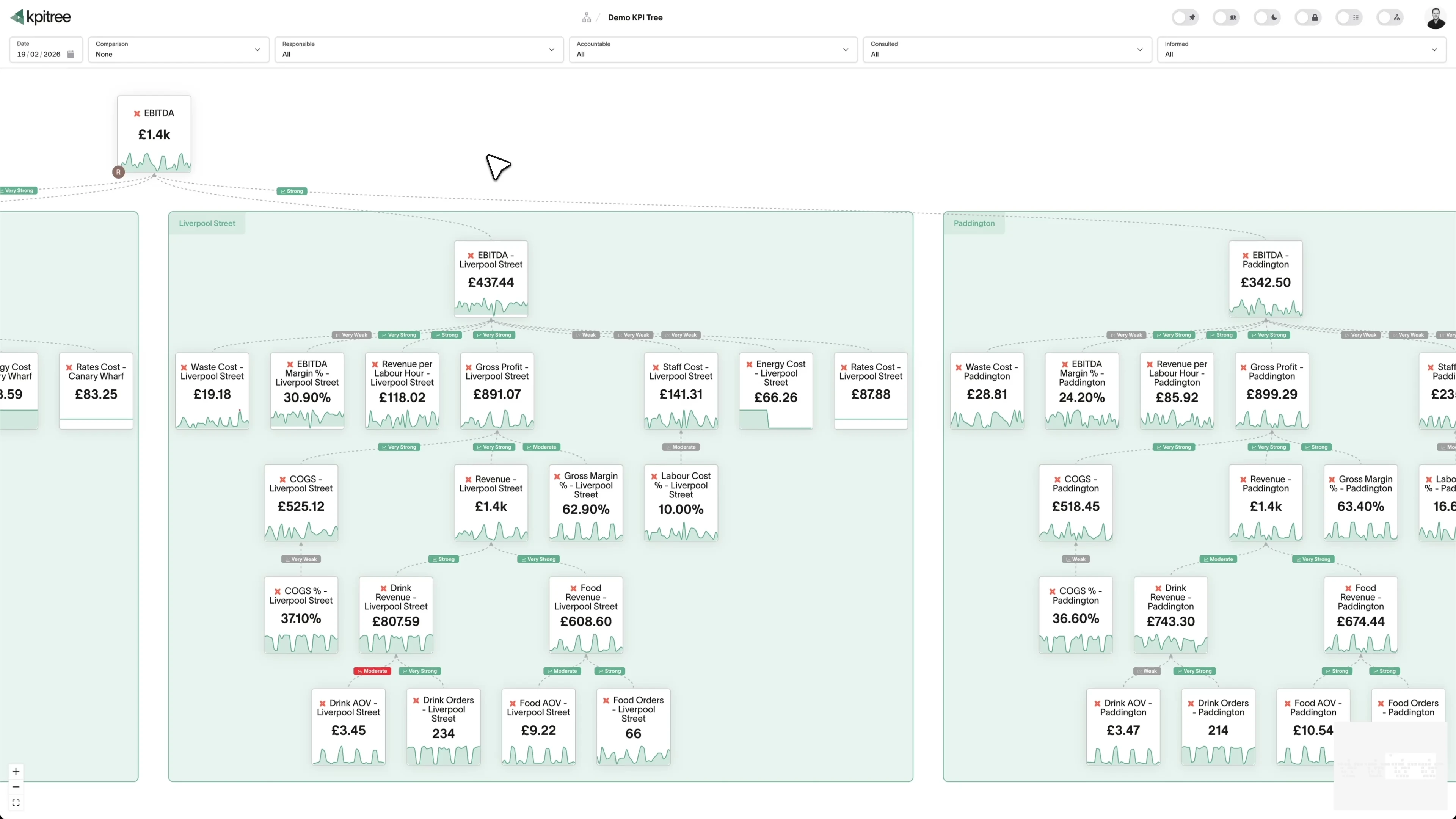
DORA metrics as a causal tree, not a dashboard
Statistical correlations between engineering and product metrics
Ownership at the metric level, not the repo level
DORA metrics that actually drive improvement.
- Deployment frequency, lead time, change failure rate, and MTTR as tree nodes
- Causal relationships show how DORA metrics drive each other
- Statistical outlier detection alerts owners before trends become crises
- Dimension breakdowns by team, repo, or service for targeted improvement
Code review health visible without chasing Slack threads.
- Review turnaround time, approval rate, and comment density as owned metrics
- Correlation analysis links review health to cycle time and defect rates
- Dimension breakdowns by reviewer, team, and repository
- Automated alerts when review queues exceed statistical thresholds
CI/CD pipeline performance tied to delivery outcomes.
- Workflow duration, pass rate, and flaky test frequency as owned metrics
- Causal trees link CI health to deployment frequency and release velocity
- Platform and product teams see shared accountability in a single view
- Historical trend analysis shows whether CI investments are paying off
Engineering investment aligned to business value.
- Engineering metrics connect upward to product and revenue KPIs in a single tree
- RACI ownership spans engineering, product, and executive stakeholders
- Quarterly business reviews use the same tree leadership sees daily
- MCP server and REST API expose engineering metrics to AI assistants and internal tools
How KPI Tree uses GitHub data differently
Engineering analytics tools visualise GitHub activity. KPI Tree connects that activity to business outcomes through causal structure, statistical analysis, and human ownership.
Data warehouses
The numbers





Semantic layers
The definitions


Business apps
Launches, decisions, blockers




Org structure
Directory-synced




For humans
Answers, briefings and pushes
 @
@Read and write over MCP
Anthropic: 21% → ~95% with curated context



Canopy Agentic Workflows the metrics start them, humans gate them
Canopy Agents four out of the box, any model, your keys
Canopy
The business context layer
Structural context The causal tree, the org chart
Temporal context What was true when, plan against actual
Behavioural context What people did, what worked
Operational context RACI, workflows, approvals
Strategic context Objectives, key results, initiatives
Map & Measure
Metric Trees
Business Models
Prove & Act
Root Cause
Ownership
Verified Impact
Strategy
Grounded in proven causality
Verified proof
Meta spend → Revenue, +£32k vs forecast, q < 0.01
Personalised Action Plans 31 experiments running
hypothesis → a real person’s plan → measure the change
Causation the test cascade
ADF p 0.02 → Granger p 0.003 → q < 0.05, 87 of 1,204 survive
Correlation
22,791 pairs tested nightly, NPS – Churn r 0.71
Data warehouses
The numbers
Semantic layers
The definitions
Business apps
Launches, decisions, blockers
Org structure
Directory-synced
Causal trees, not activity dashboards
Statistical proof that engineering work matters
Ownership that spans the org chart
Metrics you can track. Ready to add to your metric trees.
Branch Lifecycle Analysis
EngineeringBranch Lifecycle Analysis measures the duration from branch creation to merge or deletion across a repository. It surfaces stale or abandoned branches that inflate cognitive overhead and merge-conflict risk. Tracking this metric helps teams enforce hygiene policies and maintain a clean codebase.
View metricBug Fix Rate
EngineeringBug Fix Rate = Bugs Closed in Period / Total Open Bugs at Start of Period × 100
Bug Fix Rate measures the proportion of bug-labelled issues closed within a given period relative to the total number of open bugs. It reflects a team's capacity and prioritisation of quality work. A consistently low rate may signal under-investment in reliability.
View metricCode Churn Rate
EngineeringCode Churn Rate = Lines Re-changed Within N Days / Total Lines Changed × 100
Code Churn Rate quantifies the percentage of lines changed within a short window after their initial commit. High churn often indicates unclear requirements, premature coding, or inadequate design reviews. It is a proxy for wasted engineering effort.
View metricCode Coverage Trend
EngineeringCode Coverage = Lines Covered by Tests / Total Lines of Code × 100
Code Coverage Trend tracks the percentage of code exercised by automated tests over time, measured per commit or release. It highlights whether new code is being adequately tested and whether coverage is improving or regressing. Sustained downward trends signal growing risk.
View metricCode Quality Trend Analysis
EngineeringCode Quality Trend Analysis aggregates signals such as linting violations, cyclomatic complexity, code duplication, and static-analysis findings over time. It provides a longitudinal view of code health across repositories. Consistent improvement indicates maturing engineering practices.
View metricCode Review Quality Score
EngineeringCode Review Quality Score evaluates the substantiveness of pull request reviews by weighting factors such as comment depth, suggestions made, files reviewed versus files changed, and time spent. It distinguishes meaningful reviews from rubber-stamp approvals. Higher scores correlate with fewer post-merge defects.
View metricCode Review Velocity
EngineeringCode Review Velocity = Median(First Review Timestamp − PR Ready Timestamp)
Code Review Velocity measures the elapsed time from when a pull request is opened or marked ready for review to when the first substantive review is submitted. It is a key driver of lead time for changes. Long review waits are one of the most common causes of developer context-switching.
View metricCommit Frequency
EngineeringCommit Frequency = Total Commits / Time Period
Commit Frequency measures the number of commits pushed to a repository or across an organisation within a given time period. It serves as a high-level activity indicator and a proxy for continuous integration discipline. Consistently low frequency may indicate large, risky batch commits.
View metricDeployment Frequency
EngineeringDeployment Frequency = Number of Deployments / Time Period
Deployment Frequency measures how often an organisation successfully releases to production. It is one of the four DORA metrics and a key indicator of delivery maturity. Elite teams deploy on demand, multiple times per day, while low performers deploy monthly or less frequently.
View metricDeveloper Contribution Patterns
EngineeringDeveloper Contribution Patterns analyses how commits, reviews, and issue activity are distributed across team members over time. It highlights knowledge concentration, identifies potential bus-factor risks, and reveals whether workload distribution is healthy. Balanced contributions indicate resilient teams.
View metricDeveloper Productivity Score
EngineeringDeveloper Productivity Score is a composite metric that blends output indicators (commits, PRs merged), quality signals (review depth, test coverage), and collaboration measures (reviews given, discussions participated in). It provides a balanced view of developer effectiveness that avoids over-indexing on raw output.
View metricDevOps Pipeline Efficiency
EngineeringPipeline Efficiency = Successful Pipeline Runs / Total Pipeline Runs × 100
DevOps Pipeline Efficiency measures the speed, reliability, and resource utilisation of CI/CD pipelines. It encompasses build duration, test execution time, pipeline success rate, and queue wait time. Efficient pipelines accelerate feedback loops and reduce developer idle time.
View metricDiscussion Engagement Rate
EngineeringDiscussion Engagement Rate = Discussions with Responses / Total Discussions × 100
Discussion Engagement Rate measures the proportion of GitHub Discussions that receive replies, upvotes, or marked answers within a defined period. It reflects community health and the effectiveness of asynchronous knowledge-sharing. Low engagement may indicate poor discoverability or cultural barriers to participation.
View metricFeature Development Cycle Time
EngineeringCycle Time = Deployment Timestamp − First Feature Commit Timestamp
Feature Development Cycle Time measures the elapsed time from the first commit on a feature branch to successful deployment to production. It encompasses coding, review, testing, and release phases. Shorter cycle times enable faster user feedback and more responsive product development.
View metricIssue Resolution Time
EngineeringIssue Resolution Time = Issue Closed Timestamp − Issue Created Timestamp
Issue Resolution Time measures the elapsed time from when a GitHub issue is opened to when it is closed. It reflects team responsiveness, prioritisation effectiveness, and overall execution speed. Segmenting by label (bug, feature, chore) provides more actionable insights.
View metricLead Time for Changes
EngineeringLead Time = Production Deployment Timestamp − Commit Timestamp
Lead Time for Changes measures the elapsed time from when a code change is committed to when it is successfully running in production. It is one of the four DORA metrics and a key indicator of delivery pipeline efficiency. Elite performers achieve lead times measured in hours rather than days or weeks.
View metricOpen Source Contribution Analysis
EngineeringOpen Source Contribution Analysis tracks the volume, diversity, and quality of contributions to public repositories, including pull requests, issues, reviews, and discussions from external contributors. It measures community health and the effectiveness of open-source engagement strategies.
View metricPull Request Approval Rate
EngineeringPR Approval Rate = PRs Approved on First Review / Total PRs Reviewed × 100
Pull Request Approval Rate measures the percentage of pull requests that are approved without requiring changes on their first review cycle. A high rate indicates well-aligned coding standards, effective planning, and good communication between authors and reviewers.
View metricPull Request Bottleneck Analysis
EngineeringPull Request Bottleneck Analysis examines the stages of the PR lifecycle - authoring, review wait, review-in-progress, CI execution, and merge - to identify where delays accumulate. It transforms aggregate cycle time into an actionable breakdown that pinpoints specific process failures.
View metricRelease Velocity
EngineeringRelease Velocity = Number of Releases / Time Period
Release Velocity measures the frequency and speed at which new versions are tagged and published via GitHub Releases or deployment workflows. It encompasses the cadence of releases, the volume of changes per release, and the time between successive releases. Healthy velocity balances speed with stability.
View metricRepository Health Score
EngineeringRepository Health Score is a composite metric that evaluates key health indicators for a GitHub repository, including documentation completeness, test coverage, CI configuration, dependency freshness, branch protection rules, and recent maintenance activity. It provides a single number for comparing repository maturity across an organisation.
View metricSecurity Alert Resolution Time
EngineeringResolution Time = Alert Resolved Timestamp − Alert Created Timestamp
Security Alert Resolution Time measures the elapsed time from when a security alert (Dependabot, code scanning, or secret scanning) is opened to when it is resolved or dismissed in GitHub. It quantifies the organisation's responsiveness to known vulnerabilities and the effectiveness of its security remediation process.
View metricSecurity Vulnerability Trends
EngineeringSecurity Vulnerability Trends tracks the number, severity, and type of security vulnerabilities discovered across repositories over time. It encompasses Dependabot alerts, code scanning findings, and secret scanning detections. Improving trends indicate maturing security practices and proactive dependency management.
View metricSprint Velocity Tracking
EngineeringSprint Velocity = Sum of Story Points (or Issue Count) Completed in Sprint
Sprint Velocity Tracking measures the amount of work - typically in story points or issue count - completed during each sprint or iteration, as tracked through GitHub Projects. It provides a baseline for capacity planning and helps teams set realistic commitments for upcoming sprints.
View metricTeam Collaboration Index
EngineeringTeam Collaboration Index quantifies the degree of cross-functional and cross-team interaction on GitHub, including cross-team code reviews, co-authored commits, discussion participation, and issue triage across repository boundaries. It measures whether knowledge and responsibility are shared or siloed.
View metricTechnical Debt Accumulation
EngineeringTechnical Debt Accumulation measures the rate at which technical debt grows across a codebase, using proxies such as TODO/FIXME comment count, aged open issues labelled as tech-debt, increasing cyclomatic complexity, and dependency staleness. Rising accumulation signals that short-term trade-offs are compounding into long-term burden.
View metricRelated integrations. More sources that work with KPI Tree.
Common questions
How does GitHub data get into KPI Tree?
Through GitHub's own official MCP server at github/github-mcp-server. It is the reference implementation GitHub maintains, covering repositories, pull requests, issues, Actions, and code security. KPI Tree queries it over OAuth for the remote variant or a personal access token for the local one. If you have already replicated GitHub events to Snowflake, BigQuery, or another warehouse via Fivetran, Airbyte, or a custom GraphQL job, KPI Tree reads those tables instead so DORA breakdowns run against your governed copy. Teams without a warehouse engage our professional services team, which stands up the pipeline and ships a dbt semantic layer for engineering performance.
What GitHub metrics can I track?
Any metric you can derive from your GitHub warehouse tables: PR cycle time, deployment frequency, review turnaround, merge rates, CI pass rates, workflow duration, commit frequency, change failure rate, time to restore, and more. Metrics are defined with SQL or the metric builder and support dimensions like team, repo, and author.
Does this replace tools like LinearB or Sleuth?
KPI Tree solves a different problem. Engineering analytics tools visualise GitHub activity in isolation. KPI Tree connects engineering metrics to product and revenue outcomes in a causal tree with ownership. Many teams use both - an engineering analytics tool for developer-level detail, and KPI Tree for cross-functional accountability.
How long does setup take?
The MCP connection takes minutes - no warehouse required. If your GitHub data is already in a warehouse, connecting KPI Tree takes under an hour. If you need AI foundations built from scratch, our professional services team handles the setup end to end. Most teams have a working DORA metric tree within a single session.
Can I track DORA metrics with this integration?
Yes. Deployment frequency, lead time for changes, change failure rate, and time to restore service can all be defined as metrics from your GitHub warehouse tables. KPI Tree adds what DORA dashboards lack: causal relationships between the four metrics, ownership at each level, and statistical alerts when any metric degrades.
Is my source code exposed to KPI Tree?
No. Whether you connect via MCP or a data warehouse, KPI Tree reads aggregate metrics - not source code, file contents, or commit diffs. It works with metadata like PR counts, timestamps, and workflow statuses, not code.
Can I break metrics down by team or repository?
Yes. Metrics support dimensions like team, repository, author, and workflow name. You can create dimension breakdowns that auto-generate child metrics - "Cycle Time (Team: Platform)", "Cycle Time (Team: Product)" - each with its own owner and alerts.
Does KPI Tree support GitHub Enterprise?
Yes. The MCP connection works with any GitHub plan, including Enterprise. If you use the data warehouse route, KPI Tree reads from your warehouse tables regardless of the GitHub plan or hosting model. Our professional services team can also set up pipelines for Enterprise environments.
Related guides. Frameworks and metrics in depth.
Your GitHub data already tells the story. Make sure your team reads it.
Connect your warehouse to KPI Tree and turn GitHub activity into an engineering performance system with causal metric trees, RACI ownership, and statistical analysis that ties engineering work to business outcomes.










