


 Linear Integration
Turn Linear's velocity data into metric trees that prove engineering drives business outcomes.
Linear gives engineering teams the fastest issue tracker on the market. But speed of execution only matters if it connects to what the business needs.Linear gives engineering teams the fastest issue tracker on the market. But speed of execution only matters if it connects to what the business needs. KPI Tree connects to Linear in three ways - pull data directly via MCP with no warehouse needed, connect your existing data warehouse where Linear data already lands, or let our professional services team build the AI foundations for you. Cycle time, throughput, and project completion are modelled to show how they causally drive product velocity, customer adoption, and revenue growth. Assign metric-level ownership that persists beyond individual cycles. Run correlations between engineering cadence and business KPIs. Make the case for engineering investment with data, not anecdotes.
From Linear data to business-connected metrics in three steps
Connect your Linear data
Three ways to get started, depending on your stack.

Pull metrics from Linear directly through the Model Context Protocol.



Connect your existing warehouse where Linear data already lands.


Our professional services team can build you turn-key AI foundations in a matter of weeks. Data warehouse on Snowflake/BigQuery, ELT with Fivetran, all modelled in dbt with a semantic layer.
Map metrics from your Linear data
Define metrics from Linear tables - cycle time, lead time, throughput per team, project completion rate, bug resolution time, estimate accuracy, triage-to-start time. Use SQL directly or sync from your dbt semantic layer.
Build trees and assign ownership
Arrange Linear metrics into causal trees alongside product, revenue, and customer metrics. Assign RACI owners to each node. When cycle time creeps up or throughput drops, the tree shows the downstream business impact and the owner accountable for the trend.
Linear's speed, connected to the metrics that matter
Cycle time as a competitive advantage metric
Project-level metrics connected to company-level goals
Team-level analytics with cross-team correlation
Cycle time decomposition that finds the real bottleneck.
- Decompose cycle time into triage, development, review, and deployment phases
- Model each phase as a child metric with its own owner
- Statistical anomaly detection flags when any phase breaks its baseline
- Correlate phase durations with downstream delivery and business metrics
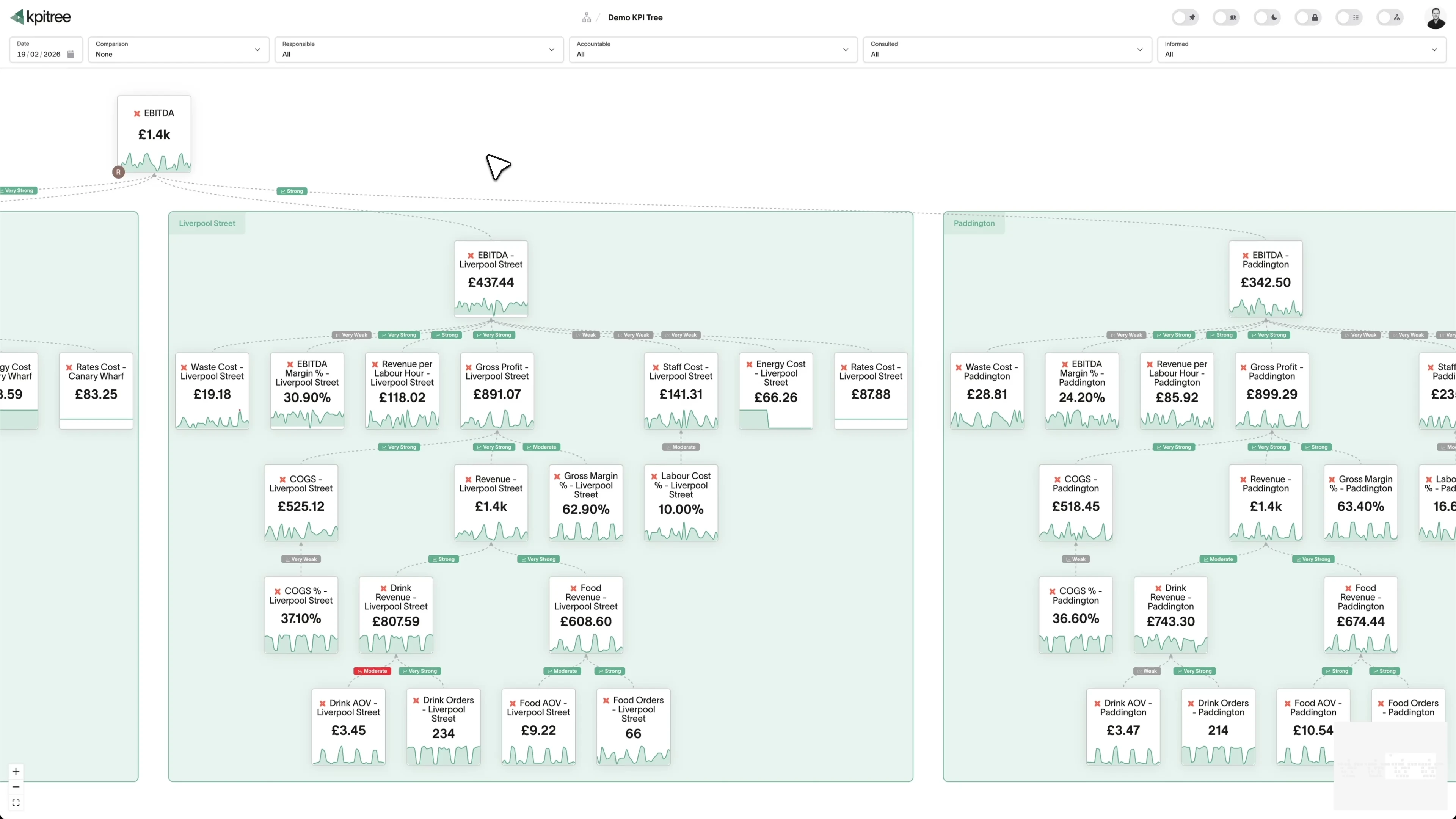
Throughput that tells a story beyond issues closed.
- Track throughput by team, project, label, and priority
- Model throughput drivers: capacity, complexity, dependencies, and scope
- Correlate throughput trends with product release cadence
- Quantify the business value of throughput improvements
Estimate accuracy as a planning reliability metric.
- Track estimate vs. actual across teams, projects, and issue types
- Model accuracy as a driver of delivery predictability and planning quality
- Surface systematic estimation biases with trend analysis
- Alert team leads when accuracy drops below acceptable thresholds
Engineering metrics unified with the rest of the business.
- Combine Linear metrics with Stripe, PostHog, Salesforce, and support data
- Model causal relationships across engineering, product, and commercial teams
- Statistical analysis confirms or disproves assumed cross-functional causation
- Every metric has a RACI owner regardless of which system generated it




How KPI Tree uses Linear data differently
Linear reporting features optimise engineering workflow. KPI Tree connects engineering workflow to the business outcomes that justify the team's existence.
Data warehouses
The numbers





Semantic layers
The definitions


Business apps
Launches, decisions, blockers




Org structure
Directory-synced




For humans
Answers, briefings and pushes
 @
@Read and write over MCP
Anthropic: 21% → ~95% with curated context



Canopy Agentic Workflows the metrics start them, humans gate them
Canopy Agents four out of the box, any model, your keys
Canopy
The business context layer
Structural context The causal tree, the org chart
Temporal context What was true when, plan against actual
Behavioural context What people did, what worked
Operational context RACI, workflows, approvals
Strategic context Objectives, key results, initiatives
Map & Measure
Metric Trees
Business Models
Prove & Act
Root Cause
Ownership
Verified Impact
Strategy
Grounded in proven causality
Verified proof
Meta spend → Revenue, +£32k vs forecast, q < 0.01
Personalised Action Plans 31 experiments running
hypothesis → a real person’s plan → measure the change
Causation the test cascade
ADF p 0.02 → Granger p 0.003 → q < 0.05, 87 of 1,204 survive
Correlation
22,791 pairs tested nightly, NPS – Churn r 0.71
Data warehouses
The numbers
Semantic layers
The definitions
Business apps
Launches, decisions, blockers
Org structure
Directory-synced
Outcome-connected, not process-optimised
Metric ownership that scales beyond one team
Cross-system correlations that validate engineering ROI
Metrics you can track. Ready to add to your metric trees.
Bug Escape Rate
Issue TrackingBug Escape Rate = (Production Bugs / Total Bugs Found) × 100
Bug Escape Rate measures the percentage of bugs that are discovered in production rather than caught during development or QA stages in Linear. It quantifies the effectiveness of pre-release quality gates and testing processes.
View metricCode Review Bottleneck Analysis
Issue TrackingCode Review Bottleneck Analysis examines the time Linear issues spend waiting for or undergoing code review. It identifies reviewer capacity constraints, uneven review distribution, and workflow states where issues accumulate, slowing overall delivery throughput.
View metricComment Collaboration Rate
Issue TrackingComment Collaboration Rate tracks the volume and distribution of comments on Linear issues, measuring how actively team members engage in discussions, share context, and collaborate on solutions. It distinguishes between meaningful collaboration and minimal status updates.
View metricCross-Team Dependency Impact
Issue TrackingCross-Team Dependency Impact measures how dependencies between Linear teams affect delivery timelines. It quantifies the additional cycle time, blocked time, and coordination overhead caused by cross-team handoffs and blockers.
View metricCycle Burndown Rate
Issue TrackingCycle Burndown Rate tracks the rate at which remaining work decreases during a Linear cycle. It compares the actual burndown trajectory against the ideal straight-line path, revealing whether the team is on pace to complete their cycle commitment.
View metricCycle Commitment Accuracy
Issue TrackingCommitment Accuracy = (Completed Committed Issues / Total Committed Issues) × 100
Cycle Commitment Accuracy measures the percentage of issues committed at the start of a Linear cycle that are completed by cycle end. It excludes work added mid-cycle to provide a clean measure of planning accuracy.
View metricDeveloper Workload Balance
Issue TrackingDeveloper Workload Balance analyses the distribution of assigned issues, estimated effort, and active work across team members in Linear. It identifies imbalances where some developers carry disproportionate loads while others have available capacity.
View metricEpic Completion Forecasting
Issue TrackingEpic Completion Forecasting uses historical team velocity data and remaining scope to predict when Linear projects and epics will be completed. It applies probabilistic models to provide a range of likely completion dates rather than a single point estimate.
View metricFeature Delivery Cycle Time
Issue TrackingFeature Delivery Cycle Time = Delivery Date − Development Start Date
Feature Delivery Cycle Time measures the total elapsed time from when work begins on a feature in Linear to when it is delivered. It captures the full pipeline duration including development, review, testing, and deployment stages.
View metricIntegration Impact Analysis
Issue TrackingIntegration Impact Analysis evaluates how connected tools and integrations with Linear affect team workflows, productivity, and data quality. It measures the volume and value of automated actions, synced data, and cross-tool workflows.
View metricIssue Aging Analysis
Issue TrackingIssue Aging Analysis examines the age profile of open issues in Linear, categorising them into brackets to reveal how much of the backlog is recent versus stale. It tracks aging trends over time and identifies patterns in which issue types age fastest.
View metricIssue Priority Distribution Analysis
Issue TrackingIssue Priority Distribution Analysis examines the proportion of Linear issues at each priority level over time. It detects priority inflation, where too many issues are marked urgent or high, and identifies whether prioritisation practices are producing a workable distribution.
View metricIssue Reopening Rate
Issue TrackingReopening Rate = (Reopened Issues / Total Completed Issues) × 100
Issue Reopening Rate measures the percentage of Linear issues that are moved back to an active state after being marked as done. It serves as a quality indicator, reflecting whether work is genuinely complete when marked as such.
View metricIssue Resolution Time
Issue TrackingResolution Time = Issue Resolved Date − Issue Created Date
Issue Resolution Time measures the total elapsed time from when a Linear issue is created to when it is resolved. It encompasses both waiting time and active work time, providing a full lifecycle view of how long issues take to address.
View metricLabel Work Classification Analysis
Issue TrackingLabel Work Classification Analysis examines how Linear labels are used to categorise work into types such as features, bugs, improvements, and maintenance. It measures the distribution of effort across work categories and the consistency of labelling practices.
View metricMilestone Delivery Predictability
Issue TrackingMilestone Delivery Predictability measures the consistency with which Linear milestones and projects are delivered within their target dates. It tracks the variance between planned and actual delivery across milestones to assess organisational forecasting reliability.
View metricProject Health Score
Issue TrackingProject Health Score is a composite metric that combines multiple Linear project indicators, such as issue completion progress, velocity trends, reopening rates, and milestone adherence, into a single normalised score for at-a-glance project assessment.
View metricRoadmap Progress Tracking
Issue TrackingRoadmap Progress Tracking monitors the advancement of strategic initiatives on the Linear roadmap by aggregating progress across constituent projects and milestones. It provides a high-level view of whether the organisation is executing against its planned direction.
View metricSeasonal Development Patterns
Issue TrackingSeasonal Development Patterns identifies recurring cyclical trends in Linear development activity, such as productivity dips during holiday periods, velocity surges before major releases, or reduced throughput during hiring seasons. It helps teams anticipate and plan for predictable capacity fluctuations.
View metricTeam Capacity Utilisation
Issue TrackingCapacity Utilisation = (Allocated Estimate Points / Available Capacity) × 100
Team Capacity Utilisation measures the proportion of available team capacity that is actively allocated to Linear issues. It compares the total estimated work assigned to the team against their available capacity, accounting for team size and any known availability constraints.
View metricTeam Velocity Analysis
Issue TrackingVelocity = Total Estimate Points Completed per Cycle
Team Velocity Analysis measures and analyses the amount of work completed per cycle by Linear teams. It tracks velocity trends, variability, and the factors that influence throughput to provide a reliable basis for capacity planning and delivery forecasting.
View metricTechnical Debt Accumulation Rate
Issue TrackingAccumulation Rate = Debt Issues Created − Debt Issues Resolved (per period)
Technical Debt Accumulation Rate measures the net change in technical debt issues in Linear over time. It compares the rate at which new debt issues are created against the rate at which existing debt is resolved, indicating whether overall debt levels are growing or shrinking.
View metricUser Story Size Consistency
Issue TrackingUser Story Size Consistency analyses the distribution and variance of issue size estimates in Linear. It measures whether teams consistently break work into similarly sized pieces and identifies patterns of oversized or undersized stories that affect planning accuracy.
View metricWorkflow State Transition Analysis
Issue TrackingWorkflow State Transition Analysis examines how issues move through Linear workflow states, including forward progress, backwards transitions, and time spent in each state. It identifies the most common transition paths, bottleneck states, and unexpected backflows that indicate process problems.
View metricRelated integrations. More sources that work with KPI Tree.
Common questions
How quickly can I see Linear cycle metrics in KPI Tree?
With MCP the answer is usually the same afternoon. KPI Tree queries your Linear workspace directly, so issues, cycles, projects, and labels become metric tree nodes without you building a pipeline first. If your team has already replicated Linear to a warehouse via Fivetran, Airbyte, or a GraphQL sync script, KPI Tree connects to that warehouse instead and reads the tables in place, which is the right choice for any Linear workspace with more than a few thousand issues per month. If you want the warehouse built from scratch around Linear as the source of truth, our professional services team delivers the full setup, including dbt models for cycle time, throughput, and estimate accuracy, as a fixed-scope engagement.
What Linear metrics can I track?
Any metric derivable from your Linear warehouse tables: cycle time, lead time, throughput, project completion rate, bug resolution time, estimate accuracy, triage-to-start time, issues by priority and label, team-level velocity, and more. If it is queryable in SQL, it can be a KPI Tree metric.
Does it work with Linear's native analytics?
They serve different purposes. Linear's built-in analytics focus on sprint and cycle-level engineering workflow. KPI Tree adds the business context layer: causal trees, cross-system correlations, RACI ownership, and statistical analysis that connects engineering metrics to company-level outcomes. Teams use both.
How long does setup take?
With MCP, you can start pulling Linear data in minutes - no warehouse required. With an existing data warehouse, connecting KPI Tree takes under an hour. Teams running dbt on their Linear data can sync metric definitions in one click. Professional services engagements typically take a few weeks to deliver a full data foundation.
Can I combine Linear metrics with data from other tools?
Yes. Build metric trees that connect Linear engineering metrics with GitHub deployment data, PostHog product analytics, Stripe revenue data, and Intercom customer feedback. KPI Tree models causal relationships across all of them in a single tree.
Is my Linear data secure?
Yes, regardless of connection method. MCP connections use secure, scoped API access. Data warehouse connections use encrypted authentication (RSA key-pair for Snowflake, service accounts for BigQuery), and your existing warehouse security policies remain fully enforced. Data is processed in KPI Tree's engine and never stored in raw form.
Can I track metrics per Linear team?
Yes. Define team-scoped metrics - cycle time for Team A, throughput for Team B - and model them as children of an organisation-wide metric. Run cross-team correlations to surface dependencies and bottlenecks that are invisible within a single team's Linear view.
Does KPI Tree support Linear projects and initiatives?
Yes. Model project-level metrics (completion rate, delivery vs. estimate, scope change) alongside the business KPIs each project targets. After delivery, KPI Tree's change detection verifies whether the project actually moved the intended metric.
Related guides. Frameworks and metrics in depth.
Connect Linear to KPI Tree via MCP, warehouse, or professional services.
Pull Linear data directly via MCP, connect your existing warehouse, or let our team build the foundations. Turn issue data into causal metric trees linking engineering cycle time and throughput to product outcomes and revenue.










