

 Granola Integration
Turn meeting data into a productivity system that proves which meetings actually drive outcomes.
Granola captures meeting transcripts, action items, decisions, and follow-ups with AI-powered accuracy.Granola captures meeting transcripts, action items, decisions, and follow-ups with AI-powered accuracy. But meeting data stuck inside a note-taking tool cannot show whether meetings are driving business outcomes or consuming time without impact. KPI Tree connects to your data warehouse where Granola data lands, maps it to metrics like meeting frequency, decision velocity, action item completion rate, and follow-up latency, then structures those metrics into causal trees that tie meeting health to team productivity and revenue. Every organisation suspects some meetings are unnecessary. Now you can prove which ones drive results and which ones do not.
From warehouse to meeting effectiveness tree in under an hour
Connect your Granola data
Two ways to get started, depending on your stack.



Connect your existing warehouse where Granola data already lands.


Our professional services team can build you turn-key AI foundations in a matter of weeks. Data warehouse on Snowflake/BigQuery, ELT with Fivetran, all modelled in dbt with a semantic layer.
Map meeting metrics from your warehouse tables
Define metrics from your Granola data using SQL or the metric builder: meeting frequency, average duration, action items generated per meeting, action item completion rate, decision count, follow-up latency, and more. Each metric supports dimensions like team, meeting type, and participant count.
Build trees and assign ownership
Arrange meeting metrics into causal trees - action item completion drives project velocity, decision throughput drives alignment, meeting load drives available focus time. Assign RACI owners so team leads and chiefs of staff own the meeting health metrics for their scope.
Meeting metrics that connect to the outcomes meetings are supposed to produce
Causal trees from meeting activity to business velocity
Decision velocity as a measurable, owned metric
Action item completion that closes the loop
Meeting load visible alongside the outcomes it produces.
- Meeting frequency, duration, and total participant hours as owned metrics
- Causal trees link meeting load to productivity outcomes and focus time
- Dimension breakdowns by team, meeting type, and recurring vs. ad-hoc
- Statistical correlations quantify whether fewer meetings mean more output
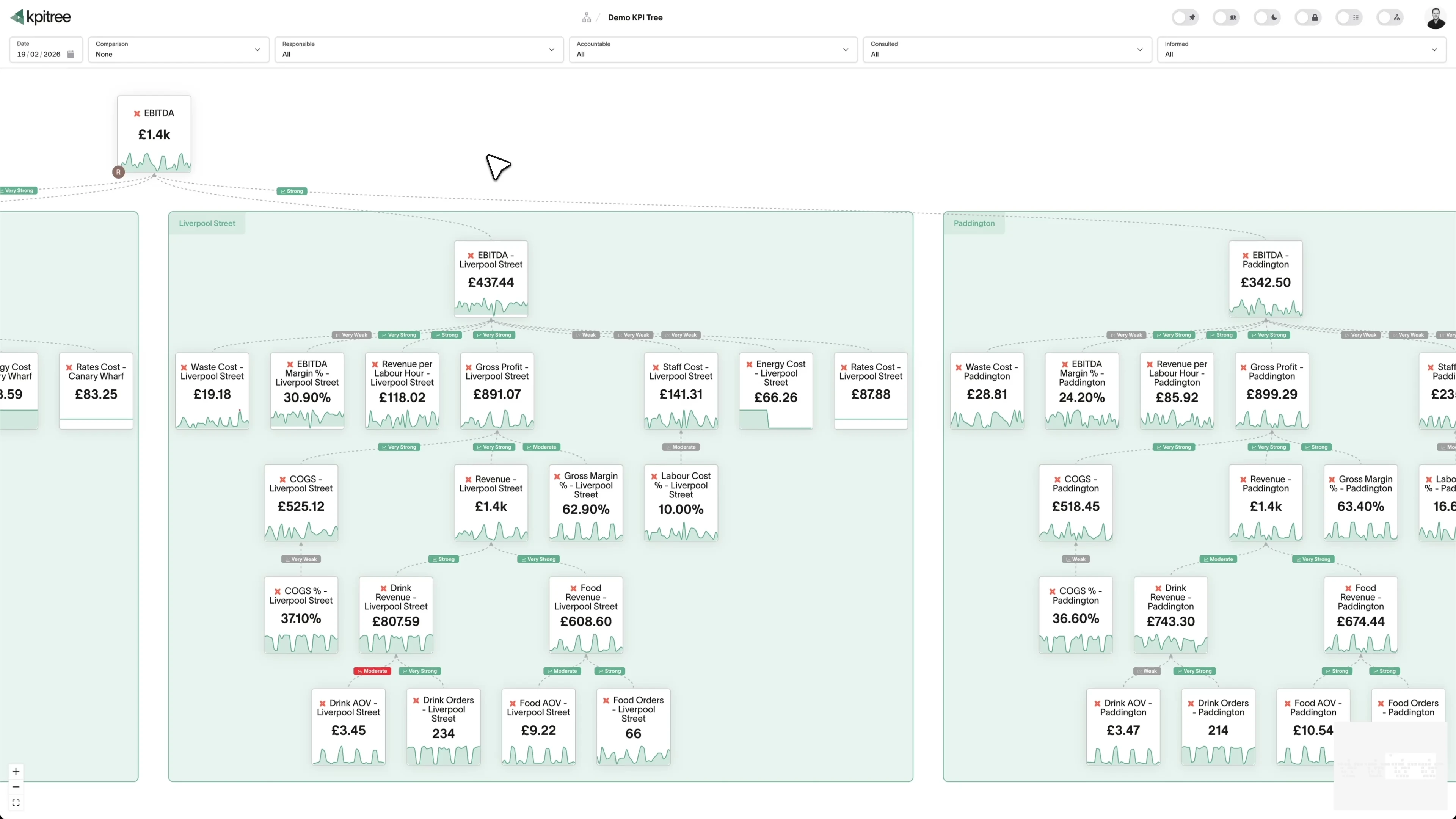
Decision velocity tracked from transcript to outcome.
- Decisions per meeting, time-to-decision, and decision follow-through as metrics
- Trend analysis shows whether decision velocity is improving or degrading
- Correlation engine links decision velocity to project delivery and revenue
- Ownership assigned to chiefs of staff, team leads, or programme managers
Action item completion that predicts project health.
- Action item completion rate, time-to-completion, and overdue frequency tracked
- Causal trees connect action item health to project delivery metrics
- Dimension breakdowns by team, meeting type, and assignee
- Automated alerts when action item backlogs cross statistical thresholds
Meeting culture measured, not debated.
- Recurring meeting efficiency and participant-to-decision ratios as metrics
- Cross-functional meeting frequency shows alignment investment
- Meeting-free focus time tracked as a productivity leading indicator
- Before-and-after measurement for meeting culture initiatives
How KPI Tree uses Granola data differently
Granola excels at capturing meeting content with AI. KPI Tree connects that content to business outcomes through causal structure, statistical analysis, and organisational accountability.
Data warehouses
The numbers





Semantic layers
The definitions


Business apps
Launches, decisions, blockers




Org structure
Directory-synced




For humans
Answers, briefings and pushes
 @
@Read and write over MCP
Anthropic: 21% → ~95% with curated context



Canopy Agentic Workflows the metrics start them, humans gate them
Canopy Agents four out of the box, any model, your keys
Canopy
The business context layer
Structural context The causal tree, the org chart
Temporal context What was true when, plan against actual
Behavioural context What people did, what worked
Operational context RACI, workflows, approvals
Strategic context Objectives, key results, initiatives
Map & Measure
Metric Trees
Business Models
Prove & Act
Root Cause
Ownership
Verified Impact
Strategy
Grounded in proven causality
Verified proof
Meta spend → Revenue, +£32k vs forecast, q < 0.01
Personalised Action Plans 31 experiments running
hypothesis → a real person’s plan → measure the change
Causation the test cascade
ADF p 0.02 → Granger p 0.003 → q < 0.05, 87 of 1,204 survive
Correlation
22,791 pairs tested nightly, NPS – Churn r 0.71
Data warehouses
The numbers
Semantic layers
The definitions
Business apps
Launches, decisions, blockers
Org structure
Directory-synced
Meeting metrics as part of the productivity tree
Decision velocity as a first-class metric
Accountability for meeting culture
Metrics you can track. Ready to add to your metric trees.
Action Item Completion Rate
Meeting IntelligenceCompletion Rate = Completed Action Items / Total Action Items Assigned × 100
Action Item Completion Rate measures the percentage of action items captured during Granola-recorded meetings that are completed within their assigned timeframe. It is the most direct measure of whether meetings produce results or merely consume time.
View metricAction Item Distribution Balance
Meeting IntelligenceAction Item Distribution Balance measures how evenly meeting action items are distributed across team members. It identifies individuals who consistently receive a disproportionate share of action items, creating bottleneck and burnout risk, versus those who rarely take on commitments.
View metricAction Item Velocity
Meeting IntelligenceAction Item Velocity = Average(Completion Timestamp − Assignment Timestamp)
Action Item Velocity measures the average time from when an action item is assigned in a Granola-recorded meeting to when it is completed. It reflects the organisation's ability to translate meeting decisions into executed work and is a leading indicator of operational agility.
View metricConversation Topic Analysis
Meeting IntelligenceConversation Topic Analysis uses Granola's meeting transcripts to identify and categorise the topics discussed in meetings, measuring how much time is allocated to each. It reveals whether meeting time is spent on strategic priorities or consumed by recurring operational issues.
View metricCross-Team Collaboration Rate
Meeting IntelligenceCross-Team Rate = Meetings with Multi-Team Participants / Total Meetings × 100
Cross-Team Collaboration Rate measures the percentage of meetings that include participants from two or more different teams or departments. It serves as a proxy for organisational connectivity and the degree to which teams are breaking down silos through direct interaction.
View metricDecision Velocity Tracking
Meeting IntelligenceDecision Velocity Tracking measures how quickly decisions are reached within and across meetings, from initial discussion to final commitment. It identifies topics that are decided efficiently versus those that cycle through multiple meetings without resolution, consuming time and delaying progress.
View metricKnowledge Transfer Effectiveness
Meeting IntelligenceKnowledge Transfer Effectiveness measures how successfully meetings disseminate information to participants and non-participants alike. It evaluates note quality, transcript sharing rates, follow-up documentation, and whether meeting outcomes reach everyone who needs them - not just those who attended.
View metricMeeting Attendance Rate
Meeting IntelligenceAttendance Rate = Actual Attendees / Invited Participants × 100
Meeting Attendance Rate measures the percentage of invited participants who actually attend a meeting. Low attendance suggests that meetings are perceived as low-value, poorly timed, or include too broad an invite list. High attendance indicates relevance and effective scheduling.
View metricMeeting Cadence Optimisation
Meeting IntelligenceMeeting Cadence Optimisation evaluates whether the frequency of recurring meetings matches actual communication needs. It analyses patterns such as short meetings that could be async, cancelled occurrences that suggest over-scheduling, and meeting clusters that fragment focus time.
View metricMeeting Conflict Resolution Rate
Meeting IntelligenceMeeting Conflict Resolution Rate measures the percentage of discussions involving disagreement or conflicting viewpoints that reach a constructive resolution within the meeting. It distinguishes between productive debate that drives better decisions and unresolved conflict that festers and delays progress.
View metricMeeting Cost per Outcome
Meeting IntelligenceCost per Outcome = (Sum of Participant Hourly Rates × Meeting Duration) / Number of Outcomes
Meeting Cost per Outcome calculates the economic cost of each tangible meeting output - decisions made, action items assigned, or problems resolved - by dividing the total cost of participant time by the number of outcomes produced. It transforms abstract meeting complaints into concrete financial data.
View metricMeeting Duration Analysis
Meeting IntelligenceMeeting Duration Analysis compares actual meeting duration (as recorded by Granola) to scheduled duration, and tracks duration trends across meeting types. It identifies meetings that consistently overrun, those that end early (potentially unnecessarily scheduled), and opportunities to right-size meeting blocks.
View metricMeeting Follow-Up Rate
Meeting IntelligenceFollow-Up Rate = Meetings with Post-Meeting Actions / Total Meetings × 100
Meeting Follow-Up Rate measures the percentage of meetings followed by post-meeting actions such as sharing notes, distributing transcripts, updating tasks in project management tools, or sending summary communications. It indicates whether meetings produce persistent outputs or evaporate after the call ends.
View metricMeeting Frequency Rate
Meeting IntelligenceMeeting Frequency Rate = Total Meetings / Time Period
Meeting Frequency Rate measures the number of meetings per person, team, or organisation within a given period. It provides visibility into meeting load and its impact on available focus time. High frequency rates correlate with reduced productivity, particularly for roles that require deep, uninterrupted work.
View metricMeeting Outcome Effectiveness
Meeting IntelligenceOutcome Effectiveness = Meetings with Tangible Outcomes / Total Meetings × 100
Meeting Outcome Effectiveness measures the proportion of meetings that produce at least one tangible outcome - a decision made, an action item assigned, a problem resolved, or a plan agreed upon. It separates productive meetings from informational sessions and status updates that could be asynchronous.
View metricMeeting Preparation Score
Meeting IntelligenceMeeting Preparation Score evaluates how well-prepared meetings are by assessing factors such as agenda availability, pre-read distribution, supporting material quality, and participant readiness. Well-prepared meetings are consistently more productive, shorter, and better received than ad hoc gatherings.
View metricMeeting ROI Analysis
Meeting IntelligenceMeeting ROI Analysis quantifies the return on investment of meetings by comparing the value of outcomes produced - decisions enabling revenue, problems resolved, projects unblocked - against the opportunity cost of participant time. It treats meetings as an investment that should produce measurable returns.
View metricMeeting Sentiment Analysis
Meeting IntelligenceMeeting Sentiment Analysis applies natural language processing to Granola meeting transcripts to classify the overall emotional tone - positive, neutral, or negative - and track sentiment shifts during the meeting. It provides an objective measure of meeting atmosphere that complements subjective feedback.
View metricMeeting Tag Frequency Analysis
Meeting IntelligenceMeeting Tag Frequency Analysis examines how tags and labels are applied to meetings in Granola, measuring tag usage patterns, consistency, and coverage. Effective tagging enables portfolio-level meeting analysis - understanding how time is allocated across strategic themes, project types, and meeting purposes.
View metricNote Quality Score
Meeting IntelligenceNote Quality Score evaluates the completeness and usefulness of Granola's AI-generated meeting notes by assessing factors such as action item capture rate, decision documentation, key discussion point coverage, and participant attribution accuracy. High-quality notes serve as reliable records of what was discussed and decided.
View metricParticipant Engagement Score
Meeting IntelligenceParticipant Engagement Score measures how actively each meeting participant contributes, considering factors such as speaking time, questions asked, ideas contributed, and interaction with other participants. It identifies silent attendees who may not need to be present and highlights facilitation opportunities to improve inclusivity.
View metricParticipant Network Analysis
Meeting IntelligenceParticipant Network Analysis maps the connections between individuals based on shared meeting attendance, creating a network graph that reveals who collaborates with whom, identifies key connectors who bridge different groups, and surfaces isolated clusters with limited cross-pollination.
View metricParticipant Speaking Time Distribution
Meeting IntelligenceParticipant Speaking Time Distribution measures how meeting speaking time is allocated across participants. It quantifies the Gini coefficient of speaking time, identifying meetings dominated by one or two voices versus those with balanced participation. Balanced distribution correlates with higher-quality decisions and better participant satisfaction.
View metricRecurring Meeting Efficiency Trends
Meeting IntelligenceRecurring Meeting Efficiency Trends tracks how the productivity of recurring meetings changes over time, measuring outcome production, duration adherence, attendance stability, and participant engagement across successive occurrences. It reveals whether recurring meetings are improving, stagnating, or degrading.
View metricTranscript Keyword Trending
Meeting IntelligenceTranscript Keyword Trending analyses the frequency and trajectory of specific keywords and phrases across Granola meeting transcripts over time. It surfaces emerging topics, shifting priorities, and recurring concerns that might not be visible in individual meetings but become apparent in aggregate.
View metricRelated integrations. More sources that work with KPI Tree.
Common questions
How does Granola data get into KPI Tree?
Through the warehouse. Granola ships an early-access MCP server on Business and Enterprise plans, but the server is admin-gated and off by default, so the production connection today is warehouse-first. Teams that already export Granola meeting metadata, transcripts, action items, and decisions to Snowflake, BigQuery, or another warehouse via the Granola API point KPI Tree at the warehouse and read those tables in place. Teams that do not yet have that pipeline engage our professional services team, which stands up the warehouse, configures the ELT against the Granola API, and ships a dbt model for meeting effectiveness as a fixed-scope engagement.
What meeting metrics can I track?
Any metric derivable from your Granola warehouse tables: meeting frequency, average duration, participant hours, decision count, decisions per meeting, action item generation rate, action item completion rate, time-to-completion, follow-up latency, and more. Metrics support dimensions like team, meeting type, and participant count.
Does KPI Tree read meeting transcripts?
No. KPI Tree reads aggregate metrics from your data warehouse - not raw transcripts. It sees structured metadata like meeting counts, durations, action item statuses, and decision counts, not the content of conversations.
How long does setup take?
If your Granola data is already in a warehouse, connecting KPI Tree takes under an hour and most teams have a working meeting effectiveness tree within a single session. If you need the AI foundations built from scratch, our professional services team handles the setup end to end, typically a few weeks, and delivers a warehouse, an ELT pipeline against the Granola API, and dbt models for meeting effectiveness metrics.
Can I connect meeting metrics to project delivery metrics?
Yes - this is the core value. Meeting metrics from Granola sit in the same causal tree as project delivery metrics from Jira, Linear, or Asana. The correlation engine statistically measures whether meeting patterns predict project outcomes.
Is this useful for remote or hybrid teams?
Especially so. Remote and hybrid teams rely more heavily on meetings as their primary collaboration mechanism. Tracking meeting effectiveness, decision velocity, and action item follow-through provides visibility that co-located teams get informally but distributed teams often lack.
Who typically owns meeting metrics?
It varies by organisation. Common patterns: team leads own their team's meeting metrics, chiefs of staff own organisational meeting health, and programme managers own cross-functional meeting effectiveness. KPI Tree's RACI model supports any ownership structure.
Can I measure the impact of a "meeting reset" initiative?
Yes. KPI Tree's comparison period feature lets you measure meeting metrics before and after any intervention. Track whether reducing recurring meetings actually improved focus time, decision velocity, or project delivery - with statistical confidence, not anecdotal claims.
Related guides. Frameworks and metrics in depth.

How to build a metric tree
A step-by-step metric tree and KPI tree template from North Star to daily levers
Decision Velocity
The speed from a metric moving to a measured result.
How to run a metrics review meeting that actually drives action
Stop reporting numbers. Start solving problems.
Metrics for remote and distributed teams
Measure outcomes, not office hours
Your meetings generate data. Find out which ones generate results.
Connect your warehouse to KPI Tree and turn Granola meeting data into a productivity system with causal metric trees, decision velocity tracking, and statistical proof of which meetings drive outcomes.










