

 Chargebee Integration
Turn Chargebee subscription data into a causal map of what actually drives your recurring revenue.
Chargebee tracks every subscription event, new plans, upgrades, downgrades, cancellations, dunning attempts, invoice payments.Chargebee tracks every subscription event, new plans, upgrades, downgrades, cancellations, dunning attempts, invoice payments. KPI Tree consumes Chargebee data through Chargebee's hosted MCP Agent Server, through your own warehouse where Chargebee data already lands via Fivetran or Airbyte, or through a professional services engagement that builds the full stack. Once connected, KPI Tree does what no billing dashboard can: it models how MRR, churn, expansion, contraction, and dunning recovery causally drive each other, assigns ownership to every metric, and closes the loop between a number moving and someone doing something about it. Your billing data stops being a report and starts being a system of accountability.
From billing events to accountable metric trees
Connect your Chargebee data
Three ways to get started, depending on your stack.

Pull metrics from Chargebee directly through the Model Context Protocol.



Connect your existing warehouse where Chargebee data already lands.


Our professional services team can build you turn-key AI foundations in a matter of weeks. Data warehouse on Snowflake/BigQuery, ELT with Fivetran, all modelled in dbt with a semantic layer.
Map subscription metrics from Chargebee tables
Define metrics from your Chargebee data - MRR, net new MRR, churn rate, expansion revenue, contraction revenue, dunning recovery rate, ARPU, trial conversion rate, and more. Write SQL against your existing tables or sync metric definitions from your dbt semantic layer if you have one.
Build causal trees and assign ownership
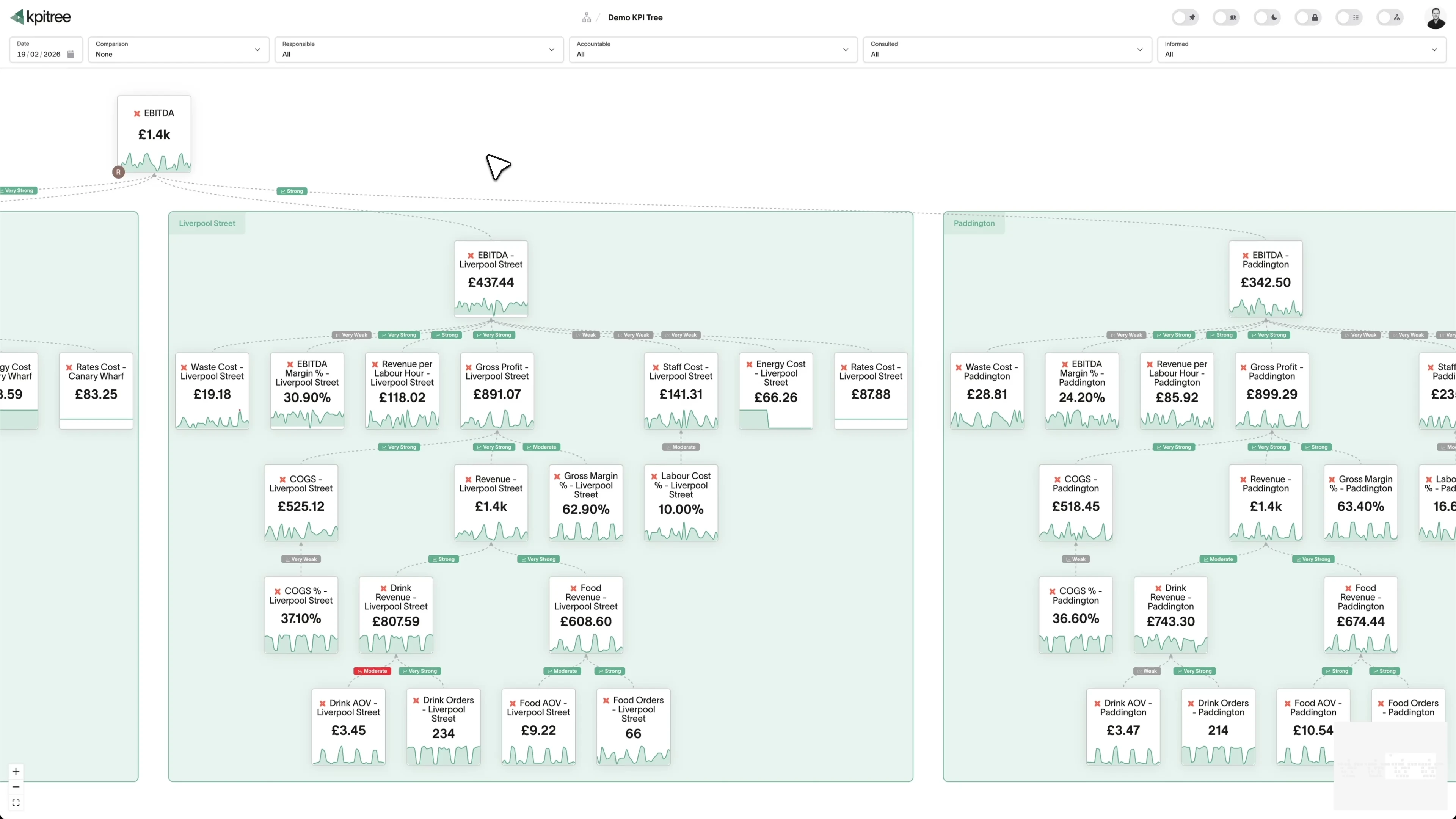
Arrange metrics into parent-child trees that model how they drive each other. MRR decomposes into new, expansion, contraction, and churned MRR. Each node gets a RACI owner, statistical monitoring, and personalised alerts. When churn spikes, the responsible team knows before the board deck lands.
Subscription intelligence your billing platform cannot provide
MRR decomposition trees built from billing events
Causal analysis between subscription metrics
Alerts that reach the right person with the right context
Decompose MRR into the components that actually explain it.
- New, expansion, contraction, and churned MRR as separate owned metrics
- Further decomposition by plan, cohort, geography, or custom dimensions
- Each node carries RACI ownership and statistical monitoring
- Period-over-period comparison shows which components drove the change
Dunning and involuntary churn as first-class metrics, not afterthoughts.
- Dunning recovery rate, retry success rate, and involuntary churn tracked independently
- Causal links to net revenue retention and overall churn
- Alerts trigger when payment failure patterns deviate from baseline
- Ownership ensures someone is accountable for payment recovery outcomes
Statistical analysis reveals what drives retention - and what kills it.
- Proprietary ML models and statistical tests across all subscription metrics
- Leading indicator detection between billing events and revenue outcomes
- Regression analysis isolates the largest drivers of churn and expansion
- Every insight links to the responsible metric owner for action
Ownership and accountability at the metric level, not the dashboard level.
- RACI ownership assigned to every metric in the tree
- Push notifications via Slack or email with statistical context
- Action tracking links initiatives to the metrics they target
- Impact verification shows whether actions moved the metric as expected
What KPI Tree adds that Chargebee reporting cannot
Chargebee's built-in analytics show you what happened to your subscriptions. KPI Tree models why it happened, who owns it, and what is being done about it.
Data warehouses
The numbers





Semantic layers
The definitions


Business apps
Launches, decisions, blockers




Org structure
Directory-synced




For humans
Answers, briefings and pushes
 @
@Read and write over MCP
Anthropic: 21% → ~95% with curated context



Canopy Agentic Workflows the metrics start them, humans gate them
Canopy Agents four out of the box, any model, your keys
Canopy
The business context layer
Structural context The causal tree, the org chart
Temporal context What was true when, plan against actual
Behavioural context What people did, what worked
Operational context RACI, workflows, approvals
Strategic context Objectives, key results, initiatives
Map & Measure
Metric Trees
Business Models
Prove & Act
Root Cause
Ownership
Verified Impact
Strategy
Grounded in proven causality
Verified proof
Meta spend → Revenue, +£32k vs forecast, q < 0.01
Personalised Action Plans 31 experiments running
hypothesis → a real person’s plan → measure the change
Causation the test cascade
ADF p 0.02 → Granger p 0.003 → q < 0.05, 87 of 1,204 survive
Correlation
22,791 pairs tested nightly, NPS – Churn r 0.71
Data warehouses
The numbers
Semantic layers
The definitions
Business apps
Launches, decisions, blockers
Org structure
Directory-synced
Causal structure, not flat dashboards
Metric-level ownership across the business
Statistical analysis grounded in billing data
Metrics you can track. Ready to add to your metric trees.
Add-on Revenue Analysis
Subscription BillingAdd-on revenue analysis measures the total revenue generated from optional add-ons attached to subscription plans. It breaks down which add-ons drive the most incremental value and how adoption rates change over time.
View metricAnnual Recurring Revenue
Subscription BillingARR = MRR × 12
Annual recurring revenue (ARR) is the annualised value of all active subscription contracts. It normalises monthly, quarterly, and annual billing cycles into a single yearly figure that represents predictable revenue.
View metricAverage Revenue Per User
Subscription BillingARPU = Total MRR / Active Subscribers
Average revenue per user (ARPU) divides total recurring revenue by the number of active subscribers. It captures how effectively your pricing and packaging converts users into revenue.
View metricCAC Payback Period
Subscription BillingCAC Payback Period = Customer Acquisition Cost / (ARPU × Gross Margin %)
CAC payback period measures the number of months required for a new subscriber to generate enough gross margin to recover the cost of acquiring them. It is a critical efficiency metric linking sales spend to subscription revenue.
View metricCohort Retention Analysis
Subscription BillingCohort retention analysis groups subscribers by their sign-up period and tracks what percentage remain active over subsequent months. It reveals whether retention is improving or deteriorating for newer cohorts compared to older ones.
View metricCoupon Redemption Rate
Subscription BillingCoupon Redemption Rate = (Coupons Redeemed / Coupons Issued) × 100
Coupon redemption rate measures the percentage of issued coupons that are actually applied to subscriptions. It indicates how effectively promotional campaigns convert prospects or incentivise upgrades.
View metricCredit Note Impact Analysis
Subscription BillingCredit note impact analysis measures the total value and frequency of credit notes issued against invoices. It quantifies revenue leakage from refunds, billing corrections, and goodwill credits.
View metricCustomer Churn Rate
Subscription BillingCustomer Churn Rate = (Churned Customers / Start-of-Period Customers) × 100
Customer churn rate is the percentage of subscribers who cancel their subscriptions within a given period. It is the inverse of retention and one of the most critical health indicators for any subscription business.
View metricCustomer Lifetime Value
Subscription BillingLTV = ARPU / Customer Churn Rate
Customer lifetime value (LTV) estimates the total revenue a subscriber will generate over their entire relationship. It combines average revenue per user with expected customer lifespan to quantify long-term value.
View metricCustomer Segmentation Analysis
Subscription BillingCustomer segmentation analysis groups subscribers by attributes such as plan tier, billing frequency, geography, or revenue contribution. It identifies high-value segments and surfaces patterns that inform pricing and retention strategies.
View metricDays Sales Outstanding
Subscription BillingDSO = (Accounts Receivable / Total Revenue) × Number of Days
Days sales outstanding (DSO) measures the average number of days it takes to collect payment after an invoice is issued. Lower DSO indicates faster cash collection and healthier working capital.
View metricDunning Campaign Effectiveness
Subscription BillingDunning Effectiveness = (Recovered Payments / Total Failed Payments) × 100
Dunning campaign effectiveness measures the percentage of failed payments successfully recovered through automated retry and communication sequences. It quantifies how well your recovery process prevents involuntary churn.
View metricFailed Payment Rate
Subscription BillingFailed Payment Rate = (Failed Payments / Total Payment Attempts) × 100
Failed payment rate is the percentage of subscription payment attempts that are declined or fail to process. It encompasses card declines, insufficient funds, expired cards, and gateway errors.
View metricGeographic Revenue Distribution
Subscription BillingGeographic revenue distribution breaks down subscription revenue by country or region. It shows market concentration, identifies growth opportunities in underserved regions, and highlights currency exposure.
View metricInvoice Collection Rate
Subscription BillingInvoice Collection Rate = (Paid Invoices / Total Invoices Issued) × 100
Invoice collection rate measures the percentage of issued invoices that are successfully paid within the billing period. It reflects the health of your billing and collections process.
View metricMonthly Recurring Revenue
Subscription BillingMRR = Sum of (Active Subscription Monthly Value)
Monthly recurring revenue (MRR) is the normalised monthly value of all active subscriptions. It aggregates annual, quarterly, and monthly plans into a single monthly figure for consistent period-over-period comparison.
View metricNet Revenue Retention
Subscription BillingNRR = ((Start MRR + Expansion - Contraction - Churn) / Start MRR) × 100
Net revenue retention (NRR) measures the percentage of recurring revenue retained from existing customers, including expansions, contractions, and churn. An NRR above 100% means existing customers generate more revenue than they did a year ago.
View metricPayment Method Analysis
Subscription BillingPayment method analysis examines the distribution and performance of payment methods used by subscribers, including credit cards, direct debit, ACH, and digital wallets. It correlates payment method with success rates and churn.
View metricPlan Performance Analysis
Subscription BillingPlan performance analysis evaluates how each subscription plan contributes to revenue, growth, and retention. It compares plans on metrics like adoption, ARPU, churn rate, and upgrade/downgrade patterns.
View metricPlan Upgrade Rate
Subscription BillingPlan Upgrade Rate = (Upgrades in Period / Active Subscribers at Start) × 100
Plan upgrade rate measures the percentage of subscribers who move to a higher-value plan within a given period. It is a key indicator of product value realisation and expansion revenue potential.
View metricRevenue Churn Rate
Subscription BillingRevenue Churn Rate = (Churned MRR / Start-of-Period MRR) × 100
Revenue churn rate (also called MRR churn rate) is the percentage of recurring revenue lost from cancellations and downgrades in a given period. It captures the monetary impact of attrition, which can differ significantly from customer churn rate.
View metricRevenue Cohort Analysis
Subscription BillingRevenue cohort analysis tracks the revenue contribution of subscriber groups over time, grouped by sign-up period. Unlike customer retention cohorts, it accounts for expansions and contractions within each cohort.
View metricSeasonal Revenue Trends
Subscription BillingSeasonal revenue trends analysis identifies recurring patterns in subscription revenue, sign-ups, and churn across calendar periods. It helps distinguish genuine growth from cyclical fluctuations.
View metricSubscription Growth Rate
Subscription BillingSubscription Growth Rate = ((End Subscribers - Start Subscribers) / Start Subscribers) × 100
Subscription growth rate measures the net percentage change in active subscribers over a period. It accounts for new subscriptions, reactivations, and cancellations to show the overall trajectory of your subscriber base.
View metricSubscription Lifecycle Analysis
Subscription BillingSubscription lifecycle analysis maps the complete journey from trial or sign-up through activation, expansion, and eventual cancellation or renewal. It identifies conversion rates and drop-off points at each stage.
View metricRelated integrations. More sources that work with KPI Tree.


Common questions
How does Chargebee data reach KPI Tree?
Through Chargebee's hosted MCP Agent Server. Chargebee ships an official hosted MCP server that exposes customers, subscriptions, invoices, MRR, ARR, churn, trials, and coupons as queryable tools over Streamable HTTP, and KPI Tree consumes it directly. Teams that have already replicated Chargebee to Snowflake, BigQuery, or another warehouse via Fivetran or Airbyte point KPI Tree at the warehouse instead so attribution and period comparisons work against the copy your finance team trusts. Teams that have not built that pipeline engage our professional services team, which delivers the warehouse, the Chargebee ELT, and a dbt semantic layer for subscription metrics as a fixed-scope project.
What Chargebee metrics can I track in KPI Tree?
Any metric you can compute from Chargebee data in your warehouse: MRR, ARR, net new MRR, expansion revenue, contraction revenue, churn rate (voluntary and involuntary), dunning recovery rate, ARPU, LTV, trial conversion rate, plan distribution, billing cycle mix, and more. If it exists as a SQL query against your Chargebee tables, it can be a KPI Tree metric.
Do I need a dbt semantic layer to use this integration?
No. You can define metrics directly with SQL against your Chargebee warehouse tables. If you do have a dbt semantic layer with Chargebee metrics already defined, KPI Tree can sync those definitions automatically via the dbt Cloud or dbt Core integration.
How long does setup take?
It depends on your connection method. With MCP, you can be pulling Chargebee metrics in minutes - no warehouse required. If your data is already in a warehouse, connecting KPI Tree takes under an hour. Teams with a dbt semantic layer can sync Chargebee metrics in one click. For Professional Services engagements where we build the AI foundations, timelines depend on scope but typically take a few weeks.
Does KPI Tree replace Chargebee's built-in reporting?
No. Chargebee's reporting is designed for billing operations - invoice status, payment retries, subscription management. KPI Tree serves a different purpose: modelling how subscription metrics causally drive each other, assigning ownership, and creating accountability loops. Most teams use both.
Can I break metrics down by plan, cohort, or geography?
Yes. Any dimension available in your Chargebee warehouse tables can be used to decompose metrics. MRR by plan tier, churn by cohort, expansion by geography - each breakdown becomes its own metric node with independent ownership and monitoring.
Is my billing data secure?
KPI Tree connects to your warehouse using the same security model you already have in place - RSA key-pair authentication for Snowflake, service account credentials for BigQuery, and so on. KPI Tree queries your warehouse and processes results in its own engine. Your warehouse governance, network policies, and access controls remain fully enforced.
Can I combine Chargebee metrics with data from other tools?
Yes. That is one of the core advantages. A single metric tree can include Chargebee subscription metrics alongside Stripe payment metrics, HubSpot pipeline data, and product usage data - all queried from your warehouse. KPI Tree's correlation engine analyses relationships across all of them.
Related guides. Frameworks and metrics in depth.

How to build a metric tree
A step-by-step metric tree and KPI tree template from North Star to daily levers
Metric trees for subscription businesses
Structuring recurring revenue metrics across media, physical goods, and D2C models
Monthly recurring revenue: a metric tree decomposition
The predictable monthly revenue from active subscriptions and how to decompose it into growth drivers
Net revenue retention: formula, benchmarks and levers
Decompose net revenue retention into the drivers that move it
Churn rate analysis: formulas, benchmarks and fixes
Run a churn rate analysis that finds causes, not just symptoms
Your subscription data deserves more than a billing dashboard.
Connect your warehouse to KPI Tree and turn Chargebee billing events into causal metric trees with ownership, statistical analysis, and accountability that extends across your entire organisation.










