

 Attio Integration
Turn Attio relationship data into metric trees that reveal what drives deals forward.
Attio gives you a modern CRM with powerful data modelling and relationship intelligence.Attio gives you a modern CRM with powerful data modelling and relationship intelligence. But CRM data alone doesn't tell you why deals stall, which activities predict close rates, or who should act when pipeline health changes. KPI Tree connects to your Attio data via MCP, your existing warehouse, or a fully managed data foundation - maps the causal relationships between CRM activity and revenue outcomes, and assigns clear ownership so your go-to-market team knows exactly where to focus.
From Attio data to accountable revenue metrics
Connect your Attio data
Three ways to get started, depending on your stack.

Pull metrics from Attio directly through the Model Context Protocol.



Connect your existing warehouse where Attio data already lands.

Our professional services team can build you turn-key AI foundations in a matter of weeks. Data warehouse on Snowflake/BigQuery, ELT with Fivetran, all modelled in dbt with a semantic layer.
Define metrics from your Attio data
Build metrics from Attio's rich data model - deals created, pipeline value, stage conversion rates, relationship scores, activity frequency, close rates by segment. Use SQL, your dbt semantic layer, or let KPI Tree suggest metrics from discovered tables.
Build causal trees and assign ownership
Arrange metrics into trees that show how leading indicators drive revenue. Assign RACI ownership so every rep, AE, and manager knows which metrics they own. KPI Tree adds statistical monitoring, correlation analysis, and personalised action plans automatically.
CRM intelligence that connects activity to outcomes
Causal trees across your deal pipeline
Leading indicators that predict revenue outcomes
Real-time alerts when CRM health shifts
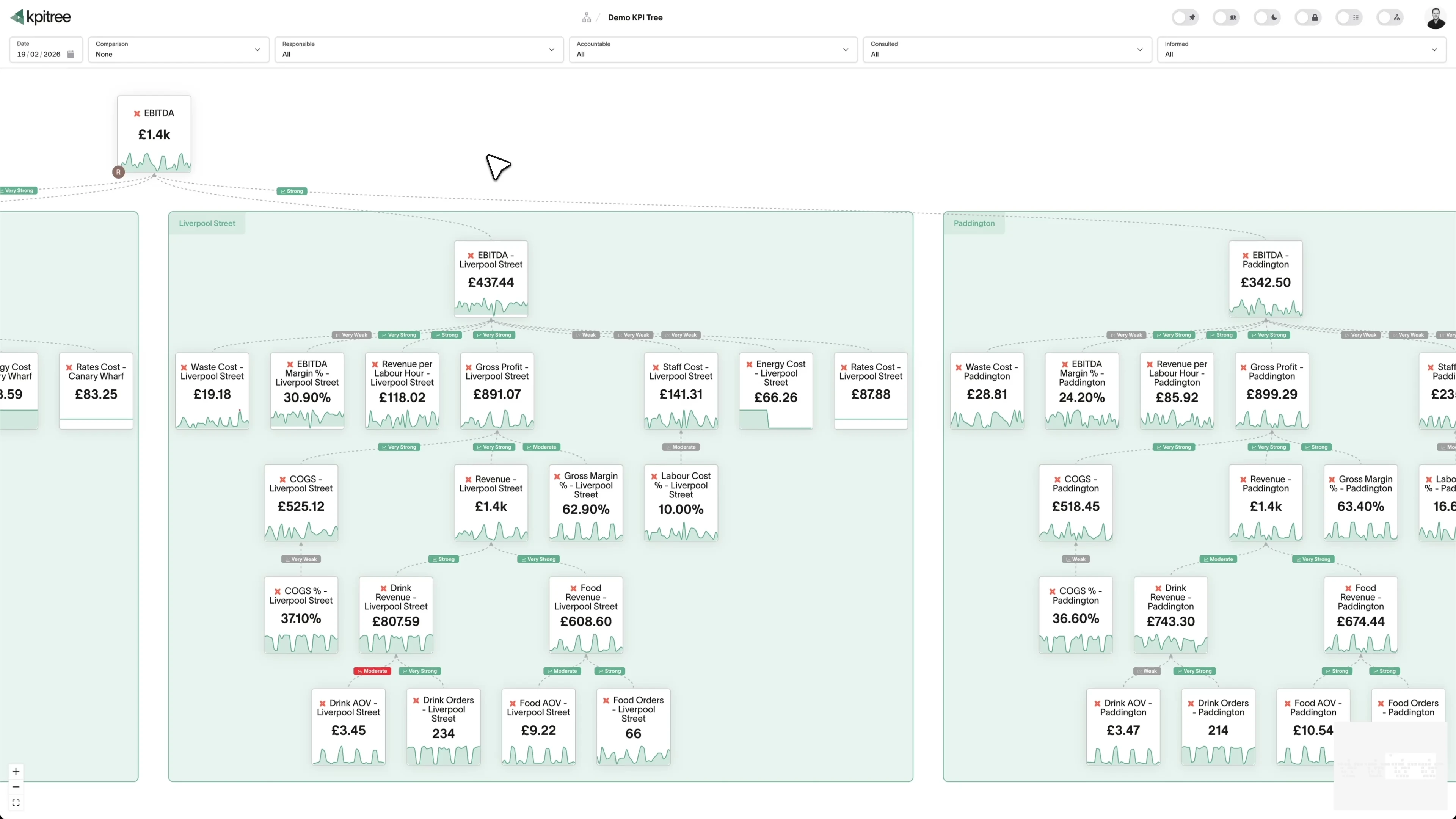
Pipeline trees that show cause, not just status.
- Visual trees connecting pipeline metrics to their upstream drivers
- Automatic decomposition showing exactly where pipeline value changed
- Stage-by-stage conversion metrics with ownership at each transition
- Period comparison to quantify what changed and by how much
Relationship intelligence meets statistical rigour.
- Correlation analysis between relationship engagement metrics and revenue
- Identify which interaction patterns predict deal progression
- Quantify the revenue impact of relationship depth and frequency
- Compare high-performing reps' activity patterns against the team baseline
Every deal stage has an owner. Every metric has a target.
- RACI ownership for every metric in the revenue tree
- Personalised dashboards showing each team member their owned metrics
- Automated action plans when metrics move outside expected ranges
- Manager views with team-level aggregation and individual drill-down
Attio data alongside every other revenue signal.
- Combine Attio CRM metrics with data from any warehouse-connected tool
- Single metric tree across sales, marketing, product, and support
- Cross-functional correlation reveals hidden dependencies between teams
- Unified ownership model across every tool and every team




How KPI Tree uses Attio data differently
Attio is a brilliant CRM for managing relationships and deals. KPI Tree adds the analytical and accountability layer that turns CRM data into a system that drives consistent revenue growth.
Data warehouses
The numbers





Semantic layers
The definitions


Business apps
Launches, decisions, blockers




Org structure
Directory-synced




For humans
Answers, briefings and pushes
 @
@Read and write over MCP
Anthropic: 21% → ~95% with curated context



Canopy Agentic Workflows the metrics start them, humans gate them
Canopy Agents four out of the box, any model, your keys
Canopy
The business context layer
Structural context The causal tree, the org chart
Temporal context What was true when, plan against actual
Behavioural context What people did, what worked
Operational context RACI, workflows, approvals
Strategic context Objectives, key results, initiatives
Map & Measure
Metric Trees
Business Models
Prove & Act
Root Cause
Ownership
Verified Impact
Strategy
Grounded in proven causality
Verified proof
Meta spend → Revenue, +£32k vs forecast, q < 0.01
Personalised Action Plans 31 experiments running
hypothesis → a real person’s plan → measure the change
Causation the test cascade
ADF p 0.02 → Granger p 0.003 → q < 0.05, 87 of 1,204 survive
Correlation
22,791 pairs tested nightly, NPS – Churn r 0.71
Data warehouses
The numbers
Semantic layers
The definitions
Business apps
Launches, decisions, blockers
Org structure
Directory-synced
From deal tracking to causal revenue analysis
Metric ownership beyond deal ownership
Statistical analysis your CRM can't do
Metrics you can track. Ready to add to your metric trees.
Activity Volume Trends
CRMActivity volume trends measure the total count and distribution of logged activities (emails, calls, meetings, notes) across time periods in Attio. This metric tracks whether activity levels are increasing, decreasing, or seasonal, and segments volume by activity type, rep, and deal stage to reveal effort allocation patterns.
View metricCompany Segmentation Analysis
CRMCompany segmentation analysis breaks down CRM performance metrics by company attributes stored in Attio: industry, employee count, revenue range, geography, and custom fields. It identifies which company segments yield the highest conversion rates, largest deal sizes, and fastest sales cycles.
View metricContact Engagement Score
CRMContact engagement score is a composite metric that quantifies how actively a contact is interacting with your team based on activity data logged in Attio. It weights emails exchanged, calls completed, meetings held, and recency of last interaction to produce a single score indicating relationship strength and buying intent.
View metricContact Lifecycle Analysis
CRMContact lifecycle analysis tracks how contacts progress through defined stages in Attio: from initial creation, through qualification, active engagement, opportunity association, and customer conversion. It measures conversion rates between stages, time spent in each stage, and identifies where contacts stall or churn out of the pipeline.
View metricContact-to-Deal Conversion Rate
CRMContact-to-Deal Conversion Rate = (Contacts with Active Deals / Total Qualified Contacts) x 100
Contact-to-deal conversion rate measures the percentage of contacts in Attio that progress from initial CRM entry to being associated with an active deal. It is the most direct measure of whether your lead generation and qualification processes are producing contacts that enter the sales pipeline.
View metricCustomer Acquisition Cost
CRMCustomer Acquisition Cost = Total Sales & Marketing Spend / Number of New Customers Acquired
Customer acquisition cost (CAC) measures the total sales and marketing investment required to convert a prospect into a paying customer. By combining Attio's deal and activity data with cost inputs, CAC quantifies the efficiency of the entire acquisition process from first touch to closed deal.
View metricDeal Age Distribution
CRMDeal age distribution analyses the spread of open deals in Attio by their age (days since creation or days in current stage). It categorises deals into age buckets and compares the distribution against historical close patterns to identify deals that have exceeded normal timelines and may be stale or at risk.
View metricDeal Conversion Rate
CRMDeal Conversion Rate = (Closed-Won Deals / Total Deals Created) x 100
Deal conversion rate measures the percentage of deals created in Attio that ultimately close as won. It is the broadest measure of pipeline effectiveness, capturing the combined impact of deal qualification, sales execution, competitive positioning, and pricing across the entire sales process.
View metricDeal Loss Analysis
CRMDeal loss analysis examines closed-lost deals in Attio to identify patterns in loss reasons, competitive losses, deal characteristics, and sales process gaps. It categorises losses by reason, stage of loss, deal size, competitor, and rep to surface systemic issues that can be addressed to improve future win rates.
View metricDeal Size Trend Analysis
CRMDeal size trend analysis tracks the average, median, and distribution of deal values in Attio over time. It identifies whether deal sizes are growing, shrinking, or shifting across segments, revealing trends in customer willingness to invest and the effectiveness of up-sell and pricing strategies.
View metricDeal Stage Conversion Analysis
CRMDeal stage conversion analysis measures the percentage of deals that successfully advance from one pipeline stage to the next in Attio. It calculates stage-to-stage conversion rates, time-in-stage, and identifies the specific transitions where deals most frequently stall or drop out.
View metricDeal Velocity Analysis
CRMDeal velocity analysis examines the speed at which deals progress through pipeline stages in Attio. It measures time-in-stage at each transition, identifies stages where deals decelerate, and compares velocity across segments, deal sizes, and reps to surface factors that accelerate or slow the sales process.
View metricForecast Accuracy
CRMForecast Accuracy = (1 - |Forecasted Revenue - Actual Revenue| / Actual Revenue) x 100
Forecast accuracy measures the percentage deviation between forecasted revenue (based on Attio pipeline data and probability-weighted projections) and actual closed revenue for a given period. It evaluates the reliability of the sales forecasting process and identifies systematic biases like chronic over-forecasting or under-forecasting.
View metricLead Response Time
CRMLead Response Time = Timestamp of First Rep Activity - Timestamp of Lead Creation
Lead response time measures the elapsed time between a new contact or lead being created in Attio and the first meaningful outreach by a sales rep (email, call, or meeting). It quantifies how quickly the sales team acts on new leads, which directly correlates with conversion probability.
View metricLead Source Attribution
CRMLead source attribution traces deals and revenue in Attio back to the original source that created the contact: inbound marketing, outbound prospecting, referrals, events, partnerships, or organic channels. It quantifies the pipeline and revenue contribution of each acquisition channel to inform investment decisions.
View metricList Performance Analysis
CRMList performance analysis evaluates how contacts and companies within Attio's lists and filtered segments perform across engagement and pipeline metrics. It compares lists head-to-head on conversion rates, deal sizes, and sales velocity to determine which segmentation strategies produce the best outcomes.
View metricPipeline Coverage Ratio
CRMPipeline Coverage Ratio = Total Open Pipeline Value / Revenue Target
Pipeline coverage ratio measures the total value of open pipeline in Attio divided by the revenue target for a given period. It indicates whether sufficient pipeline exists to achieve the target, accounting for historical win rates and the time remaining to close deals.
View metricPipeline Health Score
CRMPipeline health score is a composite metric that evaluates the overall quality and reliability of the sales pipeline in Attio. It combines deal age distribution, stage balance, activity recency, deal progression velocity, and coverage ratios into a single score that indicates whether the pipeline is likely to convert as expected.
View metricSales Pipeline Velocity
CRMPipeline Velocity = (Number of Opportunities x Average Deal Value x Win Rate) / Sales Cycle Length
Pipeline velocity quantifies the rate at which the sales pipeline in Attio converts into revenue. It combines the number of open opportunities, average deal value, win rate, and sales cycle length into a single metric representing the revenue-generating throughput of the pipeline per unit of time.
View metricRevenue Attribution by Source
CRMRevenue attribution by source allocates closed-won deal revenue in Attio back to the original acquisition channel or lead source. It goes beyond pipeline attribution by measuring which sources actually produce paying customers and revenue, not just deals created, providing the most accurate view of channel ROI.
View metricSales Cycle Length
CRMSales Cycle Length = Average(Close Date - Deal Creation Date)
Sales cycle length measures the average number of days from deal creation in Attio to a closed-won outcome. It captures the full duration of the active sales process and reveals how efficiently deals move through the pipeline from qualification to close.
View metricSales Rep Performance Analysis
CRMSales rep performance analysis compares individual reps across the full spectrum of CRM metrics in Attio: activity volume, lead response time, deal creation rate, conversion rates, deal size, cycle length, and revenue closed. It identifies top performers, surfaces coaching opportunities, and reveals the specific behaviours that differentiate high and low performers.
View metricTask Completion Rate
CRMTask Completion Rate = (Tasks Completed On Time / Total Tasks Assigned) x 100
Task completion rate measures the percentage of assigned tasks in Attio (follow-up calls, email responses, proposal sends, contract reviews) that are completed within their due date. It reflects sales process discipline and directly impacts deal progression and pipeline health.
View metricWin Rate by Deal Size
CRMWin rate by deal size segments overall deal conversion rates in Attio into value brackets, revealing how close rates vary across different deal sizes. It identifies the deal value ranges where the team is most and least competitive, informing pricing strategy, qualification criteria, and resource allocation.
View metricWorkspace Utilisation Analysis
CRMWorkspace utilisation analysis measures how effectively the team uses Attio's CRM capabilities: list creation and maintenance, custom field population rates, automation usage, integration activity, and data completeness. It identifies underutilised features and data quality gaps that reduce the value of the CRM investment.
View metricPipeline Velocity
SalesPipeline Velocity = (Number of Open Deals x Average Deal Value x Win Rate) / Average Sales Cycle Length in Days
Pipeline Velocity measures how quickly revenue moves through your Attio pipeline, expressed as the value generated per day. It combines the number of open deals, the average deal value, the win rate, and the average length of the sales cycle drawn from your Attio deal records and stage history. A higher figure means deals are progressing faster and converting more reliably from the moment they enter the pipeline.
View metricRelated integrations. More sources that work with KPI Tree.

Common questions
How does KPI Tree fit into an Attio-led RevOps stack?
Attio tends to be the first CRM that founder-led sales, partnerships, and RevOps teams take seriously, and KPI Tree layers on top without forcing you to adopt a heavier stack. MCP queries Attio directly, so custom objects, lists, workflows, deals, and relationship fields flow into metric trees without an intermediate warehouse. As you mature and start syncing Attio to a warehouse via Fivetran, Hightouch, or a custom worker, KPI Tree reads the warehouse tables in place and the trees keep working. If you would rather skip the DIY stage, our professional services team builds Snowflake or BigQuery, the ELT, the dbt semantic layer, and the starter metric tree templates, so Attio becomes a production-grade analytics source without your RevOps team needing to hire a data engineer.
What Attio metrics can I track?
Any metric derivable from your Attio data: deals created, pipeline value by stage, conversion rates, deal velocity, win rates, average deal size, relationship engagement scores, activity frequency, and any custom metrics you define using Attio's custom objects and attributes.
Does KPI Tree work with Attio's custom objects?
Yes. As long as your custom objects and attributes are synced to your warehouse, KPI Tree can build metrics from them. The data model in your warehouse is what matters - KPI Tree is schema-agnostic.
How long does setup take?
With MCP, you can be pulling Attio data in minutes. If your Attio data is already in a warehouse, you can have metrics defined and trees built in under an hour. The professional services route takes longer but delivers a complete, production-ready data foundation.
Can I combine Attio data with other CRM or sales data?
Absolutely. Many teams use Attio alongside Apollo for outbound, Stripe for billing, or other tools. KPI Tree builds metric trees across all data sources in your warehouse - giving you a single view of how every function drives revenue.
Does KPI Tree replace Attio's reporting?
No. Attio's native reporting is excellent for deal management and pipeline views. KPI Tree adds causal analysis, statistical monitoring, cross-tool metric trees, and RACI ownership - capabilities that complement Attio's built-in analytics.
Is my data secure?
KPI Tree connects to your warehouse with least-privilege read-only access. No Attio credentials are involved. All warehouse credentials are encrypted at rest with HSM-backed KMS, and your existing warehouse security policies remain fully enforced.
We're a small team - is this relevant for us?
Especially so. Small teams can't afford to guess which activities drive revenue. KPI Tree gives a lean go-to-market team the same causal analysis and accountability that large organisations build with armies of analysts - without the overhead.
Related guides. Frameworks and metrics in depth.

How to build a metric tree
A step-by-step metric tree and KPI tree template from North Star to daily levers
Metric trees for sales teams
Connect every rep activity to a revenue outcome
Metric ownership: who should own which metric and why it matters
The most underrated lever in business performance
Your Attio data knows what drives deals. Make sure your team does too.
Connect Attio data to KPI Tree through your warehouse. Build causal metric trees, assign ownership across your revenue team, and let statistical analysis show you what actually moves the number.










