

 Customer.io Integration
Your Customer.io workflows drive engagement. KPI Tree shows you which ones actually drive revenue.
io tells you open rates, click rates, and conversion rates per campaign.Customer.io tells you open rates, click rates, and conversion rates per campaign. KPI Tree connects those metrics into a causal tree that reveals how onboarding flows affect activation, how re-engagement campaigns influence churn, and which lifecycle touchpoints genuinely move your north-star metrics. Connect via MCP to pull Customer.io data directly, point KPI Tree at your existing data warehouse where Customer.io data already lands, or let our Professional Services team build the AI foundations for you. KPI Tree maps your data into metric trees with RACI ownership, statistical correlations, and action tracking. Stop guessing which workflow matters. Start proving it.
From connection to accountability in under an hour
Connect your Customer.io data
Three ways to get started, depending on your stack.

Pull metrics from Customer.io directly through the Model Context Protocol.



Connect your existing warehouse where Customer.io data already lands.


Our professional services team can build you turn-key AI foundations in a matter of weeks. Data warehouse on Snowflake/BigQuery, ELT with Fivetran, all modelled in dbt with a semantic layer.
Map metrics from your Customer.io data
Define metrics from your Customer.io tables - email delivery rates, open rates, click-through rates, conversion rates, unsubscribe rates, workflow completion rates, and revenue attribution per campaign. Use SQL, your dbt semantic layer, or natural language with Cortex Analyst.
Build metric trees and assign ownership
Arrange lifecycle marketing metrics into causal trees. Link onboarding email performance to activation rates. Connect re-engagement workflow metrics to retention and churn. Assign RACI owners to every metric so the right person is notified when something moves - and accountable for acting on it.
Lifecycle marketing metrics that connect to business outcomes
Causal trees from messaging metrics to revenue
Statistical correlations across campaigns and workflows
RACI ownership for every lifecycle metric
See how lifecycle messaging actually drives activation and retention.
- Causal trees linking email/SMS/push metrics to activation, retention, and revenue
- Trace metric movements to specific workflows and campaign steps
- Statistical correlations between messaging engagement and business KPIs
- Drag-and-drop tree builder for lifecycle marketing metric hierarchies
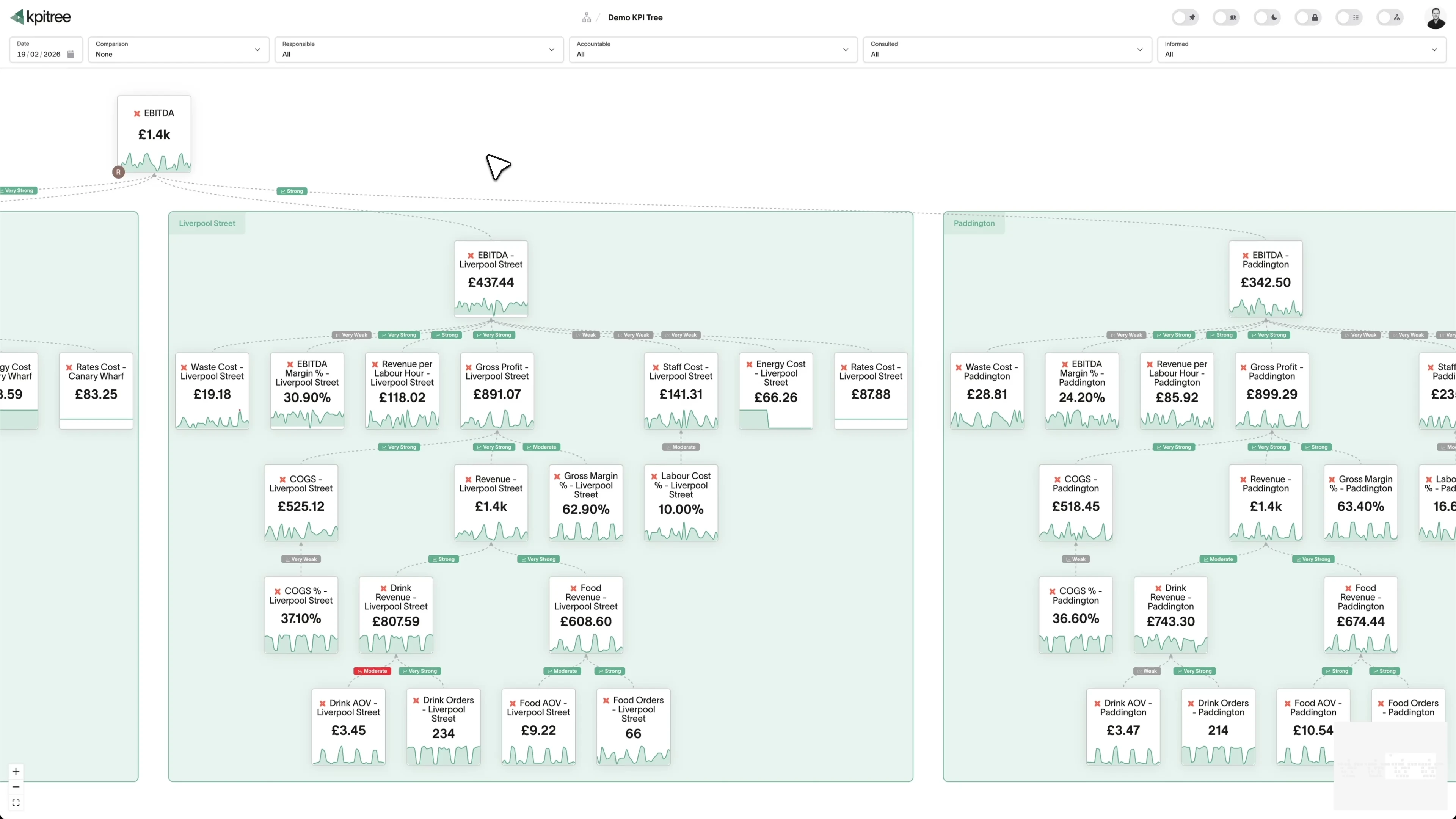
Every campaign metric has an owner. Every movement gets a response.
- RACI ownership per metric - not per dashboard or per team
- Push notifications via Slack or email with statistical context
- Action tracking tied to specific metric movements
- Impact verification after actions are taken
Correlations that tell you which workflows to invest in.
- Statistical correlation between messaging metrics and downstream KPIs
- Causality testing to identify leading indicators
- Partial correlations that control for confounding variables
- Period-over-period comparisons with statistical significance thresholds
All your messaging data, analysed off-warehouse.
- One scheduled query per metric, regardless of team size
- Correlations, regressions, and outlier detection run off-warehouse
- Supports Snowflake, BigQuery, and other major warehouses
- Works alongside your existing dbt semantic layer if you have one
How KPI Tree uses Customer.io data differently
Customer.io's own reporting tells you how campaigns perform. BI tools put that data in dashboards. KPI Tree connects messaging metrics to business outcomes with causation, ownership, and accountability.
Data warehouses
The numbers





Semantic layers
The definitions


Business apps
Launches, decisions, blockers




Org structure
Directory-synced




For humans
Answers, briefings and pushes
 @
@Read and write over MCP
Anthropic: 21% → ~95% with curated context



Canopy Agentic Workflows the metrics start them, humans gate them
Canopy Agents four out of the box, any model, your keys
Canopy
The business context layer
Structural context The causal tree, the org chart
Temporal context What was true when, plan against actual
Behavioural context What people did, what worked
Operational context RACI, workflows, approvals
Strategic context Objectives, key results, initiatives
Map & Measure
Metric Trees
Business Models
Prove & Act
Root Cause
Ownership
Verified Impact
Strategy
Grounded in proven causality
Verified proof
Meta spend → Revenue, +£32k vs forecast, q < 0.01
Personalised Action Plans 31 experiments running
hypothesis → a real person’s plan → measure the change
Causation the test cascade
ADF p 0.02 → Granger p 0.003 → q < 0.05, 87 of 1,204 survive
Correlation
22,791 pairs tested nightly, NPS – Churn r 0.71
Data warehouses
The numbers
Semantic layers
The definitions
Business apps
Launches, decisions, blockers
Org structure
Directory-synced
From campaign dashboards to causal understanding
Metric-level ownership across lifecycle teams
Statistical proof, not A/B intuition
Metrics you can track. Ready to add to your metric trees.
A/B Testing Analysis
Marketing AutomationA/B testing analysis evaluates the performance of message variants within Customer.io campaigns and workflows. It measures statistical differences in engagement and conversion between control and treatment groups to identify which content, timing, or segmentation strategies produce better outcomes.
View metricBroadcast vs Campaign Performance
Marketing AutomationBroadcast vs campaign performance compares the effectiveness of one-time broadcast messages against triggered campaign workflows in Customer.io. It examines engagement rates, conversion outcomes, and revenue attribution across both message types to determine optimal messaging strategies.
View metricCampaign Attribution Analysis
Marketing AutomationCampaign attribution analysis determines which Customer.io campaigns and touchpoints contribute to conversions and revenue. It maps the relationship between message interactions and downstream outcomes, accounting for multi-touch journeys where customers engage with multiple campaigns before converting.
View metricCampaign Conversion Rate
Marketing AutomationCampaign Conversion Rate = (Conversions / Messages Delivered) x 100
Campaign conversion rate measures the percentage of recipients who complete a desired action after receiving a Customer.io campaign message. It connects message delivery to business outcomes such as purchases, signups, or feature activations, providing a direct measure of campaign effectiveness.
View metricMarketing ROI
Marketing AutomationCampaign ROI = ((Revenue Attributed - Campaign Cost) / Campaign Cost) x 100
Campaign ROI measures the return on investment for Customer.io campaigns by comparing revenue attributed to a campaign against the costs of creating and sending it. It quantifies the financial effectiveness of your lifecycle marketing efforts and guides budget allocation decisions.
View metricCustomer Attribute Analysis
Marketing AutomationCustomer attribute analysis examines how profile attributes in Customer.io - such as plan type, industry, signup source, or behaviour history - correlate with engagement and conversion outcomes. It identifies which customer characteristics predict responsiveness to different messaging strategies.
View metricCustomer Journey Mapping
Marketing AutomationCustomer journey mapping traces the sequence of Customer.io touchpoints a customer experiences from first contact through conversion and beyond. It visualises the paths customers take through workflows, campaigns, and transactional messages, identifying the most common and most effective journey patterns.
View metricCustomer Reactivation Rate
Marketing AutomationReactivation Rate = (Reactivated Customers / Targeted Inactive Customers) x 100
Customer reactivation rate measures the percentage of lapsed or inactive customers who re-engage after receiving Customer.io reactivation campaigns. It quantifies the effectiveness of win-back workflows in recovering customers who have stopped interacting with your product or service.
View metricEmail Click-Through Rate
Marketing AutomationClick-Through Rate = (Unique Clicks / Emails Delivered) x 100
Email click-through rate measures the percentage of delivered Customer.io emails where the recipient clicked at least one link. It indicates how effectively email content drives recipients to take the next step in your desired journey, bridging the gap between opening a message and converting.
View metricEmail Deliverability Analysis
Marketing AutomationEmail deliverability analysis examines the factors affecting whether Customer.io emails reach recipients' inboxes. It encompasses bounce rates, spam complaint rates, domain reputation, and authentication status to assess and improve the technical health of your email programme.
View metricEmail Engagement Score
Marketing AutomationEmail engagement score is a composite metric that combines open rates, click-through rates, conversion rates, and recency of interaction to produce a single score representing a Customer.io subscriber's engagement level. It provides a holistic view of subscriber health beyond any single engagement metric.
View metricEmail Funnel Analysis
Marketing AutomationEmail funnel analysis tracks the progression of Customer.io recipients through the stages of email interaction - from delivery to open, open to click, click to conversion, and conversion to revenue. It identifies where drop-offs occur and quantifies the impact of each stage on overall campaign performance.
View metricEmail Open Rate
Marketing AutomationOpen Rate = (Unique Opens / Emails Delivered) x 100
Email open rate measures the percentage of delivered Customer.io emails that were opened by recipients. While affected by privacy features like Apple Mail Privacy Protection, it remains a useful directional indicator of subject line effectiveness and sender reputation when tracked consistently over time.
View metricEmail Revenue per Recipient
Marketing AutomationRevenue per Recipient = Total Attributed Revenue / Emails Delivered
Email revenue per recipient measures the average revenue attributed to each recipient of a Customer.io campaign or workflow. It combines delivery volume with revenue attribution to quantify the monetary value each email generates, providing a direct link between messaging activity and financial outcomes.
View metricEmail Unsubscribe Rate
Marketing AutomationUnsubscribe Rate = (Unsubscribes / Emails Delivered) x 100
Email unsubscribe rate measures the percentage of Customer.io email recipients who opt out of future communications after receiving a message. It serves as a direct indicator of message relevance, frequency appropriateness, and audience-content alignment.
View metricEvent-Driven Engagement Analysis
Marketing AutomationEvent-driven engagement analysis measures how effectively Customer.io messages triggered by user behaviour events drive engagement and conversion. It evaluates the responsiveness and conversion impact of messages sent in response to specific actions such as page views, feature usage, or purchase behaviour.
View metricLifecycle Stage Progression
Marketing AutomationStage Progression Rate = (Customers Advancing to Next Stage / Customers in Current Stage) x 100
Lifecycle stage progression measures the rate at which customers advance through defined lifecycle stages - such as lead, activated, engaged, loyal, and at-risk - within Customer.io workflows. It quantifies how effectively your messaging programme moves customers toward higher-value states.
View metricMessage Deliverability Rate
Marketing AutomationDeliverability Rate = (Messages Delivered / Messages Sent) x 100
Message deliverability rate measures the percentage of Customer.io messages - across email, push notifications, and SMS - that are successfully delivered to recipients. It encompasses all messaging channels to provide a unified view of your delivery infrastructure health.
View metricMessage Frequency Optimisation
Marketing AutomationMessage frequency optimisation analyses the relationship between how often Customer.io sends messages to subscribers and the resulting engagement, conversion, and unsubscribe outcomes. It identifies the optimal sending cadence that maximises engagement without driving subscriber fatigue.
View metricNewsletter Subscriber Churn
Marketing AutomationSubscriber Churn Rate = (Subscribers Lost / Total Subscribers at Start of Period) x 100
Newsletter subscriber churn measures the rate at which subscribers leave your Customer.io mailing list through unsubscribes, bounces, or manual removals over a given period. It quantifies the attrition side of your list growth equation and indicates the long-term health of your subscriber base.
View metricSegment Growth Rate
Marketing AutomationSegment Growth Rate = ((Segment Size End - Segment Size Start) / Segment Size Start) x 100
Segment growth rate measures the rate at which a Customer.io audience segment expands or contracts over a given period. It tracks the net change in segment membership, accounting for new additions, removals, and natural attrition to assess the health and trajectory of key audience cohorts.
View metricSegmentation Performance Analysis
Marketing AutomationSegmentation performance analysis compares engagement, conversion, and revenue metrics across different Customer.io audience segments. It evaluates whether your segmentation strategy effectively targets distinct audiences with relevant messaging, and identifies which segments deliver the most value.
View metricTransactional Message Success Rate
Marketing AutomationTransactional Success Rate = (Successfully Delivered Transactional Messages / Transactional Messages Triggered) x 100
Transactional message success rate measures the percentage of Customer.io transactional messages - such as password resets, order confirmations, and account notifications - that are successfully delivered and rendered. Unlike marketing messages, transactional messages are critical to user experience and product functionality.
View metricWorkflow Completion Rate
Marketing AutomationWorkflow Completion Rate = (Recipients Completing Workflow / Recipients Entering Workflow) x 100
Workflow completion rate measures the percentage of Customer.io recipients who progress through an entire automated workflow from entry to final step. It indicates how effectively your workflows retain recipients through multi-step sequences and whether the full journey delivers its intended outcome.
View metricWorkflow Drop-Off Analysis
Marketing AutomationWorkflow drop-off analysis identifies the specific steps within Customer.io workflows where recipients disengage or fail to proceed. It quantifies attrition at each workflow stage to pinpoint the messages, delays, or conditions that cause recipients to abandon the automated journey.
View metricCampaign ROI
MarketingCampaign ROI = (Revenue Attributed to Campaign - Campaign Cost) / Campaign Cost x 100
Campaign ROI measures the net return generated by a Customer.io campaign relative to the cost of running it. In Customer.io, this draws on the conversions and revenue attributed to a campaign through goal events and conversion tracking, set against the cost of message volume, content production, and the team time behind the journey. It tells you whether an automated workflow is creating more value than it consumes.
View metricRelated integrations. More sources that work with KPI Tree.


Common questions
Can I measure campaign attribution in KPI Tree?
Yes, and you have three paths depending on how you already move Customer.io data around. The fastest is MCP: KPI Tree queries Customer.io directly, reads campaigns, broadcasts, newsletters, transactional messages, events, segments, and people attributes, and builds a metric tree that links campaign-level delivery and click-through metrics to downstream activation and revenue. Teams that already use the Customer.io Data Pipelines destination to Snowflake, BigQuery, or Redshift, or who sync events via Segment, point KPI Tree at the warehouse instead and reuse whatever identity resolution they have already built. Teams that want Customer.io analytics built for them from scratch get the warehouse, ELT, and dbt semantic layer from our professional services team as a fixed-scope engagement. Regardless of the path, attribution trees that link email performance to downstream conversion and revenue work the same way.
What Customer.io metrics can I track?
Any metric you can derive from your Customer.io warehouse tables - email delivery rates, open rates, click-through rates, conversion rates, unsubscribe rates, bounce rates, revenue per campaign, workflow completion rates, segment growth, and more. If it is in your warehouse, you can build a metric from it.
Do I need a data warehouse to use KPI Tree with Customer.io?
No. KPI Tree can pull Customer.io data directly via MCP with no warehouse required. If you do have a warehouse, KPI Tree connects to it regardless of how the data got there. And if you need a warehouse but do not have one yet, our Professional Services team can build the full data foundation - Snowflake/BigQuery, Fivetran, and dbt - for you.
Can I combine Customer.io metrics with metrics from other tools?
Yes - that is the core value. Build a metric tree where Customer.io email engagement feeds into product activation metrics from PostHog, revenue metrics from Stripe, and support metrics from Intercom. KPI Tree runs correlations across all of them to show which levers actually drive your business.
How long does setup take?
If you use MCP or already have Customer.io data in a warehouse KPI Tree supports, setup takes under an hour. Connect via MCP or point KPI Tree at your warehouse, define metrics from your Customer.io data, and start building trees. If you need a warehouse built from scratch, our Professional Services team handles that for you.
Does KPI Tree store my Customer.io data?
KPI Tree queries your warehouse and processes aggregated metric values in its own engine for analytics. Raw Customer.io event data stays in your warehouse. All warehouse security - network policies, role-based access, encryption - remains fully enforced.
Can I track metrics at the workflow level or only at the campaign level?
Both. You define the SQL behind each metric, so you can track at whatever granularity your warehouse tables support - individual workflow steps, full workflows, campaign types, segments, or aggregate totals. Most teams build a hierarchy: aggregate messaging metrics at the top, with campaign and workflow breakdowns beneath.
What if I do not have a data warehouse?
You have two options. Use MCP to pull Customer.io data directly into KPI Tree - no warehouse needed, ideal for getting started quickly. Or engage our Professional Services team, who will build a production-grade data foundation (Snowflake/BigQuery, Fivetran, and dbt) tailored to your stack, giving you richer historical data and the ability to join Customer.io metrics with data from other tools.
Related guides. Frameworks and metrics in depth.

How to build a metric tree
A step-by-step metric tree and KPI tree template from North Star to daily levers
Metric trees for marketing teams
Connect every campaign to revenue impact
Churn rate analysis: formulas, benchmarks and fixes
Run a churn rate analysis that finds causes, not just symptoms
Conversion rate: a metric tree decomposition
Break conversion rate into its component parts so you can see exactly where prospects drop off and how to fix it
Your lifecycle messaging data deserves more than open rates.
Connect your warehouse to KPI Tree and turn Customer.io campaign metrics into causal trees with ownership, statistical analysis, and accountability. See which workflows actually drive your business - and who is responsible for each one.










