

 Xero Integration
Turn Xero accounting data into a causal model of where revenue comes from, why margins move, and who is accountable.
Xero captures every invoice, bill, bank feed transaction, and journal entry that flows through your business.Xero captures every invoice, bill, bank feed transaction, and journal entry that flows through your business. KPI Tree reads that data through the official Xero MCP server in their AI Toolkit, or through the data warehouse where your Xero exports already land when you prefer a warehouse-first architecture. If you do not yet run a warehouse, our professional services team will build one around Xero as the canonical source of financial truth. Once connected, KPI Tree builds what no accounting platform offers: causal metric trees that decompose revenue, expenses, and cash flow into the underlying drivers, assign ownership at every level, and alert the right person when a number deviates from plan. Gross profit margin, operating cash flow, days sales outstanding, burn rate, and expense-to-revenue ratio each become a node in a tree with an owner, statistical monitoring, and a direct line to action. Your general ledger stops being a month-end report and starts driving real-time financial accountability.
From general ledger to owned financial trees
Connect your Xero data
Three ways to get started, depending on your stack.

Pull metrics from Xero directly through the Model Context Protocol.



Connect your existing warehouse where Xero data already lands.


Our professional services team can build you turn-key AI foundations in a matter of weeks. Data warehouse on Snowflake/BigQuery, ELT with Fivetran, all modelled in dbt with a semantic layer.
Define revenue, cost, and cash metrics
Create metrics from your Xero data - total revenue, gross profit margin, operating expenses, operating cash flow, accounts receivable ageing, days sales outstanding, days payable outstanding, cash runway, burn rate, revenue per employee, and more. Slice by tracking category to break totals into departments, regions, or cost centres. Write SQL against warehouse tables, or let KPI Tree query the Xero reports through MCP directly without a replication step.
Build finance trees and assign ownership
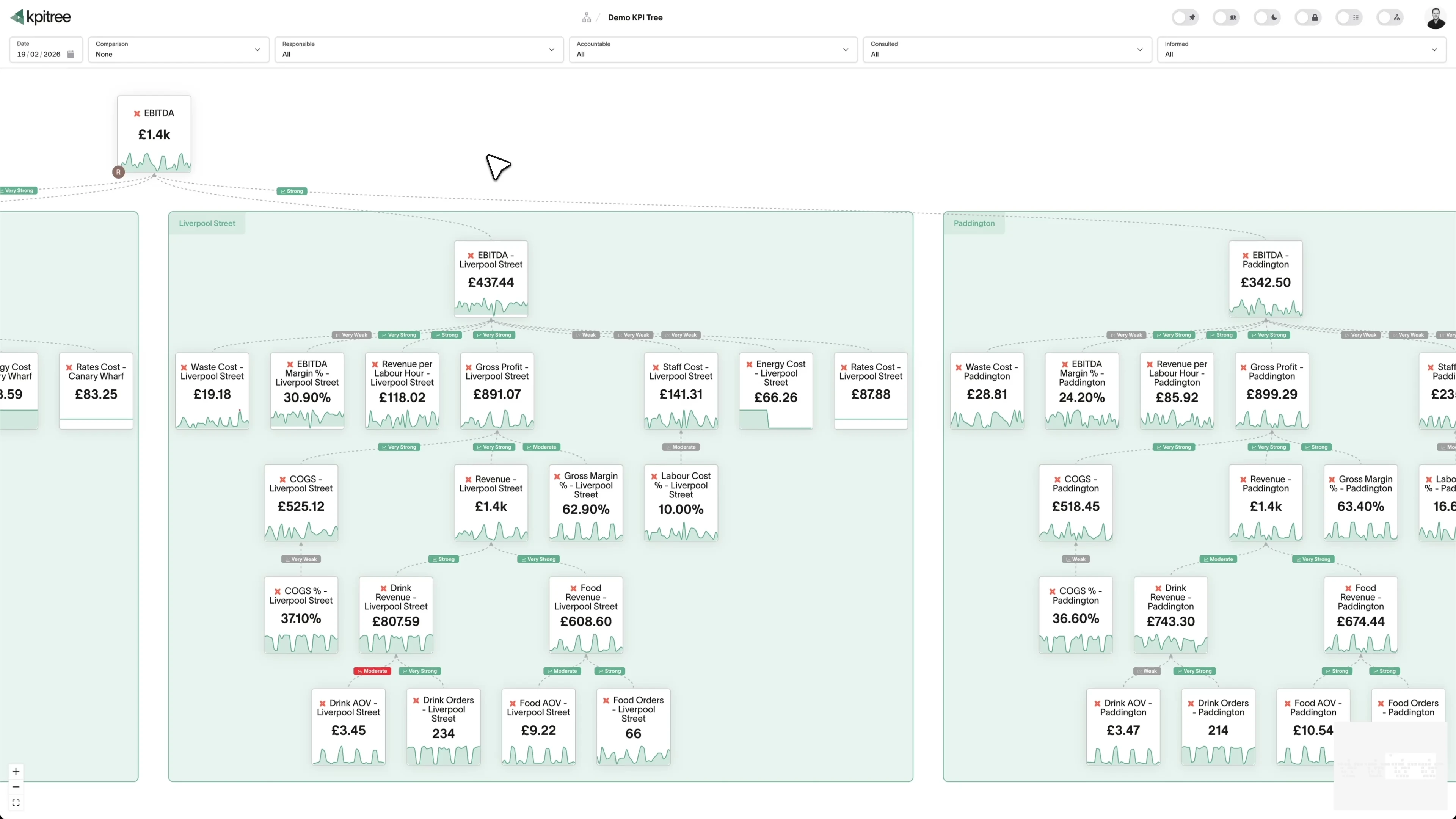
Arrange metrics into parent-child trees that model how they drive each other. Total revenue decomposes into product lines and customer segments. Gross profit decomposes into revenue and cost of goods sold. Each node gets a RACI owner, statistical monitoring, and alerts. When cash burn accelerates, the CFO and department heads know immediately - with context on which expense categories and which late-paying customers drove the change.
Financial intelligence that goes beyond monthly reports
P&L decomposition trees by product line, department, and tracking category
Cash flow and working capital metrics with causal context
Budget deviation alerts routed to the right owner
Revenue and margin decomposition that reveals the real drivers.
- Revenue decomposed into product lines, segments, and tracking categories
- Gross profit broken down into revenue and cost of goods sold drivers
- Each level is an owned metric with statistical baseline and alerts
- Period-over-period comparison isolates which components drove changes
Cash flow metrics connected to the accounts that move them.
- Operating cash flow, runway, and burn rate as owned metrics
- DSO and DPO linked causally to specific customers and suppliers
- Correlation analysis surfaces which accounts drive cash movement
- Period comparisons show working capital trends as the business scales
Expense analysis with ownership and vendor trend detection.
- Operating expenses decomposed into departments, categories, and vendors
- Vendor-level trend detection with statistical outlier alerts
- Expense-to-revenue ratio tracked as a first-class owned metric
- Cross-referenced with headcount and revenue to flag genuine inefficiencies
Combine Xero with revenue, spend, and pipeline data from every source.
- Xero revenue and expense data alongside Stripe, Chargebee, and Ramp
- End-to-end financial modelling from pipeline to cash collected
- Cross-tool correlation reveals which activities generate the best returns
- Every metric carries ownership regardless of its data source




What KPI Tree adds that Xero's reports and JAX cannot
Xero's reports and Just Ask Xero are built for bookkeeping accuracy and conversational lookups. KPI Tree is built for understanding how financial metrics drive business outcomes and holding teams accountable across functions.
Data warehouses
The numbers





Semantic layers
The definitions


Business apps
Launches, decisions, blockers




Org structure
Directory-synced




For humans
Answers, briefings and pushes
 @
@Read and write over MCP
Anthropic: 21% → ~95% with curated context



Canopy Agentic Workflows the metrics start them, humans gate them
Canopy Agents four out of the box, any model, your keys
Canopy
The business context layer
Structural context The causal tree, the org chart
Temporal context What was true when, plan against actual
Behavioural context What people did, what worked
Operational context RACI, workflows, approvals
Strategic context Objectives, key results, initiatives
Map & Measure
Metric Trees
Business Models
Prove & Act
Root Cause
Ownership
Verified Impact
Strategy
Grounded in proven causality
Verified proof
Meta spend → Revenue, +£32k vs forecast, q < 0.01
Personalised Action Plans 31 experiments running
hypothesis → a real person’s plan → measure the change
Causation the test cascade
ADF p 0.02 → Granger p 0.003 → q < 0.05, 87 of 1,204 survive
Correlation
22,791 pairs tested nightly, NPS – Churn r 0.71
Data warehouses
The numbers
Semantic layers
The definitions
Business apps
Launches, decisions, blockers
Org structure
Directory-synced
Causal finance trees, not flat P&L reports
Cross-functional ownership of financial outcomes
Finance connected to every other source of data
Metrics you can track. Ready to add to your metric trees.
Total Revenue
AccountingTotal revenue is the sum of all income recognised across every income account over a period. It is the top line of the profit and loss statement and the foundation metric every other financial KPI depends on.
View metricGross Profit Margin
AccountingGross Profit Margin = (Revenue − COGS) / Revenue
Gross profit margin is the percentage of revenue left after subtracting the cost of goods sold. It shows how efficiently your business produces and delivers what it sells.
View metricNet Profit Margin
AccountingNet Profit Margin = Net Profit / Total Revenue
Net profit margin is the percentage of revenue that remains as profit after every operating expense, interest charge, and tax has been deducted. It is the cleanest single-number measure of overall business profitability.
View metricOperating Cash Flow
AccountingOperating cash flow measures the cash generated (or consumed) by the core trading activity of the business over a period. Unlike profit, it is not distorted by accruals, non-cash items, or timing of invoices.
View metricCash Runway
AccountingCash Runway (months) = Cash Balance / Monthly Net Burn
Cash runway measures how many months the business can continue operating at its current net burn rate before cash runs out. It is the single most important survival metric for any business spending more than it earns.
View metricBurn Rate
AccountingNet Burn Rate = Monthly Cash Outflows − Monthly Cash Inflows
Burn rate measures the net cash consumed by the business each month, calculated as the difference between cash outflows and cash inflows. Gross burn is total monthly spend; net burn is gross burn minus any revenue collected.
View metricDays Sales Outstanding
AccountingDSO = (Accounts Receivable / Total Credit Sales) × Days in Period
Days sales outstanding (DSO) measures the average number of days it takes to collect payment after an invoice is raised. It is the most direct measure of the efficiency of your credit and collections process.
View metricDays Payable Outstanding
AccountingDPO = (Accounts Payable / COGS) × Days in Period
Days payable outstanding (DPO) measures the average number of days it takes the business to pay its suppliers after receiving a bill. A higher DPO preserves cash for longer but can damage supplier relationships if stretched beyond agreed terms.
View metricAccounts Receivable Ageing
AccountingAccounts receivable ageing groups outstanding customer invoices into age buckets (current, 1-30, 31-60, 61-90, and 90+ days past due). It is the single clearest view of collection health and customer payment behaviour.
View metricExpense-to-Revenue Ratio
AccountingExpense-to-Revenue Ratio = Operating Expenses / Total Revenue
Expense-to-revenue ratio measures total operating expenses as a percentage of total revenue over the same period. It is a single-number summary of how operationally efficient the business is at each level of revenue.
View metricVendor Spend Concentration
AccountingVendor spend concentration measures what share of total operating spend goes to your top N suppliers. It quantifies supply-chain risk: the more concentrated your spend, the more exposed you are to any single vendor failing, raising prices, or being acquired.
View metricRevenue Per Employee
AccountingRevenue Per Employee = Total Revenue / Average Employee Count
Revenue per employee divides total revenue over a period by the average number of employees over the same period. It is the cleanest single-number measure of headcount productivity.
View metricBudget Variance
AccountingBudget Variance % = (Actual − Budget) / Budget
Budget variance measures the difference between actual and budgeted amounts for any financial line item, expressed as an absolute value or a percentage. It tells you where performance is diverging from plan and by how much.
View metricRelated integrations. More sources that work with KPI Tree.


Common questions
How does Xero data reach KPI Tree?
Through the official Xero MCP server, your warehouse, or both. Xero publishes `@xeroapi/xero-mcp-server` as part of its AI Toolkit, which exposes read tools for the profit and loss, balance sheet, trial balance, aged receivables and payables, invoices, bills, contacts, bank transactions, payments, tracking categories, items, and payroll data. KPI Tree queries those tools in place so metrics stay close to the source. If you prefer warehouse-first, most finance teams already replicate Xero to Snowflake, BigQuery, or another warehouse via Fivetran, Airbyte, or a lightweight job against the Xero Accounting API, and KPI Tree can read those tables instead. If you do not yet have a warehouse or an ELT pipeline, our professional services team can build the warehouse, configure the ELT, and ship a dbt semantic layer for Xero as a fixed-scope engagement.
What Xero metrics can I track?
Any metric computable from Xero data through MCP or your warehouse: total revenue, revenue by product line or tracking category, gross profit margin, operating profit, EBITDA margin, net profit margin, operating cash flow, cash runway, burn rate, accounts receivable ageing, days sales outstanding, days payable outstanding, expense-to-revenue ratio, vendor spend concentration, revenue per employee, budget variance, and more. If the Xero MCP read tools can return it, or it can be expressed as SQL against your Xero tables, it can be a KPI Tree metric with an owner, a baseline, and alerts.
Can I slice metrics by department, region, or cost centre?
Yes. Xero's tracking categories are a first-class dimension in every KPI Tree metric derived from Xero. Most organisations configure tracking categories for department and region or cost centre, and KPI Tree respects those slices whether the data comes through the MCP reports or through warehouse tables. Revenue, gross profit, operating expenses, and budget variance all decompose along whichever tracking categories your Xero organisation has set up.
Can I track budget versus actual across departments?
Yes. Define budget targets as metrics and track actuals against them at the account, department, or tracking category level. KPI Tree's period comparison and statistical monitoring alert the metric owner when actual numbers deviate from budget by more than the expected variance, so variance reviews happen in real time rather than at month-end.
How long does setup take?
If you go through MCP, connecting KPI Tree takes minutes: install the Xero MCP server, authorise against your organisation, and KPI Tree starts pulling metrics. If your Xero data is already in a warehouse, connecting KPI Tree also takes under an hour, and teams with a dbt semantic layer can sync Xero-derived metrics in one click. If you do not yet have a warehouse or an ELT pipeline, our professional services engagement typically takes a few weeks end-to-end and delivers a production data foundation plus the dbt models for invoices, bills, bank transactions, and tracking categories.
Does KPI Tree replace Xero or JAX?
No. Xero handles bookkeeping, invoicing, bill payment, bank reconciliation, payroll, and statutory reporting, and Just Ask Xero (JAX) provides a conversational layer over that data for in-product lookups and actions. KPI Tree serves a different purpose: modelling how financial metrics causally relate to each other and to business outcomes, assigning ownership, and creating accountability across every tool your team uses. Most teams use both.
Can I connect Xero data to revenue and pipeline metrics?
Yes. That is one of the core advantages. A single metric tree can include Xero revenue and expense data alongside Stripe or Chargebee subscription metrics, Ramp spend, and Salesforce or HubSpot pipeline. KPI Tree's correlation engine analyses relationships across all sources, showing how pipeline generated this quarter turned into invoices, revenue recognised, and cash collected.
Is my financial data secure?
Yes. When you connect through MCP, the Xero MCP server runs with the OAuth scopes you grant it and KPI Tree only requests the read tools needed for the metrics you configure. When you connect through a warehouse, KPI Tree reads tables the warehouse already exposes, so your warehouse security model - key-pair authentication, service accounts, network policies, row-level security - remains fully enforced. KPI Tree queries aggregated metric values, not individual invoice or bill details, and never sees bank credentials or private account numbers.
Do I need a dbt semantic layer?
No. Through MCP, you get Xero metrics with no modelling layer at all. Through a warehouse, you can define metrics directly with SQL against your Xero tables. If you already use dbt to model your financial data, KPI Tree can sync those metric definitions automatically via the dbt Cloud or dbt Core integration, keeping a single source of truth between your finance modelling layer and your metric trees.
Related guides. Frameworks and metrics in depth.

How to build a metric tree
A step-by-step metric tree and KPI tree template from North Star to daily levers
Metric trees for finance teams
From DuPont analysis to modern decomposition
Cash runway: a metric tree decomposition
Understanding how many months of operating cash remain and what levers extend or compress that timeline
Gross margin: a metric tree approach
Decomposing gross margin into its component parts so you can diagnose margin pressure and improve profitability
Metric ownership: who should own which metric and why it matters
The most underrated lever in business performance
Your accounting data should drive decisions, not just close the month.
Connect Xero through MCP or your warehouse, and turn revenue, expense, and cash flow data into causal metric trees with ownership, statistical analysis, and accountability that connects finance to every other part of the business.










